



Thumb

WooCommerce Development

WooCommerce is one of the most popular eCommerce platforms, seamlessly integrating with WordPress to deliver a powerful online store experience. Its user-friendly interface, scalability, and vast customization options make it ideal for businesses of all sizes. WooCommerce offers extensive flexibility, allowing you to customize everything from the look of your store to its functionality.

With a wide variety of themes, plugins, and extensions, it gives you full control over your online store’s operations. Whether you're starting a new store or growing an existing one, WooCommerce provides the tools needed to succeed in the competitive online market.

What We Offer:

  • Easy Integration with WordPress
  • Scalable for Business Growth
  • Wide Range of Extensions

Why WooCommerce is Right for Your Business?

Blog

Full Flexibility & Control

WooCommerce gives you complete control over your store—from how it looks to how it functions. You can customize everything, add unlimited products, and scale easily as your business grows, without being tied to rigid platform rules or limitations.

Blog

Built on WordPress

Since WooCommerce runs on WordPress, the world’s most popular CMS, it offers seamless content and store management in one place. This makes it easier to integrate blogs, SEO tools, and plugins—giving you a competitive edge in both content and commerce

Blog

Cost-Effective & Scalable

WooCommerce itself is free, and you only pay for the tools and features you actually need. This makes it a highly cost-effective option for small businesses and startups, while still offering scalability for larger stores as they grow.

Blog

Wide Range of Extensions

With thousands of extensions and plugins available, WooCommerce allows you to enhance your store’s capabilities—whether it’s advanced shipping, payment gateways, or marketing automation. You can tailor the experience to fit your exact business needs

What Makes WooCommerce + WordPress a Smart Choice?

Seamless Integration

WooCommerce fits naturally within WordPress, letting you manage products, content, and design from one dashboard

Total Design Freedom

Take full control of your store's look and feel using themes, page builders, and custom CSS — no limits.

Massive Plugin Ecosystem

Extend your store with thousands of WordPress plugins for SEO, speed, marketing, and more.

Strong Community Support

Join a global community of developers, designers, and store owners ready to help and share knowledge.

Blog

Why Choose Us?

What makes us different isn’t just what we do — it’s how we do it. We don’t offer one-size-fits-all solutions. Instead, we take the time to understand your brand, your goals, and your audience before we build anything. Every campaign, every website, every feature is tailored to create long-term impact, not just short-term clicks. Our team blends creative thinking with deep technical expertise, ensuring that strategy and execution go hand in hand. We’re not just your service provider — we’re your growth partner.

We’re not just your service provider — we’re your growth partner. From in-depth market research to flawless handovers, everything we do is built on transparency, performance, and a real understanding of what your business needs to succeed in a digital world.

How We Build With WooCommerce

What a WooCommerce development agency builds, how the platform compares to Shopify, and how we keep a self-hosted store fast, secure and SEO-sound at scale.

What We Build With WooCommerce And How We Build It

WooCommerce development services start from a simple premise: WooCommerce is WordPress with commerce bolted on, which makes it the most flexible mainstream ecommerce platform and also the one that rewards genuine engineering. We build custom WordPress ecommerce stores where the storefront, product templates and checkout are designed to the brand rather than dropped into an off-the-shelf theme. Because it is open source and self-hosted, there is almost no limit on what can be modelled, so we routinely build B2B and wholesale stores with role-based pricing, request-a-quote flows and net-terms invoicing, subscription and membership commerce, and complex product configurators that managed platforms struggle to express. When the standard plugin ecosystem does not cover a requirement cleanly, we write custom plugins rather than chaining together five overlapping ones, which keeps the store maintainable.

Integrations are usually where a WooCommerce store earns its keep, so we treat them as first-class work: payment gateways beyond the defaults, regional shipping and tax engines, ERP and inventory synchronisation, CRM and email platforms, and marketplace feeds. The delivery process mirrors how we run every build. Discovery maps the catalogue, the integrations and the operational workflows the store has to support, because a WooCommerce project is as much about the back office as the storefront. Build happens in a staging environment with version control, so changes are reviewed rather than edited live. QA covers checkout, payment and tax edge cases on real devices, and launch is a controlled cutover with backups and a rollback path ready. Where a store needs genuinely custom application logic beyond commerce, we extend into WordPress development so the architecture holds up.
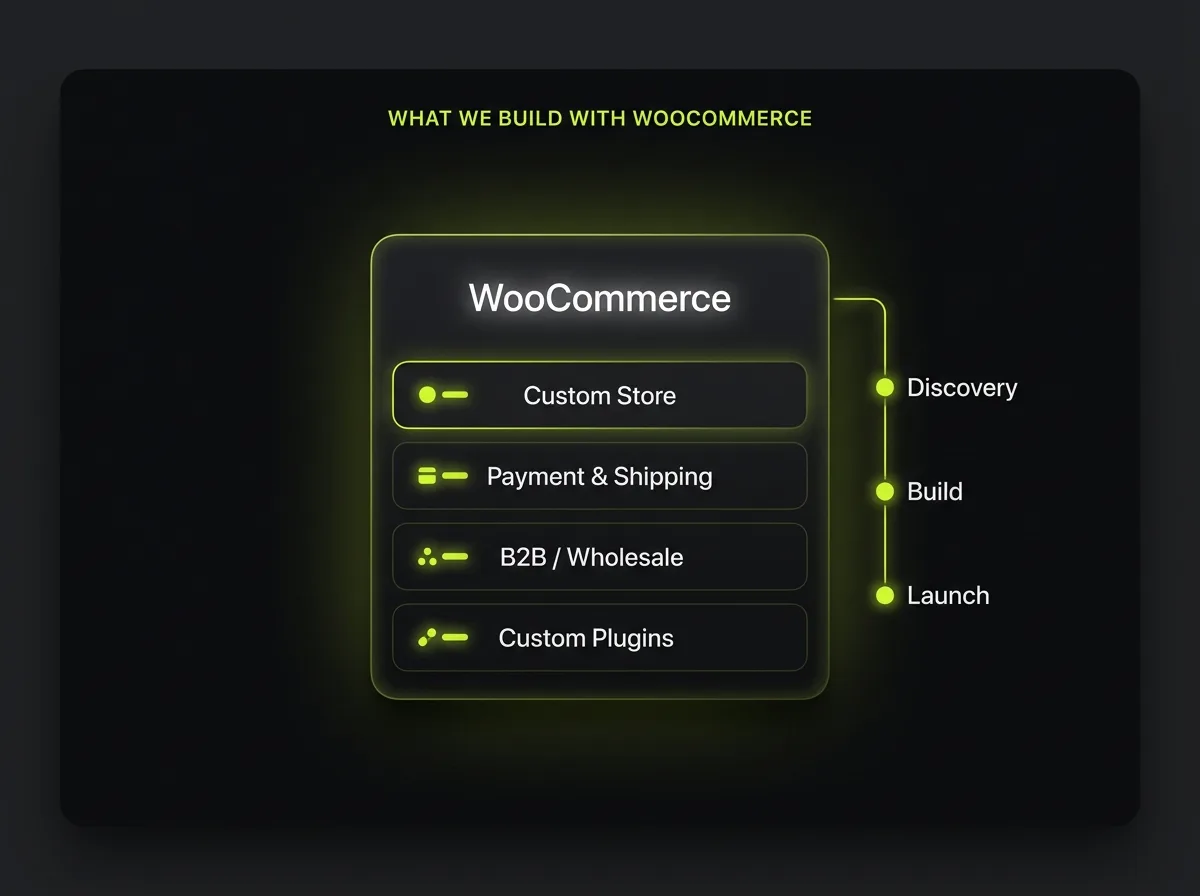
WooCommerce build card listing custom store, payment and shipping, B2B wholesale and custom plugins alongside a discovery, build and launch delivery flow

WooCommerce Vs Shopify: Choosing Right

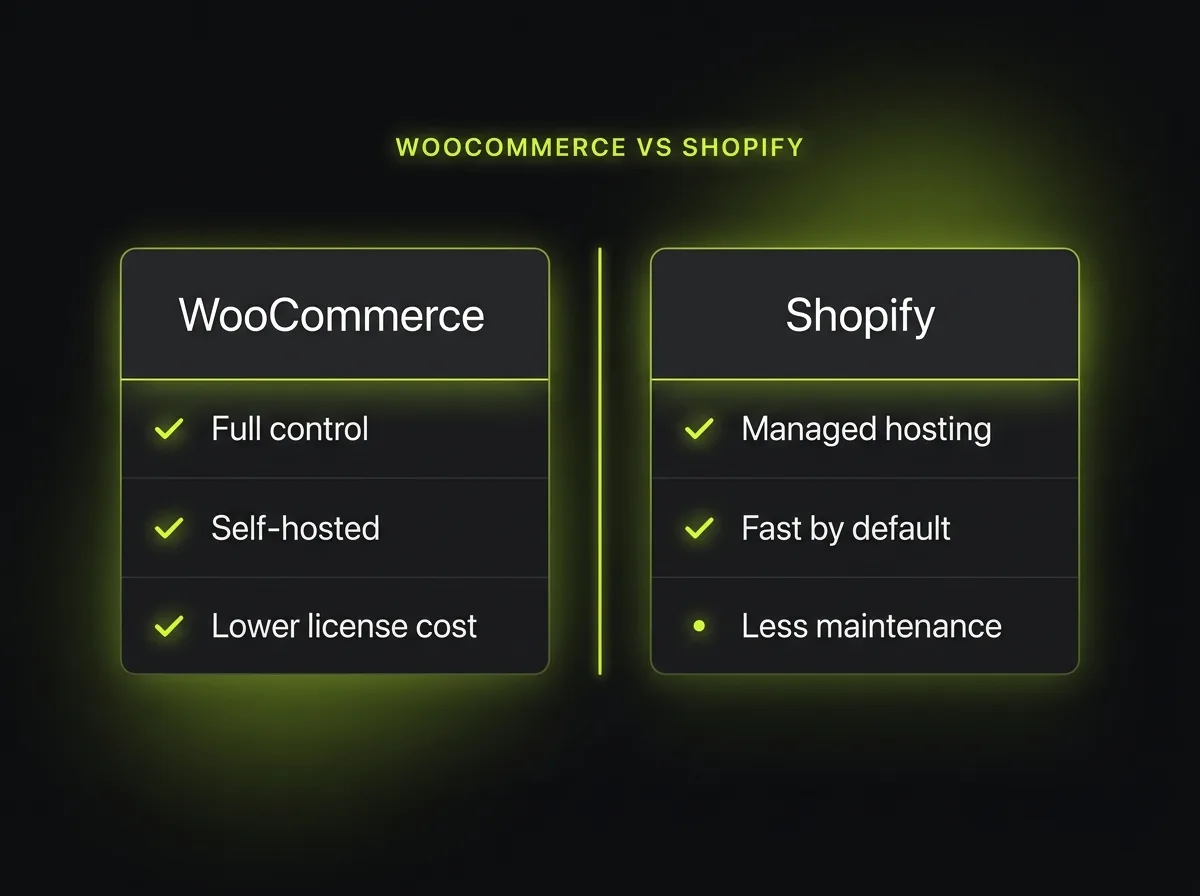
The WooCommerce versus Shopify decision is really a decision about ownership versus convenience, and the right answer depends on the business, not on which platform is fashionable. WooCommerce gives you full control and full ownership: you host it, you own the data and the code, you can change literally anything, and there are no per-transaction platform fees on top of your payment processor. That control is genuine value for stores with unusual requirements, strict data-residency needs, heavy B2B logic, or a content and SEO strategy that benefits from sitting inside a full WordPress install. The trade is responsibility, because everything that Shopify quietly manages, hosting, security, updates, uptime, becomes yours to handle or to delegate.

Shopify trades flexibility for managed simplicity. It is fast by default, secure by default and low-maintenance, with hosting and PCI compliance handled for you, which is exactly right for a brand that wants to sell rather than run infrastructure. The honest cost comparison is total cost of ownership, not the sticker price: Shopify's monthly fee and transaction costs versus WooCommerce's hosting, maintenance and development time. A small store with standard needs is often cheaper and calmer on Shopify; a larger or more bespoke operation frequently finds WooCommerce's flexibility pays for the extra upkeep. We give clients the straight version of this trade-off rather than steering toward whichever we would rather build, and if the answer turns out to be Shopify, our Shopify development team picks it up.

WooCommerce versus Shopify comparison panel weighing full control and self-hosting against managed hosting and lower maintenance

Performance And Scaling WooCommerce

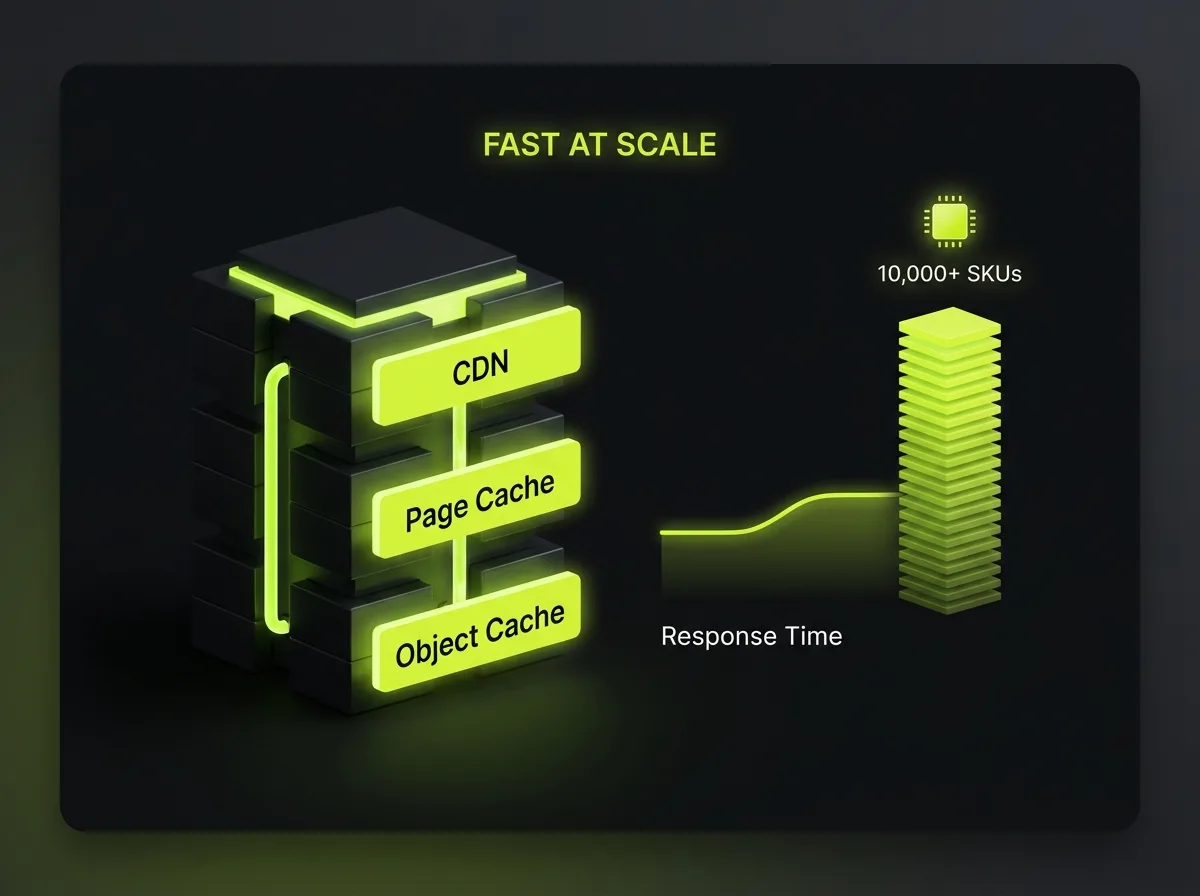
The lazy criticism of WooCommerce is that it gets slow at scale, and it can, but slow WooCommerce is almost always a configuration problem rather than a platform limit. The stores that struggle are running on cheap shared hosting with no caching strategy and a pile of poorly written plugins, and any platform would buckle under that. WooCommerce speed optimization is a layered job. At the hosting layer we use infrastructure built for WordPress with adequate PHP workers and current versions, because the runtime matters. On top of that sits a caching stack: full-page caching for anonymous traffic, a persistent object cache such as Redis to take repeated database queries off the hot path, and opcode caching for PHP itself. A content delivery network serves static assets and images close to the user.

Scaling a large catalogue is mostly about the database. WooCommerce stores a lot in the WordPress post and meta tables, and at tens of thousands of SKUs those tables need attention, so we move high-frequency commerce data into custom tables where it belongs, index the queries that matter, and keep autoloaded options lean. High Performance Order Storage is a meaningful step forward here and we enable and tune it for order-heavy stores. We load-test against realistic traffic and catalogue size rather than assuming, profile the slow queries, and tune from evidence. A properly engineered WooCommerce store comfortably handles ten thousand-plus products and serious concurrent traffic; the work is in the architecture, which is the same discipline we bring to web application development.

WooCommerce scaling diagram showing object cache, page cache and CDN layers keeping response time flat as the catalogue grows past ten thousand SKUs

Security, Maintenance And SEO Setup

Self-hosting WooCommerce means security and maintenance are your responsibility, and on an ecommerce store handling payments that is not optional. The good news is that the vast majority of WordPress and WooCommerce compromises trace back to neglected updates and weak plugins, which is to say they are preventable. Ongoing WooCommerce maintenance from us means core, theme and plugin updates applied promptly and tested on staging first so an update never breaks checkout in production. We run automated off-site backups on a schedule with tested restores, because a backup you have never restored is a hope, not a plan. Hardening covers the basics that get skipped: least-privilege user roles, two-factor authentication on admin accounts, a web application firewall, rate-limited logins, and file-permission discipline. For stores that take card details directly, we configure the environment toward PCI DSS expectations and keep TLS current.

Because WooCommerce lives inside WordPress, the SEO foundation is strong if it is set up deliberately and a liability if it is not. We configure clean, readable permalinks rather than query-string URLs, generate and submit an XML sitemap, and add Product, Offer and Review structured data so listings can earn rich results. Canonical tags are important on WooCommerce because faceted navigation, filters by colour, size, price, can generate large numbers of thin parameterised URLs that waste crawl budget and dilute relevance; we control which of those are indexable and canonicalise the rest. Image optimization, clean heading structure and a sensible category architecture round out the baseline. With that in place the store is ready for a sustained organic push, which is where our ecommerce SEO program takes over.

WooCommerce security and maintenance shield surrounded by updates, backups, hardening and PCI with an SSL badge

Most popular services

SX0 service icon — DigiRocket

SX0

Great rankings mean nothing without great user experience. Our SXO approach delivers both traffic and performance.

Performance Marketing service icon — DigiRocket

Performance Marketing

Results you can measure. We run data-driven campaigns that convert clicks into revenue across every platform.

Dropshipping service icon — DigiRocket

Dropshipping

From product research to fulfillment, our data-backed approach turns dropshipping into a real business.

Frequently Asked Questions

WooCommerce development involves creating and customizing online stores using WooCommerce, a powerful WordPress plugin. It includes theme customization, plugin development, performance optimization, and integration with third-party tools.

We do both. Based on your requirements, we can build a fully custom WooCommerce theme from scratch or customize an existing one to match your brand and functionality needs.

Yes! We offer full migration services from platforms like Shopify, Magento, Wix, and others to WooCommerce—while retaining your products, customer data, and SEO.

It depends on the project scope — a standard WooCommerce store is a different build from a custom or large-scale store. We scope the work with you up front, agree on the milestones, and keep you updated as each one ships, rather than quoting a fixed timeline before we understand the requirements.

Definitely. All our WooCommerce stores are fully responsive and tested across devices to ensure an optimal experience on mobile, tablet, and desktop.

It depends on the business, and we give you the straight answer rather than steering you toward what we would rather build. WooCommerce gives you full ownership, no platform transaction fees, and almost unlimited flexibility, which pays off for B2B, content-heavy or bespoke stores, but you (or we) own hosting, security and updates. Shopify is fast and low-maintenance by default but trades away some flexibility and adds platform fees. The honest comparison is total cost of ownership over a few years, not the monthly sticker price. If Shopify turns out to fit better, our Shopify development team handles that too.

Yes, comfortably, when it is engineered for it. WooCommerce slows down on cheap shared hosting with no caching and a pile of poor plugins, not because of a platform ceiling. We run it on WordPress-tuned infrastructure with full-page caching, a Redis object cache and a CDN, enable and tune High Performance Order Storage for order-heavy stores, optimise and index the database, and load-test against realistic catalogue size and traffic. Built this way, ten thousand-plus SKUs and serious concurrent traffic are not a problem.

Yes, and on a self-hosted store it is essential rather than optional. Ongoing maintenance covers core, theme and plugin updates tested on staging before they reach production, automated off-site backups with tested restores, and security hardening: least-privilege roles, two-factor authentication, a web application firewall, login rate limiting and regular malware scanning. For stores taking card details directly we configure the environment toward PCI DSS expectations. The vast majority of WooCommerce compromises come from neglected updates, which disciplined maintenance prevents.

Business professional

HELP US UNDERSTAND YOUR QUERY.