



Thumb

Content Personalization And Predictive Analysis

Content Personalization and Predictive Analysis combine to create smarter, more engaging digital experiences. Content personalization tailors website elements, product suggestions, and user journeys based on real-time behavior, preferences, and past interactions. Predictive analysis, powered by historical data and machine learning, anticipates future customer actions and market shifts.

When used together, these tools empower businesses to deliver highly relevant experiences while proactively fine-tuning strategies for stronger engagement and improved results.

What We Offer:

  • Deeper User Engagement
  • Improved Conversion Rates
  • Smarter, Data-Driven Decisions

Hyper-Personalized Marketing Powered by Predictive AI

Featured
1

Real-Time Personalization

Customize user experiences based on behavior, preferences, and purchase intent.

Featured
2

Predictive Targeting

Use AI to anticipate customer actions and send offers before they even search.

Featured
3

Dynamic Content Delivery

Auto-adapt emails, ads, and landing pages for each unique user.

Featured
4

Behavior-Driven Campaigns

Launch marketing flows triggered by user behavior across channels.

Featured
5

Higher ROI, Lower Waste

Spend smarter with campaigns that convert more and guess less.

Blog

Increase Retention Through Behavior-Based Content Deliver

  • Deliver content based on real-time actions like clicks, page views, and time spent, so users always see what's most relevant to them.
  • Reduce bounce rates by guiding users with personalized recommendations aligned with their browsing habits and intent.
  • Send timely nudges—like emails or app notifications—when users show signs of hesitation or drop-off, increasing the chance of re-engagement.
  • Keep repeat customers loyal by showing content or offers tailored to their purchase history and preferences.
  • Use automated workflows to scale personalization without needing manual input for every user interaction.
  • Turn passive visitors into active buyers by addressing individual needs at the right moment, building long-term brand trust.
Blog

Why Choose Us?

Choosing us for content personalization and predictive analysis means partnering with a team that combines deep data expertise with cutting-edge AI technology to deliver truly meaningful customer experiences. We don’t just offer personalization, we deliver it with precision backed by real-time data and AI-driven insights. Our approach goes beyond surface-level customization by deeply analyzing user behavior to create content that truly resonates.

With our expertise, you get more than just tools, you get strategies that convert casual browsers into loyal customers. We build automated, scalable systems that grow with your business and adapt as your audience evolves. Whether you're aiming to boost retention, reduce churn, or enhance user experience, we bring the technical know-how and marketing intuition to make it happen efficiently and effectively.

How Personalization And Prediction Work

What personalization actually changes, how predictive analytics forecasts behaviour, how they combine, and how to do it compliantly and prove the lift.

What Content Personalization Delivers

Content personalization tailors what a visitor sees, the hero message, the products surfaced, the offers, the next step suggested, based on who they are and what they have done. At its simplest this is segmentation: showing returning customers something different from first-time visitors, or surfacing region-relevant content. At its most useful it is real-time tailoring driven by behaviour: a product page reorders its recommendations based on what this person has browsed, an email leads with the category they actually buy, a homepage promotes the offer most likely to convert this particular segment. Recommendation engines are the most familiar form, the because-you-viewed and frequently-bought-together blocks that quietly drive a large share of ecommerce revenue.

The reason it works is relevance: people engage with and buy what feels meant for them, and a generic experience leaves money on the table when you already hold the signals to do better. The discipline is to personalize where it changes a decision, the product grid, the offer, the recommended next action, rather than swapping cosmetic details that do not move behaviour. Personalization is the visible front end; the intelligence that decides what to show is where predictive analytics comes in, and it sits within the wider capability set on our AI development services page.
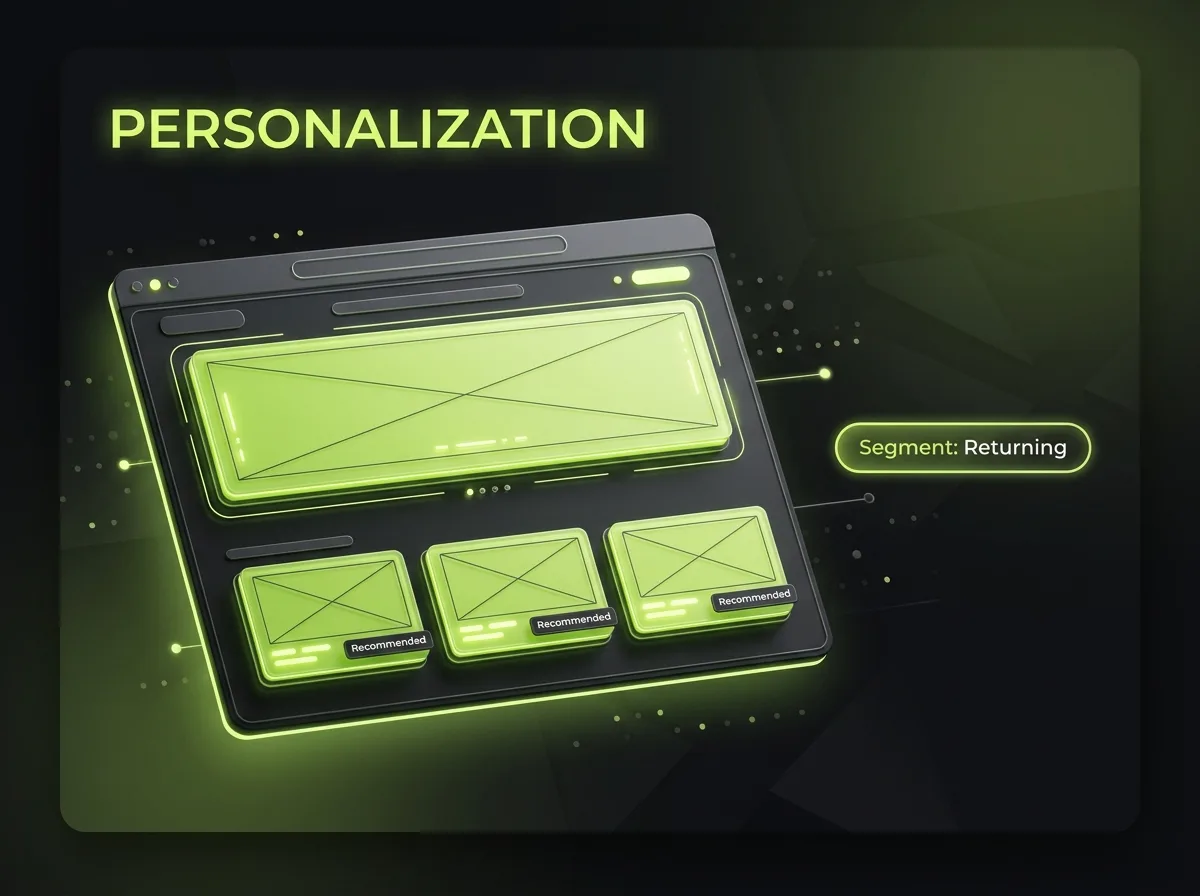
Website personalization showing dynamic content, product recommendations and segment-based tailoring in real time

How Predictive Analytics Works

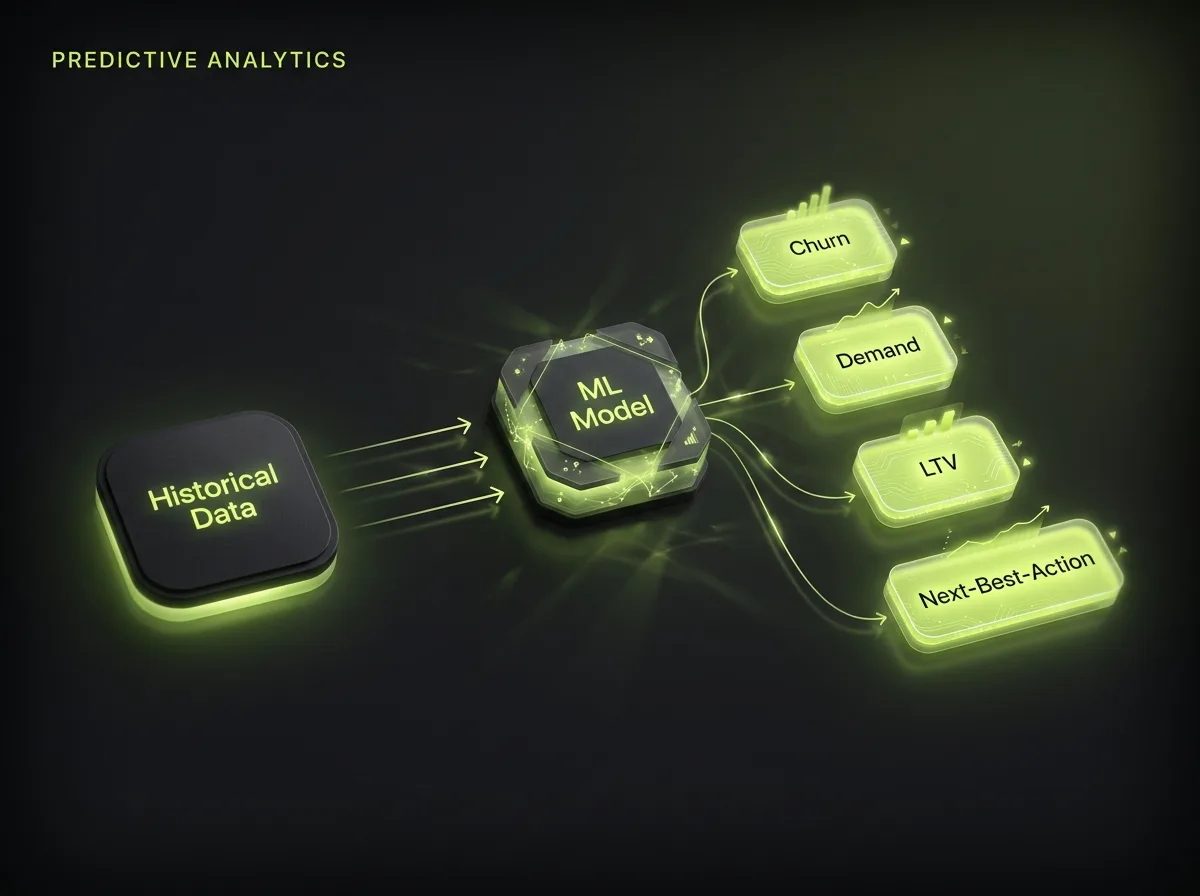
Predictive analytics uses your historical data to estimate what is likely to happen next. The mechanism is straightforward in principle: a machine learning model learns patterns from past examples where you know the outcome, then applies those patterns to current customers to produce a probability or a forecast. Churn prediction learns from customers who left versus stayed, then scores current customers on how likely they are to leave, so you can intervene before they do. Demand forecasting learns seasonal and trend patterns from sales history to predict what you will sell, sharpening inventory and staffing. Lifetime-value prediction estimates how much a customer will be worth, so you can spend acquisition budget where it pays back.

The output people find most actionable is next-best-action: given everything known about a customer, what is the single move most likely to produce the outcome you want, the right offer, the right channel, the right moment. None of this is fortune-telling, and we are careful to frame it as probability, not certainty: a prediction is a well-grounded estimate that gets better with more and cleaner data, and worse when the world shifts away from the patterns it learned. Accuracy depends on data quality far more than on model cleverness, which is why we start with your data, not with a model. The same evaluation rigour from our custom LLM and model evaluation work keeps these forecasts honest.

Predictive analytics pipeline turning historical data into forecasts for churn, demand, lifetime value and next-best-action

Personalization And Prediction Together

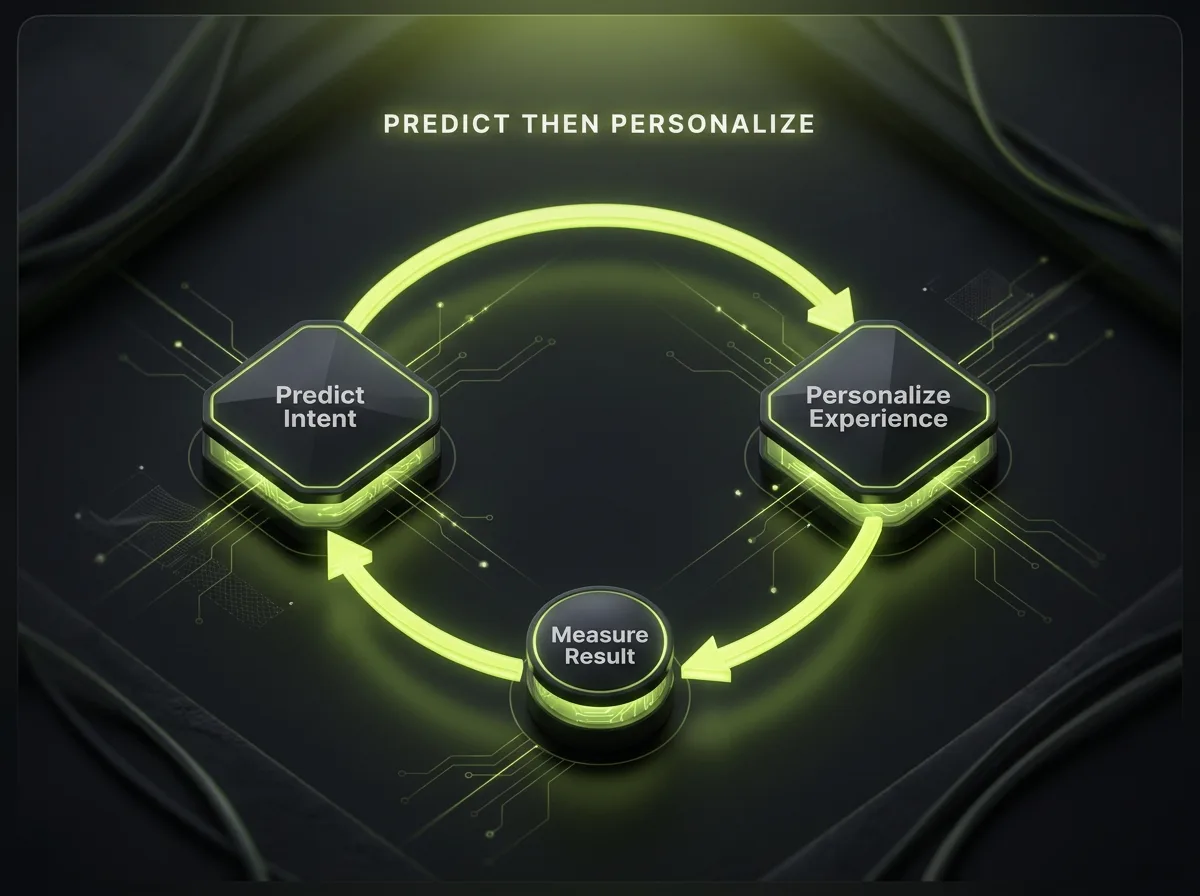
Personalization and prediction are most powerful as a loop, not two separate projects. Prediction decides what is likely true about a customer, this visitor is at risk of churning, this one is in-market for an upgrade, this segment responds to free shipping, and personalization acts on it by changing the experience accordingly. Predict intent, then personalize the response: a high-churn-risk customer sees a retention offer, an in-market visitor sees the upgrade path foregrounded, a price-sensitive segment sees the shipping incentive. Each side makes the other worth more. Prediction without personalization is an insight nobody acts on; personalization without prediction is guesswork dressed up as relevance.

Crucially, the loop closes on itself: every personalized experience produces new behavioural data, which feeds back into the models and sharpens the next prediction, so the system compounds in accuracy the more it runs. We build this as a measured cycle rather than a black box, you can see what the model predicted, what experience it triggered, and whether the outcome improved, then feed that result back in. This predict-then-personalize loop is exactly what lifts revenue per visitor in the ecommerce programs we run on our ecommerce marketing, where the same engine drives recommendations, lifecycle offers and retention.

Closed loop where prediction estimates customer intent and personalization tailors the experience, then measures the result

Data, Privacy And Implementation

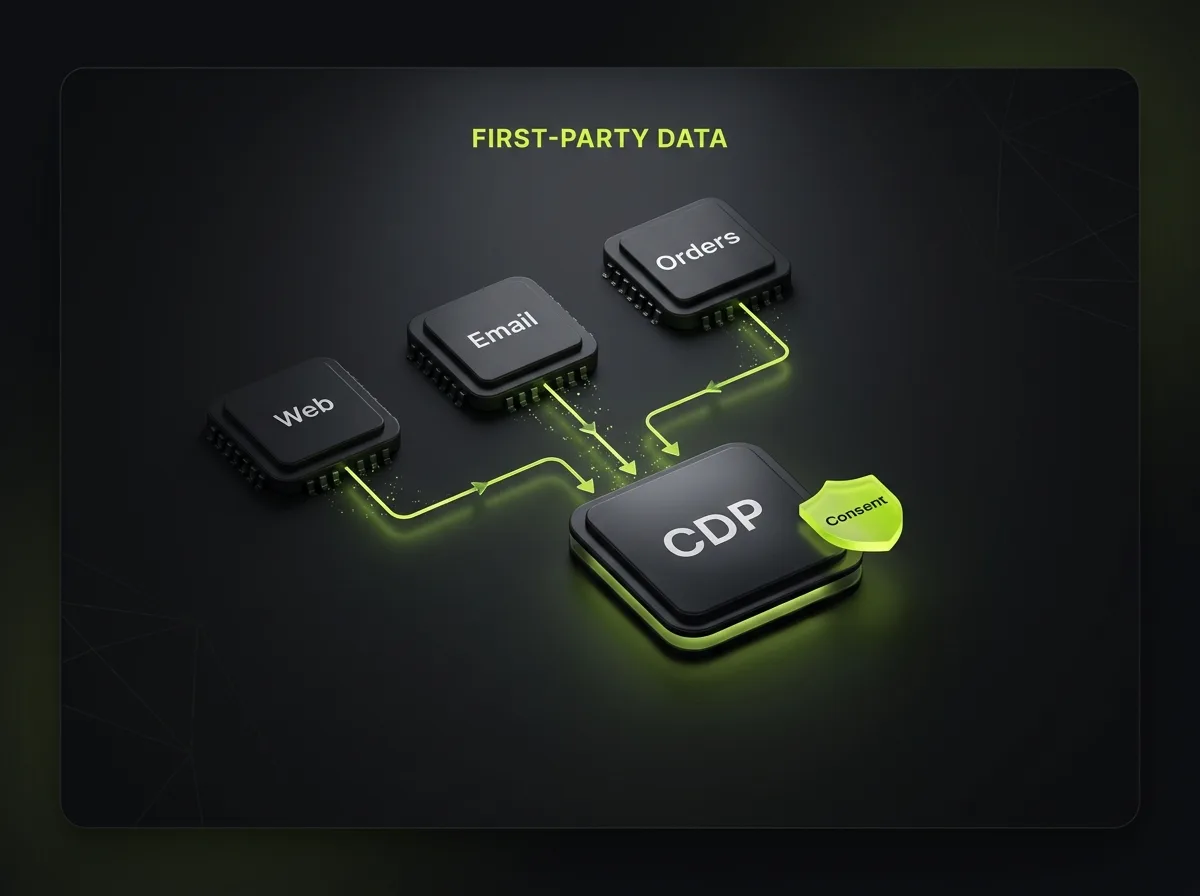
Good personalization and prediction run on first-party data, the behaviour, purchases and preferences customers share directly with you, and that has become a strength rather than a limitation as third-party cookies fade. A customer data platform, or CDP, is usually the backbone: it unifies the signals scattered across your website, app, email and order history into a single profile per customer, which is what both the personalization engine and the prediction models read from. Without that unified view you end up personalizing on fragments, and the recommendations and forecasts suffer accordingly. So the implementation work starts with getting the data clean, connected and consented, not with the model.

Privacy is not an obstacle to design around, it is part of the design. We build on consent: collecting and using data under clear permission, honouring opt-outs, and keeping the handling compliant with rules like GDPR and CCPA. Practically that means consent management wired into the data flow, sensible data retention, and personalization that degrades gracefully for visitors who decline tracking rather than breaking. Done right, a privacy-respecting first-party approach is also more durable, because it does not depend on signals that regulators and browsers keep removing. This first-party data discipline is the same foundation our performance marketing relies on for measurement after cookie loss.

First-party data flowing into a customer data platform with consent management for privacy-compliant personalization

Measuring The Lift

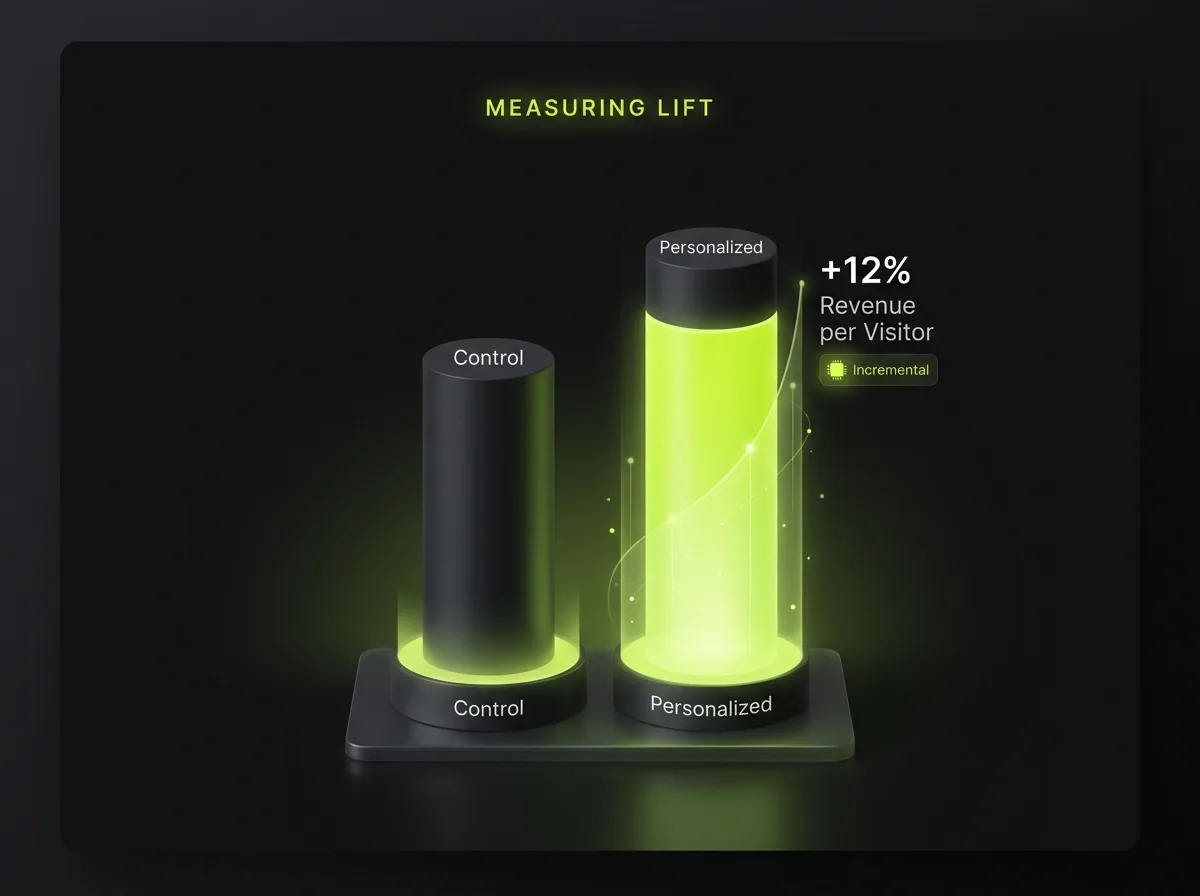
The only honest way to know personalization is working is a controlled comparison, because revenue moves for a dozen reasons and it is easy to credit personalization for a rising tide it did not cause. We run a holdout: a randomly chosen control group sees the standard experience while the treatment group sees the personalized one, and the difference between them is the genuine incremental lift, what personalization actually added rather than what would have happened anyway. This incrementality framing is the difference between a real result and a vanity number, and it is the metric we hold ourselves to.

Around that core test we track the metrics that connect to money: conversion rate, average order value, revenue per visitor and, for prediction-driven retention, churn rate and lifetime value in the treated group versus control. We are clear that early results carry uncertainty and need enough traffic to reach significance, so we do not over-claim from a small sample. The payoff of measuring this way is compounding: a clean read on lift tells you which personalization rules to keep, which to kill, and where to invest next, exactly the reporting discipline we bring to every engagement through our performance marketing analytics.

Controlled experiment comparing a personalized treatment group against a control to measure incremental revenue lift

Frequently Asked Questions

Content personalization uses user data—like behavior, preferences, and past interactions—to dynamically deliver relevant content, offers, or product recommendations tailored to each individual.

Predictive analysis uses historical and real-time data, along with machine learning models, to forecast future outcomes—such as customer behavior, sales trends, or engagement levels.

Absolutely. Predictive insights can power smarter personalization by anticipating what a user might need or do next, allowing you to deliver timely and relevant content automatically.

Typical data sources include website activity, purchase history, demographic info, CRM data, and engagement metrics—all of which help models make accurate and useful predictions.

Good personalization runs on first-party data: the behaviour, purchases and preferences your customers share directly with you, usually unified in a customer data platform. Most businesses already hold more than they think across their website, email and order history. Where data is thin, we start with broad segmentation and simple rules, then layer in predictive models as the data set grows.

A prediction is a well-grounded probability, not a certainty. Accuracy depends far more on data quality and volume than on how clever the model is, and it degrades when the world shifts away from the patterns the model learned. We are upfront about where your data is strong enough to act on and where it is not, and we keep re-evaluating the models against real outcomes.

Yes. We build on consent: collecting and using data under clear permission, honouring opt-outs, applying sensible data retention, and making sure personalization degrades gracefully for visitors who decline tracking. A first-party, consent-based approach is also more durable because it does not rely on third-party cookies that browsers and regulators keep removing.

We measure it with a controlled holdout: a randomly chosen control group sees the standard experience while a treatment group sees the personalized one, and the difference between them is the true incremental lift. Around that we track conversion rate, average order value, revenue per visitor and, for retention work, churn and lifetime value, so you see what personalization actually added rather than what would have happened anyway.

Most popular services

SX0 service icon — DigiRocket

SX0

Great rankings mean nothing without great user experience. Our SXO approach delivers both traffic and performance.

Performance Marketing service icon — DigiRocket

Performance Marketing

Results you can measure. We run data-driven campaigns that convert clicks into revenue across every platform.

Dropshipping service icon — DigiRocket

Dropshipping

From product research to fulfillment, our data-backed approach turns dropshipping into a real business.