

Thumb

Shopify Development

We build powerful, scalable, and conversion-focused Shopify stores that help your eCommerce business grow faster. From design to launch, we take care of everything—so you can focus on selling. Whether you're starting from scratch or optimizing an existing store, our team ensures seamless functionality, mobile responsiveness, and a smooth shopping experience.

We customize themes, set up payment gateways, integrate essential apps, and optimize for speed and SEO. With DigiRocket, you don’t just get a Shopify store—you get a high-performing brand hub designed to convert visitors into loyal customers.

What We Offer:

  • Custom Theme Development
  • App Integration & Setup
  • Conversion-Focused Store Optimization
Thumb

Our Shopify Developmet Service Include

Blog

Why Choose Us?

We blend business strategy with clean design and powerful development. Our team takes the time to understand your niche, your audience, and your goals before we ever write a line of code. Every store we build is tailored — not just in look and feel, but in how it performs.

We go beyond the basics, integrating the right apps, optimizing for speed and UX, and making sure every touchpoint converts. Whether you’re just getting started or scaling up, we deliver solutions that actually move the needle. With us, you don’t just get a developer — you get a partner who’s invested in your growth, from first click to repeat customer. That’s the DigiRocket difference.

Seamless Third-Party App Integration

We connect your store with essential tools like email marketing, analytics, and review apps for a complete ecosystem.

Custom Feature Development

Need something unique? We build tailored features that align with your brand goals and improve user experience.

Inventory & Order Management Tools

Automate stock updates, order tracking, and fulfillment with smart integrations that save time and reduce errors.

Payment & Checkout Enhancements

We optimize and customize your payment flow to ensure faster, secure, and smoother transactions.

Loyalty & Referral Systems

Boost customer retention by integrating loyalty points, rewards, and referral program apps into your store.

Real-Time Chat & Support Tools

Enable instant customer support with chat tools and bots that drive engagement and resolve queries instantly.

How We Build On Shopify

What a Shopify development agency actually delivers, how the project runs end to end, and the trade-offs that decide whether a store ships fast and ranks well.

What We Build On Shopify And How We Build It

Our Shopify development services cover the full range of what the platform can do, from a custom theme built to a brand's exact design system through to headless storefronts and enterprise Shopify Plus development. A custom theme is the right call for most direct-to-consumer brands: you get a fast, conversion-tuned storefront on Shopify's hosting without the complexity of a separate frontend. Headless, where the storefront is decoupled and built on a framework like Hydrogen or Next.js talking to Shopify's Storefront API, makes sense when you need a content-heavy experience, sub-second navigation across thousands of SKUs, or the same catalogue powering web, app and in-store at once. Shopify Plus development adds the parts large merchants actually need: scriptable checkout extensions, B2B price lists, multiple expansion stores, and Launchpad for timed sales. We also build the unglamorous connective tissue, the app and checkout extensions, the ERP and 3PL integrations, the subscription and bundle logic, because that is where most store projects quietly succeed or fail.

The Shopify store development process runs in six phases, and each one ships something you can see. Discovery pins down catalogue structure, integrations and the metrics the store has to move, so we are not designing in a vacuum. Design produces the storefront in Figma against your brand, signed off before a line of Liquid is written. Build is where the theme, sections and apps come together in a development store. QA is deliberately separate and deliberately ruthless: cross-browser, real-device mobile, checkout edge cases, and a full content and redirect audit. Launch is the cutover, DNS, payment gateways, analytics and consent, done on a low-traffic window. Support is the phase nobody budgets for and everyone needs, covering theme updates, conversion experiments and the inevitable post-launch fixes. If you also need a custom app or portal alongside the store, that is a web application development conversation, and we scope it in the same discovery so the pieces fit.
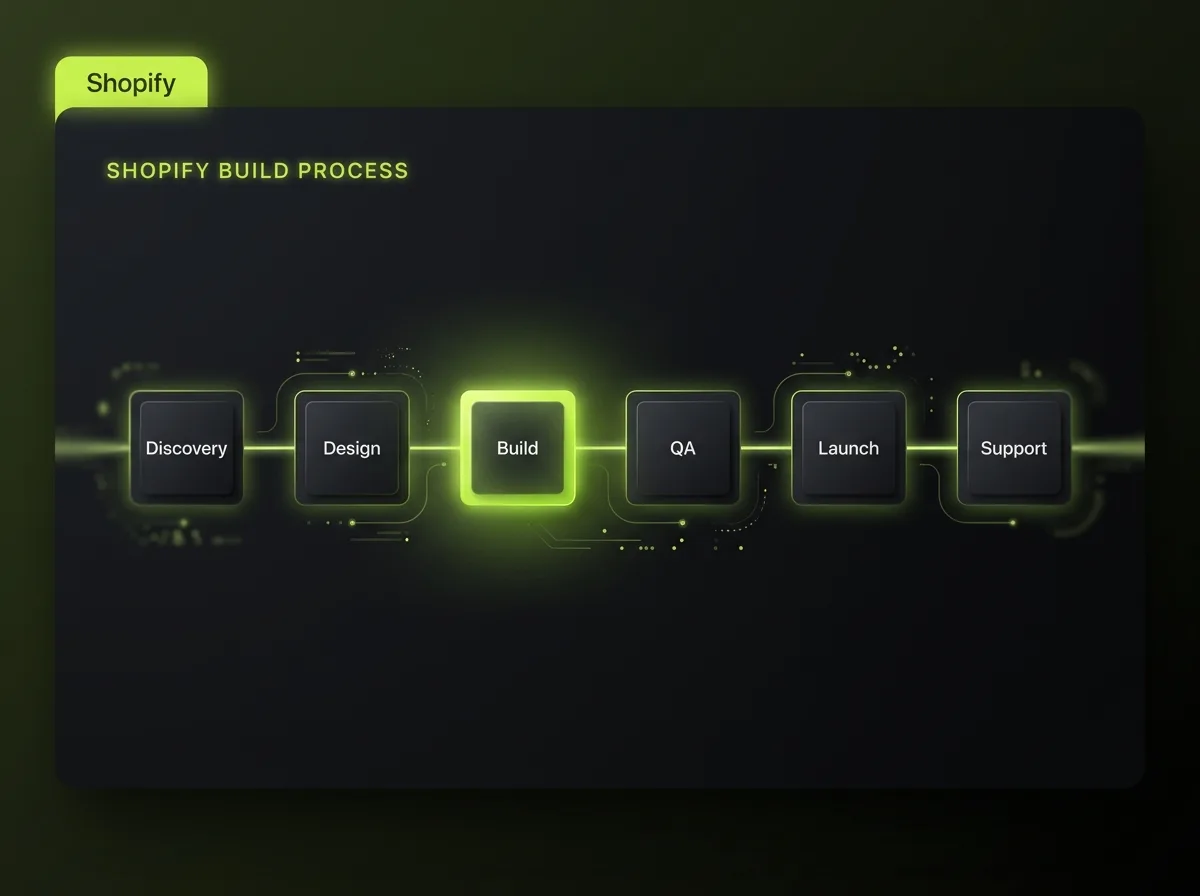
Shopify build process pipeline showing discovery, design, build, QA, launch and support phases connected by a lime line

Conversion-Focused Store Design

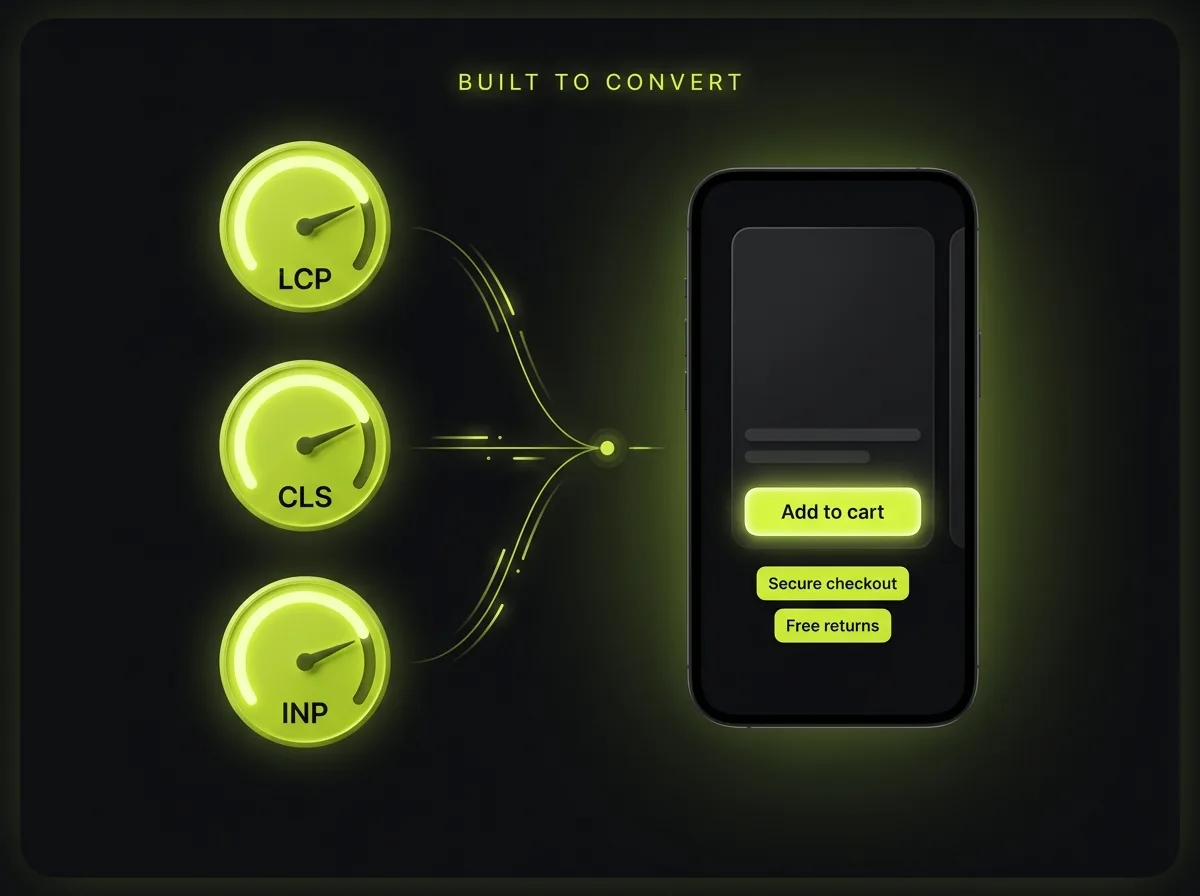
A store that looks good but loads slowly will lose money quietly, so we treat Shopify store speed as a design constraint, not a clean-up task at the end. The targets are concrete: a Largest Contentful Paint under 2.5 seconds, Cumulative Layout Shift under 0.1, and Interaction to Next Paint under 200 milliseconds, measured on a mid-range phone over 4G rather than on a developer's laptop. On Shopify that means a lean theme with deferred and conditionally loaded apps, because the single biggest speed killer we find on existing stores is a stack of half-used apps each injecting its own scripts. We lazy-load below-the-fold imagery, serve responsive WebP, reserve space for media so nothing jumps as the page paints, and audit the third-party tags that marketing teams accumulate over time.

Speed is necessary but not sufficient. Conversion-rate optimization on Shopify is mostly about removing friction and adding the right reassurance at the right moment. Over seventy percent of store traffic is mobile, so the mobile product page is the real homepage: thumb-reachable add-to-cart, a sticky buy button on long pages, and variant pickers that do not require pinch-zooming. The checkout is where intent turns into revenue, so we lean on Shopify's accelerated wallets, express options like Shop Pay, and a guest path that never forces account creation. Trust signals, clear returns, security cues, real review counts, do measurable work in the final steps. For brands that want to push conversion harder with structured experimentation and paid traffic, this dovetails with our performance marketing program.

Shopify storefront conversion diagram with Core Web Vitals gauges for LCP, CLS and INP beside a mobile product page with add to cart and trust signals

Shopify SEO Built In From Day One

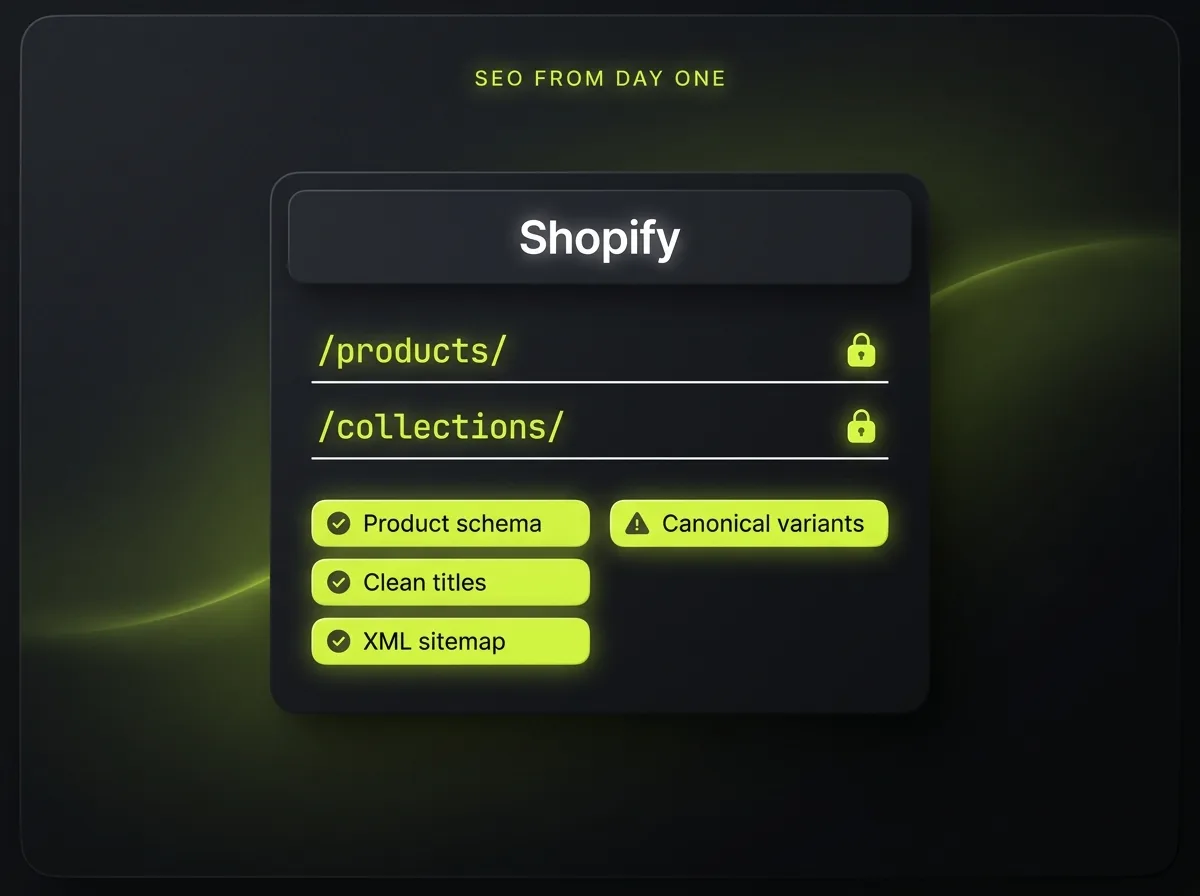
Shopify SEO is largely a matter of mastering the platform's rails rather than fighting them. Shopify enforces a fixed URL structure, products live under /products/ and categories under /collections/, and you cannot change that. Most of the time this is fine, but it has two consequences worth designing around. First, the same product can be reachable through several collection paths, so we set canonical tags carefully and keep the canonical pointing at the clean product URL. Second, product variants can spawn parameterised URLs, so we make sure the canonical consolidates them rather than letting near-duplicate pages compete. We build the technical baseline in from the start: descriptive, unique title tags and meta descriptions templated at scale, a clean heading hierarchy, an auto-maintained XML sitemap, and breadcrumb structure that both users and crawlers can follow.

The higher-leverage SEO work is in structured data and content. We add Product, Offer and AggregateRating schema so listings can earn rich results with price, availability and star ratings, which lifts click-through even when the ranking position is unchanged. Collection pages get genuine introductory and buying-guide copy rather than a bare grid, because a category page with context can rank for the head term while individual products chase the long tail. Internal linking from collections to flagship products spreads authority where it converts. A store built this way is ready for an ongoing organic program rather than needing a retrofit, which is exactly how our ecommerce SEO engagements pick up from a clean technical base.

Shopify SEO foundation card showing the fixed products and collections URL structure with product schema, clean titles, XML sitemap and a canonical variants caution

Migrations And Replatforming To Shopify

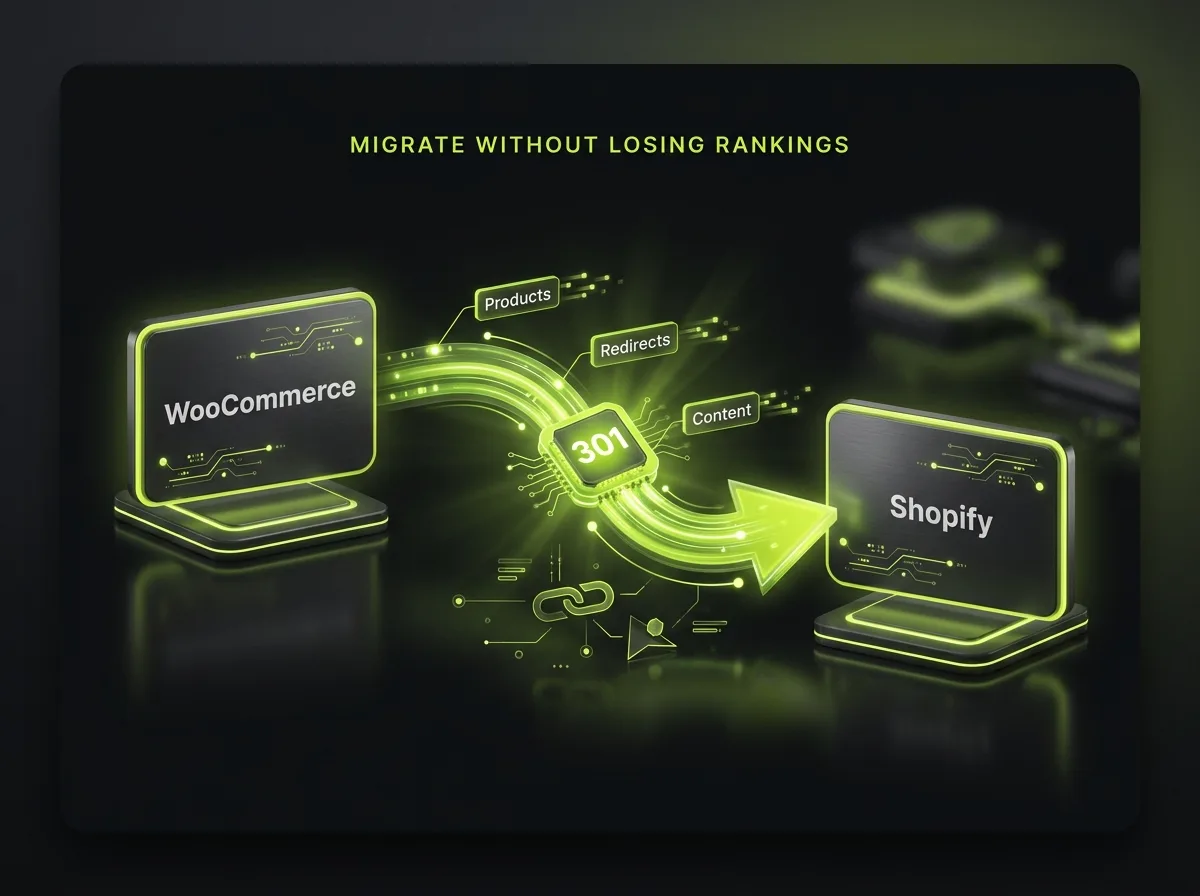
The fear that stops most migrations is losing search rankings, and it is a justified fear, because a careless replatform to Shopify can tank organic traffic overnight. The damage almost always comes from one avoidable mistake: changing URLs without mapping redirects. When you move from WooCommerce, Magento or BigCommerce, your old URL patterns will not match Shopify's, so every ranking page needs a 301 redirect to its new equivalent. We build that redirect map as a deliverable, page by page for anything with traffic or backlinks, and we crawl the old site first so nothing is missed. Done properly, link equity transfers and rankings hold within the normal post-migration settling period rather than collapsing.

A Shopify migration is more than a redirect spreadsheet. We export and clean the full catalogue, products, variants, images, collections and customer records, and reconcile it against the new data model so nothing is dropped or duplicated in transit. Content, blog posts, landing pages and meta data, comes across with its on-page SEO intact. We rebuild the integrations the business actually runs on, payment, tax, shipping, email and analytics, and we stand the new store up in parallel so it can be tested under real conditions before the cutover. The switch itself happens on a quiet traffic window with monitoring in place, and we watch indexation and crawl errors for weeks afterward. If you are weighing the move against staying on a self-hosted stack, the trade-offs are worth reading on our WooCommerce development page before you commit.

Migration diagram showing a WooCommerce store moving to Shopify with products, redirects and content carried across a 301 redirect mapping

Most popular services

SX0 service icon — DigiRocket

SX0

Great rankings mean nothing without great user experience. Our SXO approach delivers both traffic and performance.

Performance Marketing service icon — DigiRocket

Performance Marketing

Results you can measure. We run data-driven campaigns that convert clicks into revenue across every platform.

Dropshipping service icon — DigiRocket

Dropshipping

From product research to fulfillment, our data-backed approach turns dropshipping into a real business.

Frequently Asked Questions

Shopify development involves designing, customizing, and building ecommerce websites using the Shopify platform. This includes theme development, app integrations, custom functionality, and performance optimization.

Yes! We handle complete store migrations from platforms like WooCommerce, Magento, Wix, and others to Shopify—preserving your products, customers, SEO, and order history.

We offer both options. We can customize existing Shopify themes or build fully custom themes from scratch based on your brand identity and user experience goals.

It depends on the scope — a straightforward store is a very different build from a fully custom or enterprise-level Shopify project. We scope the work with you up front, agree on the milestones, and keep you updated as each one ships, rather than quoting a fixed timeline before we understand the requirements.

Yes. Every store we build is fully responsive, ensuring a seamless shopping experience across all devices—desktop, tablet, and mobile.

Yes. We build and migrate stores on Shopify Plus, the enterprise tier, and use the parts that justify it: scriptable checkout extensions, B2B price lists and company accounts, multiple expansion stores for different markets, Launchpad for timed sales and product drops, and higher API limits for heavy integrations. Plus makes sense once your volume, B2B requirements or multi-store needs outgrow standard Shopify; below that, a well-built standard plan is usually the smarter spend, and we will tell you honestly which tier fits.

We treat speed as a build constraint, not an afterthought. That means a lean theme, deferring and conditionally loading apps so unused scripts never block the page, lazy-loading below-the-fold images, serving responsive WebP, and reserving space for media so the layout does not shift. We target a Largest Contentful Paint under 2.5 seconds, Cumulative Layout Shift under 0.1 and Interaction to Next Paint under 200 milliseconds, measured on a mid-range phone over 4G rather than a fast laptop. The single biggest win on most existing stores is removing or replacing a stack of half-used apps.

We agree the metrics that matter before the build, then instrument them: conversion rate, average order value, mobile conversion specifically, Core Web Vitals, and organic visibility for your product and collection terms. Post-launch support includes reading those numbers, running conversion experiments, and reporting against the targets set in discovery rather than vanity stats. A store is a commercial asset, so we judge it on revenue per session and repeat-purchase rate, not on how it looks in a screenshot.

Business professional

HELP US UNDERSTAND YOUR QUERY.