




Thumb

Custom AI Tool Development

Custom AI Tool Development involves designing and building AI-powered solutions tailored to an organization’s unique workflows, challenges, and goals. Unlike generic tools, custom AI applications are built from the ground up—or adapted using modular frameworks—to fit specific use cases such as automated decision-making, intelligent data extraction, predictive analytics, or personalized user experiences.

This approach ensures seamless integration with existing systems while delivering highly targeted results that drive efficiency and innovation.

What We Offer:

  • Tailored to Your Business Needs
  • Greater Control and Flexibility
  • Competitive Advantage

Your Trusted AI Marketing Expert

At the core of this system lies a cutting-edge Large Language Model (LLM), designed to intelligently and efficiently address your most pressing marketing challenges. Trained on a vast and diverse dataset that spans marketing strategy, digital trends, consumer psychology, and brand communication, the model is capable of delivering insights, recommendations, and content that rival the expertise of seasoned professionals.

One of its standout capabilities is its ability to rapidly synthesize large amounts of information. Instead of spending hours researching audience behavior or testing different headlines, marketers can receive real-time suggestions backed by language intelligence and data patterns. It can assist with everything from email marketing and social media content to customer segmentation and funnel optimization.

What makes this LLM truly valuable is not just its breadth of knowledge, but its ability to evolve and learn from interactions. As it processes more queries and adapts to specific industries, it becomes even more aligned with the unique needs of your brand or business. This means faster workflows, better content, smarter decisions, and ultimately — higher ROI on your marketing efforts.

AI Project Coordinator

Converts raw business data into interactive videos where users can explore insights by asking questions.

Spider Sage

A powerful scraper that processes bulk website links to collect and store targeted data automatically.

DROK: Worlds First AI Marketing Expert

It is powered by an advanced LLM, built to solve your marketing challenges with expert-level precision.

AI Sales Automation

An agentic AI package that calls, collects and automates the entire sales process from outreach to follow-up.

Challenges That Our AI Can Help You Solve

Featured
1

Customer Segmentation

AI can analyze vast amounts of customer data to identify patterns and segment audiences effectively. This allows businesses to create highly targeted marketing campaigns, ensuring that the right message reaches the right people, increasing engagement and conversion rates while reducing wasted resources.

Featured
2

Predictive Analytics

AI-powered predictive analytics can help businesses forecast future trends, consumer behavior, and sales. By leveraging historical data, AI can provide insights into what customers are likely to purchase, allowing brands to tailor their strategies and improve decision-making, leading to enhanced ROI and reduced risks.

Featured
3

Content Personalization

AI can personalize content in real-time by analyzing customer preferences, behaviors, and interactions. It helps businesses create dynamic content that resonates with individual users, enhancing customer satisfaction, loyalty, and overall engagement, which can ultimately lead to higher sales and brand affinity.

Featured
4

Automated Customer Support

AI-driven chatbots and virtual assistants are transforming customer support by providing instant responses to queries. These systems can handle a wide range of customer service issues, from product inquiries to troubleshooting, improving customer satisfaction while reducing operational costs and increasing efficiency.

How Custom AI Tools Get Built

What a bespoke AI tool can do, how we build one that is accurate and integrated, and why custom beats a generic chatbot for most real businesses.

What A Custom AI Tool Can Do

A custom AI tool is software built around a model to do one job well for your business, rather than a general chatbot you have to coax. The most common shape is a copilot: an assistant embedded inside the tool your team already uses, drafting replies, summarising a case file, or answering questions against your own documentation. Internal knowledge assistants are close behind, letting staff ask plain-language questions and get grounded answers from your contracts, wikis, tickets and policies instead of hunting through folders. Both rely on retrieval-augmented generation, where the tool fetches the relevant passages from your data and the model answers using them, so the output is anchored to your real information.

The other heavy-hitters are document and data extraction and decision support. Extraction tools pull structured fields out of messy inputs, invoices, contracts, application forms, and drop them straight into your systems, replacing hours of manual keying. Decision-support tools surface a recommendation with its reasoning, scoring a loan application or triaging a support queue, while leaving the final call to a person. We scope each tool to a single measurable workflow first, because a focused tool that saves an hour a day beats an ambitious platform that does five things mediocrely. These tools are one branch of our wider AI development services.
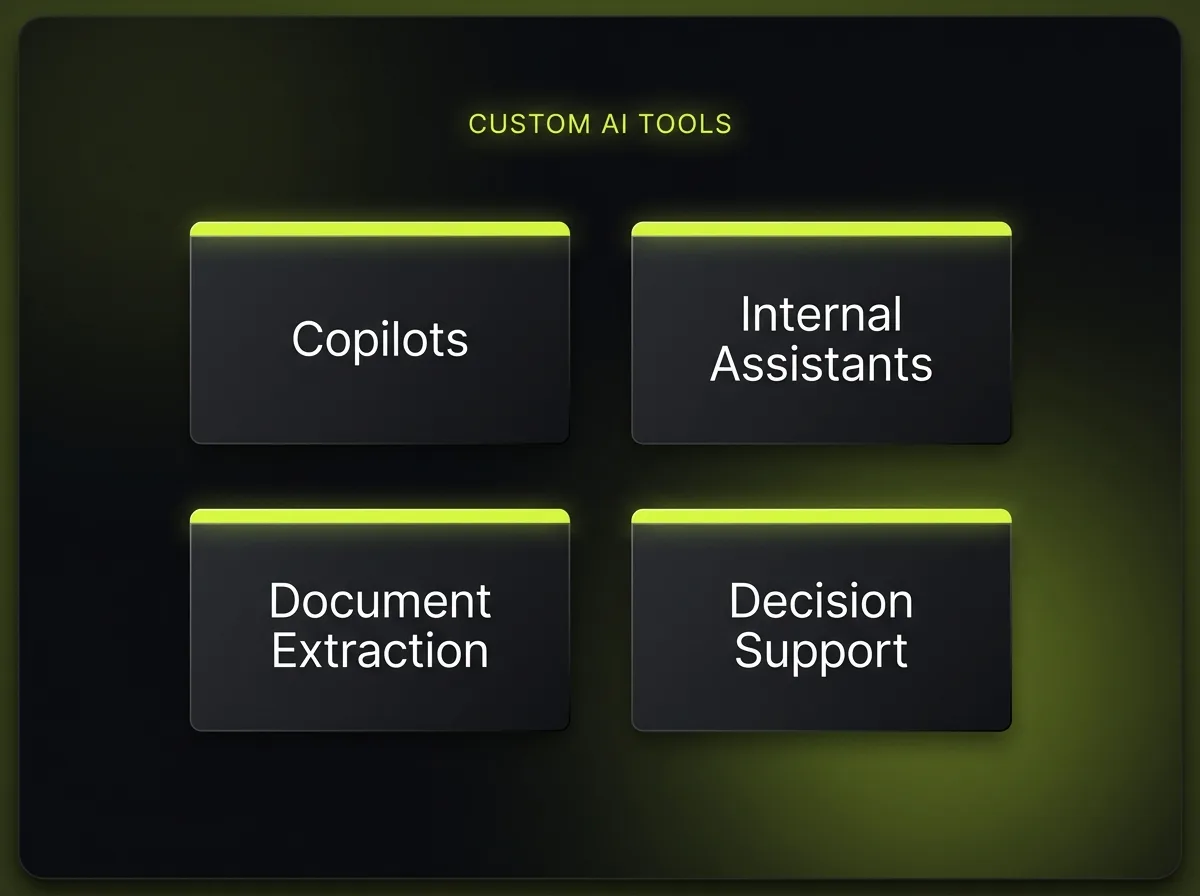
Types of custom AI tools: copilots, internal assistants, document extraction, and decision support dashboards

Our Build Approach

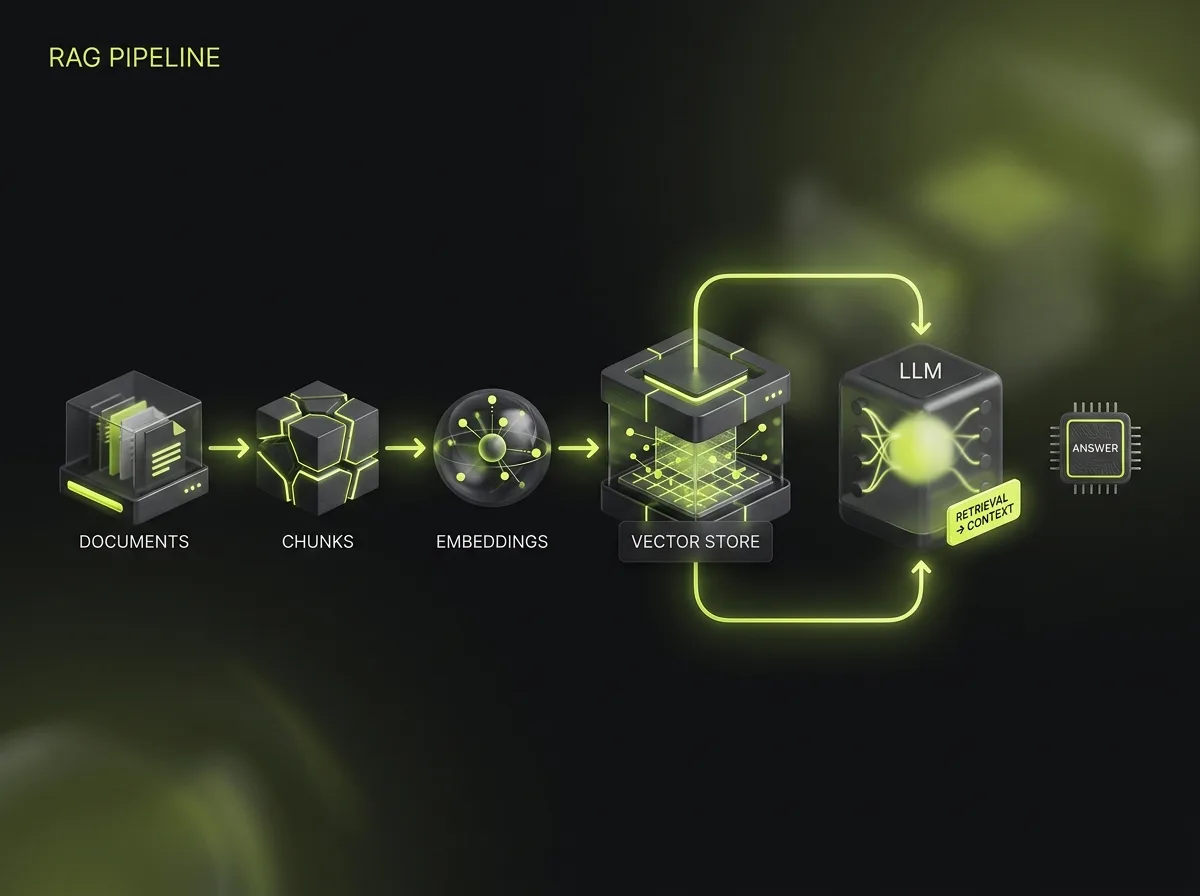
Every build starts with use-case scoping: the exact task, the inputs and outputs, who uses it, and the number that says it worked. Then comes the data and retrieval pipeline, which is where most of the engineering lives. For a knowledge tool we ingest your documents, split them into sensible chunks, turn each chunk into an embedding, a numerical representation of its meaning, and store those in a vector database. At query time the tool embeds the user's question, retrieves the closest-matching chunks, and passes them to the model as grounding context. This retrieval-augmented generation pattern is what lets a tool answer accurately from your data without retraining the model, and it is far cheaper and faster to update than fine-tuning.

Model choice comes next, fitted to the job rather than to hype: a strong general model where reasoning matters, a smaller or open-weight model where cost and privacy dominate. Then we build the interface, where it lives, how a person reviews and corrects it, and integrate it with your systems so it reads and writes the right data. We ship a narrow version early, put it in front of real users, and iterate on the prompts, retrieval quality and UI based on what they actually do. When the workload is truly specialised, a custom model becomes worth considering, which is the territory of our custom LLM and fine-tuning service.

RAG pipeline build: documents to chunks to embeddings to vector store, retrieval feeding context into the LLM

Integrating AI Into Existing Workflows

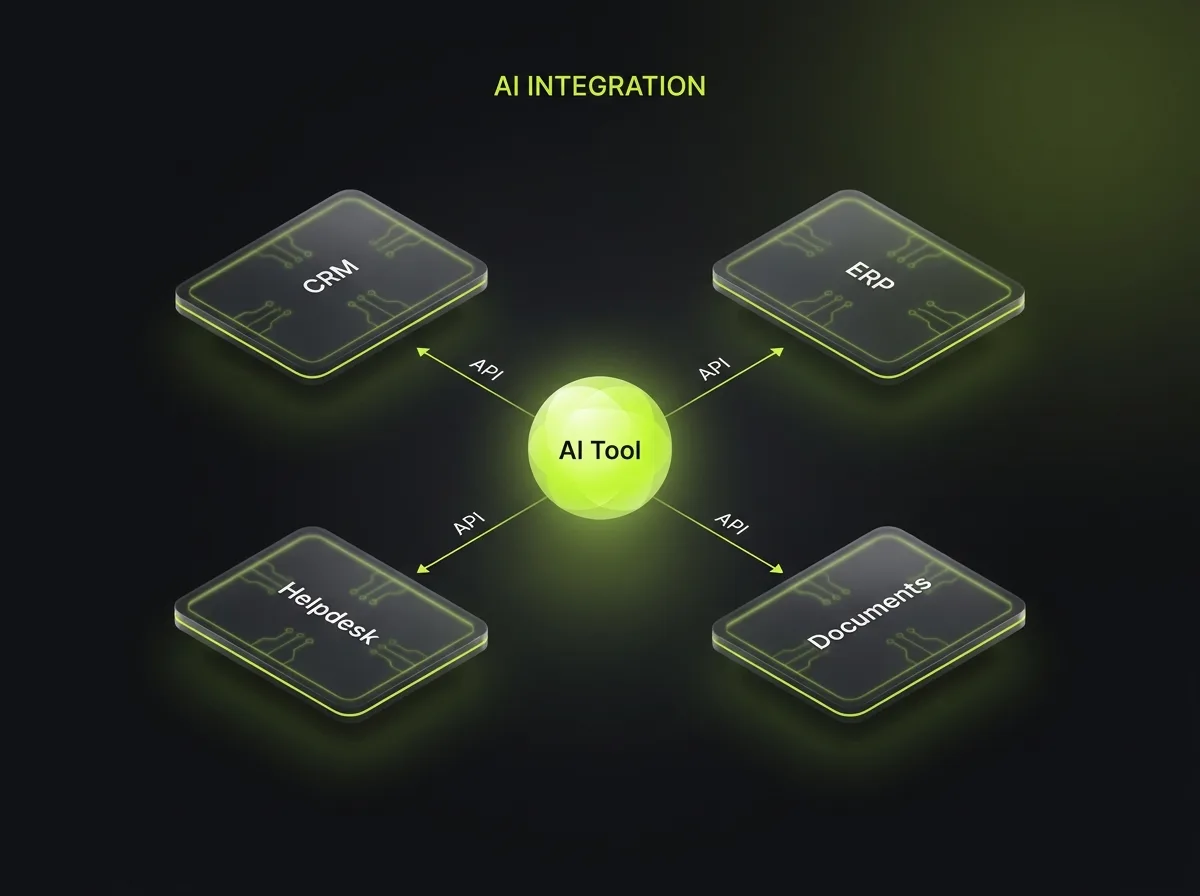
A custom AI tool earns its keep only when it lives where the work already happens, so integration is a first-class part of the build, not a bolt-on. We design API-first, connecting the tool to your CRM, ERP, helpdesk, document storage and databases so it can read the context it needs and write results back without anyone copying and pasting. A support copilot reads the customer record and ticket history, drafts a reply in the helpdesk, and logs the outcome. An extraction tool watches an inbox or folder, processes new documents, and posts the structured result into your finance system. The model is the easy half; the plumbing into your stack is what makes it usable day to day.

We respect the boundaries of your existing systems rather than asking you to rip them out. Where a system has a clean API we use it; where it does not, we use webhooks, scheduled syncs or a thin adapter layer so the integration stays maintainable. We also design for permissions, so the tool only sees and changes what the signed-in user is allowed to, which matters the moment AI touches customer data. This is the same integration discipline our web application development team brings to any connected system, and it is what separates a tool people use from a demo they forget.

AI tool connected by APIs to CRM, ERP, helpdesk and document store in an API-first integration architecture

Accuracy, Evaluation And Safety

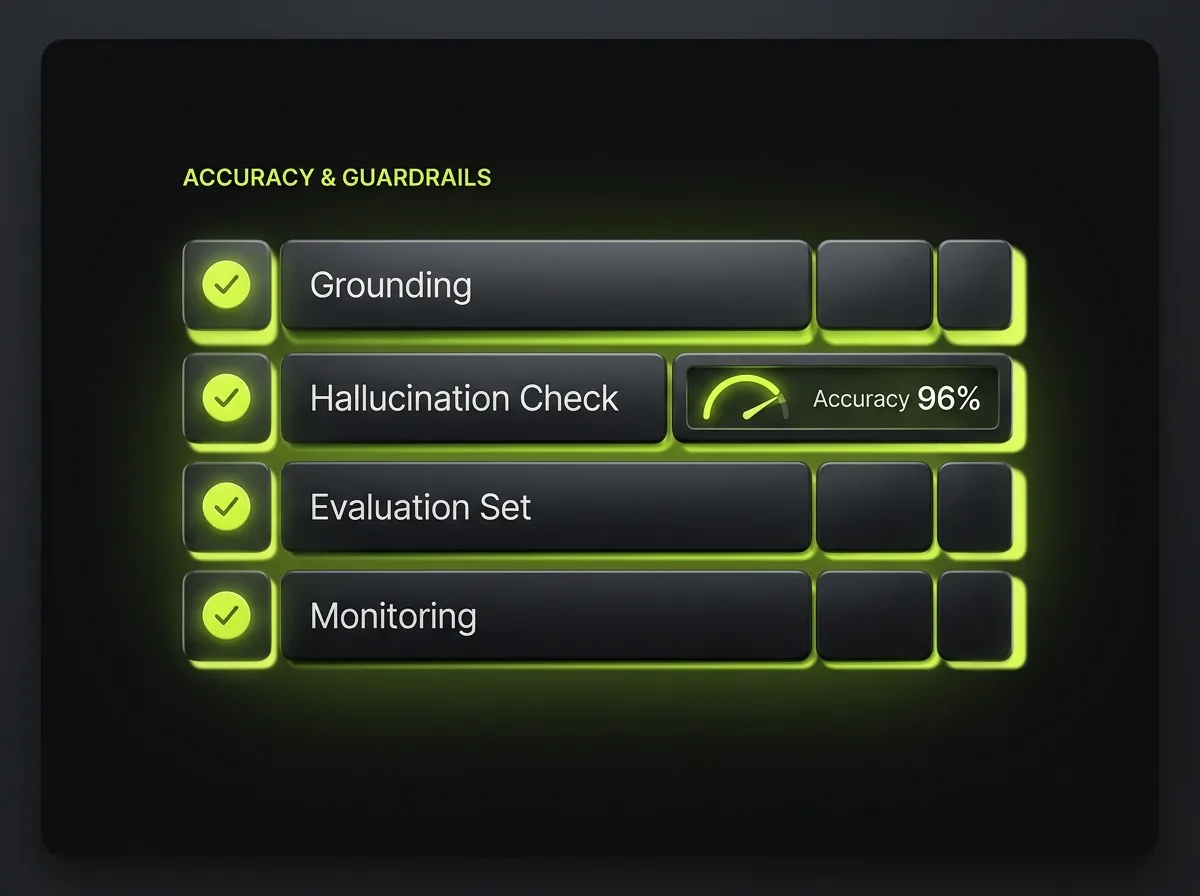
The first question buyers ask is how we stop the AI making things up, and the honest answer is a stack of controls rather than a single fix. The foundation is grounding: the tool answers from retrieved passages of your own documents and, where it matters, cites or shows the source, so a user can verify the claim. We instruct the model to say it does not know rather than guess when retrieval returns nothing relevant, which sounds trivial but eliminates a large share of confident wrong answers. For structured outputs we validate the format and range before anything is written back, so a malformed extraction is caught rather than saved.

Beyond grounding, we treat evaluation as ongoing rather than a launch-day checkbox. We assemble a test set of real inputs with known-correct outputs, score the tool against it before release, and re-run that scoring as your data and the underlying models change, so accuracy drift is caught early. In production we monitor for failures, low-confidence cases and unusual inputs, and we keep a human in the loop on anything consequential. This evaluation-first habit is the same one we apply across our AI development practice, because a tool you cannot measure is a tool you cannot trust.

AI guardrails: grounding, hallucination checks, an evaluation test set scoring accuracy, and production monitoring

Custom AI Tool vs Off-The-Shelf Chatbots

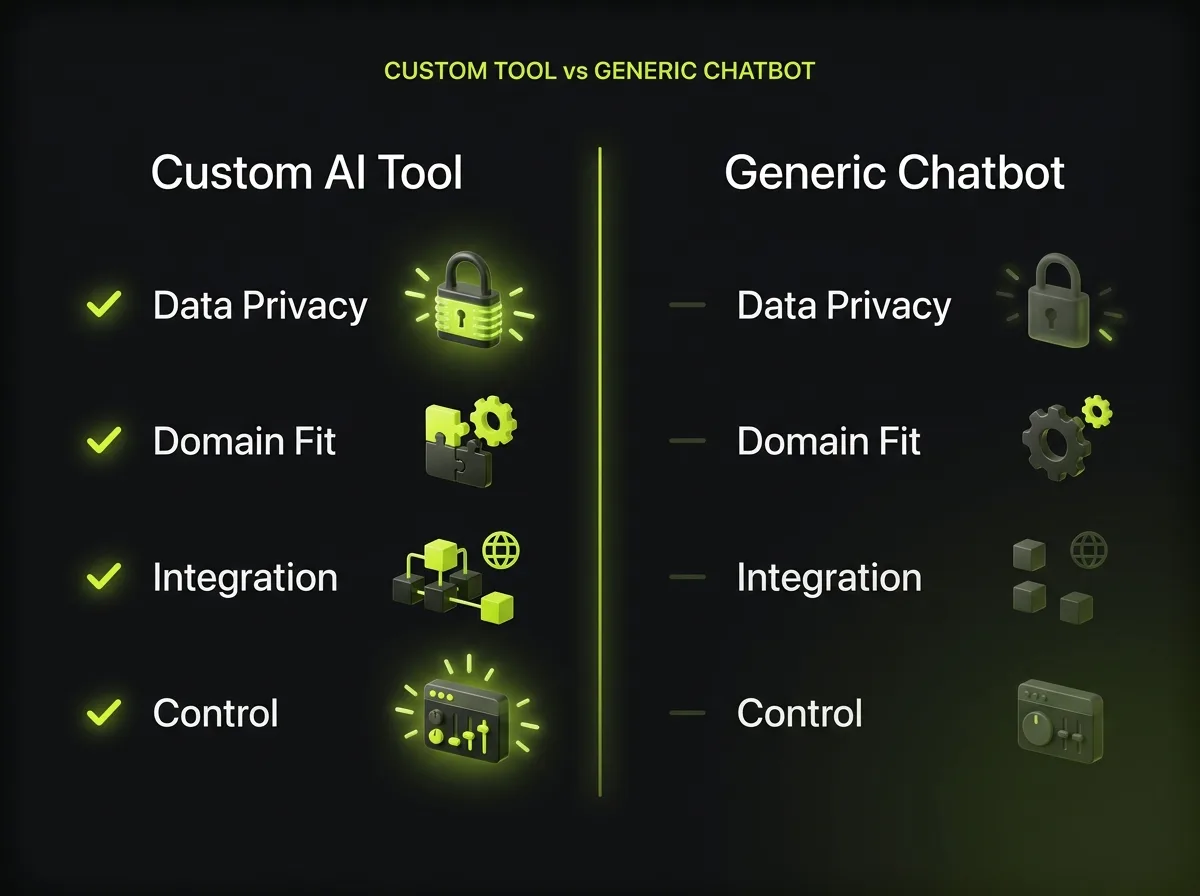
The fair question is why not just use ChatGPT or a generic chatbot, and for casual one-off tasks you often should. The case for a custom tool comes down to four things a public chatbot cannot give you. Data privacy and ownership: a custom tool runs against your data under your terms and access controls, rather than pasting sensitive information into a consumer product. Domain fit: it is grounded in your specific documents and tuned to your workflow, so it answers as your business would, not as the open internet would. Integration: it reads and writes your real systems instead of being a separate window someone has to copy out of.

The fourth is control and consistency. A custom tool gives you guardrails, evaluation and an audit trail, so you can prove how it behaves and fix it when it drifts, none of which you get from a generic assistant. The trade-off is real and we name it plainly: a custom tool costs more up front and takes longer to ship than signing up for a SaaS product, so it only makes sense when privacy, integration or domain accuracy actually matter to you. When they do not, we will tell you to buy off the shelf. When they do, custom is the difference between a novelty and a tool your team relies on, and it sits naturally alongside the rest of our AI services.

Comparison of a custom AI tool versus a generic chatbot across ownership, data privacy, domain fit and integration

Frequently Asked Questions

It depends on the tool's complexity and the systems it needs to integrate with. We scope the build with you up front, agree on the milestones, and keep you updated as each one ships, rather than quoting a fixed timeline before we understand the requirements.

Yes. We design AI tools to seamlessly integrate with your existing software, APIs, databases, and cloud platforms.

Absolutely. We provide ongoing support, performance monitoring, and updates to ensure long-term success and reliability.

Yes. Our tools are built with scalability in mind, allowing them to grow alongside your business and handle increasing data or user demand.

For casual one-off tasks, a public chatbot is fine. A custom tool wins on four things it cannot give you: data privacy and ownership, because it runs against your data under your access controls instead of pasting sensitive information into a consumer product; domain fit, because it is grounded in your own documents and workflow; integration, because it reads and writes your real systems; and control, because you get guardrails, evaluation and an audit trail. The trade-off is that custom costs more and takes longer, so it only makes sense when those things actually matter to you.

Yes, and that is usually the whole point. We use retrieval-augmented generation (RAG): your documents are ingested, split into chunks, turned into embeddings and stored, then the tool retrieves the most relevant passages at query time and answers using them. That anchors responses to your real information and lets you update the knowledge base instantly without retraining anything.

With a stack of controls rather than a single fix. The tool answers from retrieved passages of your own documents and, where it matters, shows the source so a user can verify; it is instructed to say it does not know rather than guess when nothing relevant is found; structured outputs are validated before they are written back; and we score the tool against a test set of real cases before launch and keep monitoring it in production, with a human in the loop on anything consequential.

Yes. We design API-first, connecting the tool to your CRM, ERP, helpdesk, document storage and databases so it can read the context it needs and write results back, scoped to what the signed-in user is allowed to see and change. Where a system lacks a clean API we use webhooks, scheduled syncs or a thin adapter layer so the integration stays maintainable.

Most popular services

SX0 service icon — DigiRocket

SX0

Great rankings mean nothing without great user experience. Our SXO approach delivers both traffic and performance.

Performance Marketing service icon — DigiRocket

Performance Marketing

Results you can measure. We run data-driven campaigns that convert clicks into revenue across every platform.

Dropshipping service icon — DigiRocket

Dropshipping

From product research to fulfillment, our data-backed approach turns dropshipping into a real business.