







Thumb

Ecommerce SEO Agency for Growing Online Stores

Running an online store? As an ecommerce SEO agency, we build search strategies that bring in more traffic, boost visibility, and increase conversions. From optimizing product and collection pages to fixing technical issues and targeting high-value keywords, we focus on strategies that deliver real growth — whether you sell on Shopify, WooCommerce, or a custom storefront.

We also help strengthen your site’s authority through quality backlinks and track every result through GA4. It’s a complete approach to help your store rise in search rankings and turn visitors into loyal customers.

What We Offer:

  • Product & Collection Page Optimization
  • Keyword-Driven Content Strategy
  • Technical SEO & Site Structure

Shopify SEO Agency & Platform Expertise

Most of the stores we grow run on Shopify, so a large part of our ecommerce SEO work is Shopify-specific. As a Shopify SEO agency we go beyond keywords — we control the duplicate-content and faceted-navigation issues that quietly hold Shopify stores back, tune theme speed for Core Web Vitals, and structure collections so they rank for category-level buying terms while product pages capture long-tail intent.

Shopify & Shopify Plus

Collection and product-page architecture, canonical handling for variant URLs, metafields, product and breadcrumb schema, and theme speed work — the depth you expect from a dedicated Shopify SEO expert.

WooCommerce & Custom Stores

The same technical SEO discipline applied to WooCommerce, BigCommerce and headless storefronts — crawl control, clean URL structures, internal linking and structured data.

Content That Converts

Buying guides, comparison content and category copy mapped to real search demand, then internally linked to your highest-margin products to compound rankings over time.

See how this plays out in real stores — our ecommerce SEO case studies for Just Bigger Bras, Rug Resources and Evergreen Dog show the approach applied end to end. Selling on a single platform? Our Shopify development and ecommerce marketing teams pick up where SEO leaves off.

Seo Toolkit

Blog

Our QuickWin SEO Makes All the Difference

Why is it the best move?

Our QuickWin SEO is built for businesses that want fast, visible results without cutting corners. Instead of waiting months to see progress, we focus on what can move the needle right now. We start by identifying high-impact keywords, fixing technical issues, and improving key pages that already have potential. These small but powerful changes can quickly boost your rankings and bring in more traffic.

It’s a smart way to build early momentum while setting up a strong base for long-term SEO success. QuickWin SEO helps you break that pattern, you’ll start seeing progress, getting clicks, and attracting the right audience faster. It’s a practical, results-focused approach that works — and it’s often the best first move for serious online growth.

How Ecommerce SEO Actually Works

The architecture, on-page and technical work that turns a store's catalog into organic revenue.

How Ecommerce SEO Is Different From Regular SEO

Ecommerce SEO is regular SEO multiplied by scale, then complicated by problems a blog never faces. A content site has dozens of URLs. A store has thousands, sometimes hundreds of thousands once you count product pages, collection pages, filtered views and pagination. That scale changes everything. You cannot hand-write a unique 600-word page for every product, so the discipline becomes deciding which pages deserve human attention, which can be templated well, and which should not be indexable at all.

We rank the catalog into tiers before touching a single page. The high-value money pages are collections and top products, the ones tied to terms with real search volume and buying intent, and those get genuine human investment: custom copy, hand-built internal links, original photography where it helps. The long tail, the thousands of variant and low-demand products, gets a strong, scalable template that is unique enough to index safely without consuming the time those pages cannot repay. Spending equally on every page is the most common way ecommerce teams waste their budget; concentrating effort where the demand is concentrated is what makes the catalog compound.
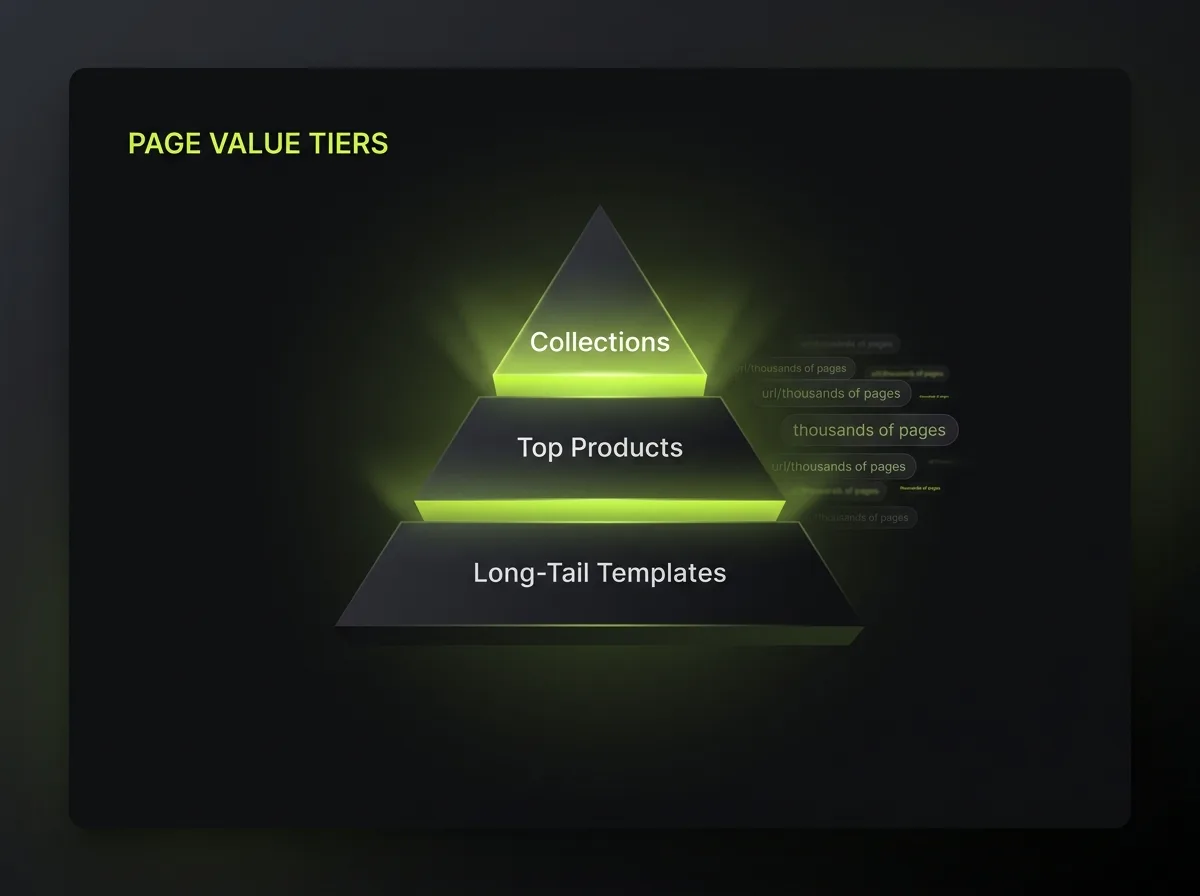
Page value tiers pyramid: collections and top products get human attention, the long tail gets a strong scalable template

Three problems are unique to stores. First, thin and duplicate descriptions: most catalogs ship with manufacturer copy reused across the web, which Google has no reason to rank above the dozen other shops using the same paragraph. Second, faceted navigation, the color, size, price and brand filters, which can spawn millions of crawlable URL combinations that bury your real pages and burn crawl budget. Third, the lifecycle problem of products going out of stock or being discontinued, which a content site never deals with.

Get these wrong and Google wastes its crawl on junk and never reaches the pages that earn money; get them right and the catalog compounds quarter over quarter. The order of attack matters too. We usually fix crawl and indexation first, because pointing Google at the right pages is wasted if it is busy crawling a million filter combinations, then we deepen the money-page content, then we systematize the lifecycle handling so the gains do not erode as the catalog turns over. The same fundamentals carry across to our local SEO work, and we run SEO inside the wider marketing mix.
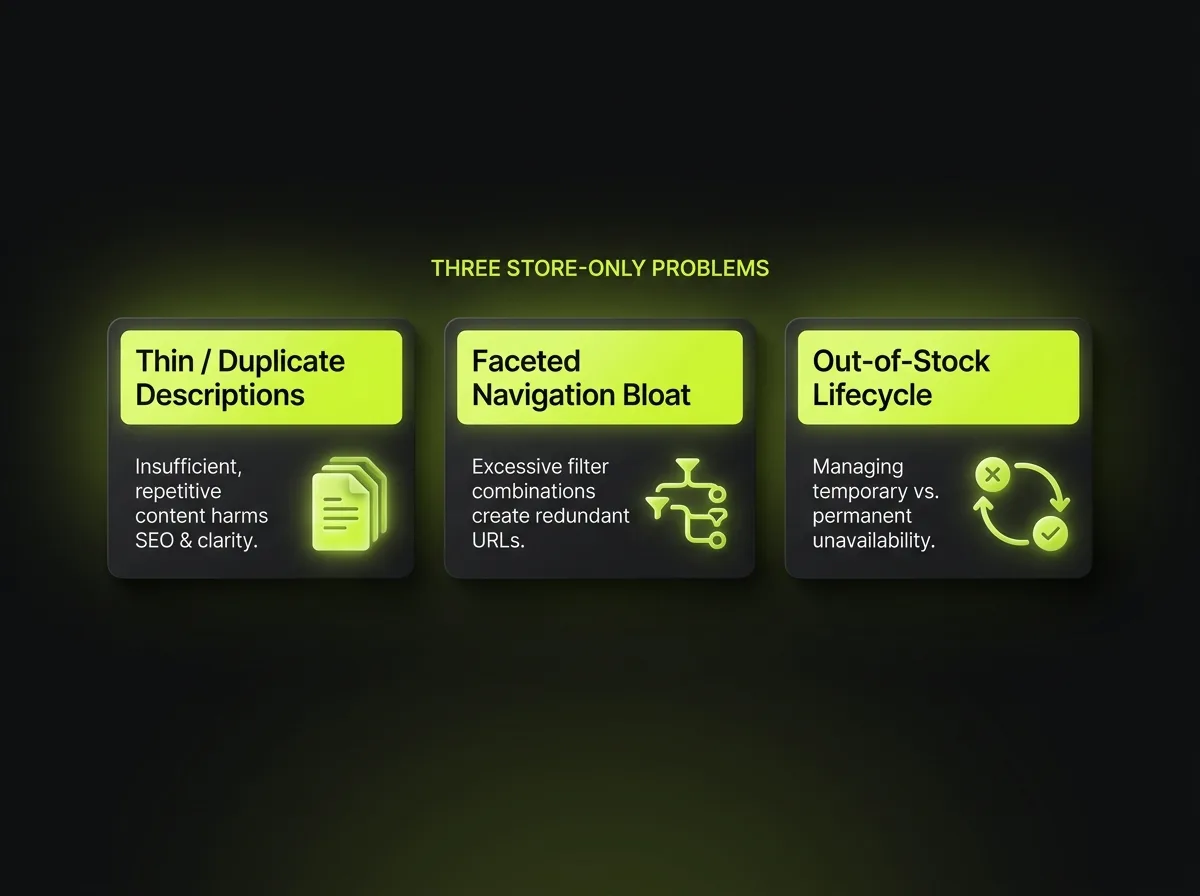
Three store-only SEO problems: thin or duplicate descriptions, faceted navigation bloat, and the out-of-stock product lifecycle

Product and Collection Page Optimization

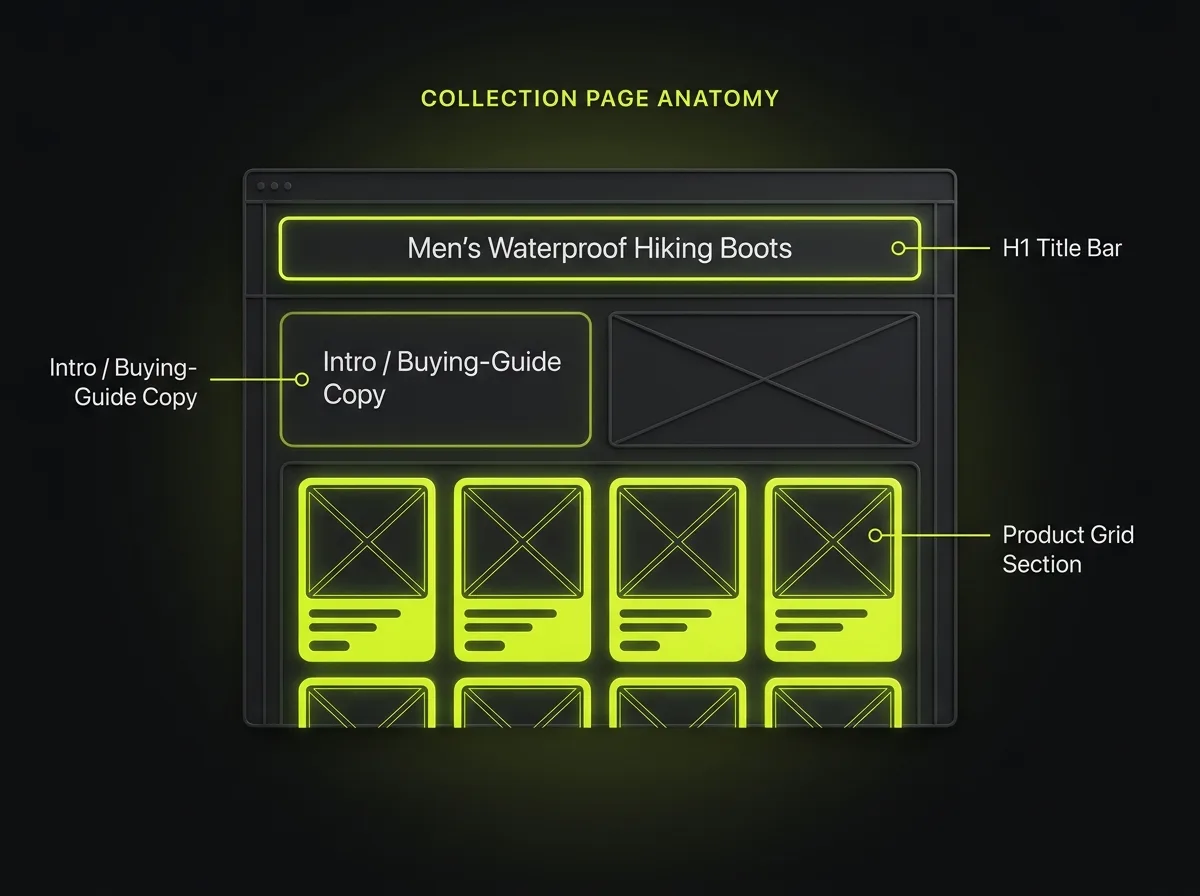
Collection pages are the workhorses of ecommerce SEO because they target the category-level terms with real buying intent, the searches like "men's waterproof hiking boots" rather than a single product name. We give each priority collection a unique H1, a title pattern that leads with the head term, and a block of genuine intro or buying-guide copy above or below the grid that answers what shoppers weigh before they buy: how to choose, what the trade-offs are, which option suits which use.

That copy is where you win the category term without resorting to thin filler, and where the page earns the right to outrank a marketplace listing. Products then capture the long-tail and branded intent beneath them, and tight internal linking from collections down to products passes authority to the pages that actually convert. A clean hierarchy, collection to subcollection to product, also helps Google understand the catalog's structure, so the head term and the specific product term reinforce rather than cannibalize each other.

Collection page anatomy: a category H1, intro and buying-guide copy block, and a product grid that targets buying-intent terms

Product pages need unique copy at scale, not spun manufacturer text. We build templates that force in the details Google and shoppers both want: specifics, use cases, sizing and materials, and real answers to the questions buyers ask before adding to cart. On top of that goes structured data: Product, Offer and AggregateRating schema so listings can show price, availability and star ratings directly in the search result. Those rich results lift click-through even when the ranking position does not change, which is one of the highest-return technical jobs on a store.

Buying guides and comparison content come in when a category is genuinely considered, expensive or confusing enough that shoppers research before purchasing, and we link those guides into the collections they support so the research traffic flows toward a purchase. On Shopify specifically, the template and metafield changes that make this schema and copy structure work cleanly are a development job, not a settings toggle, which is why our Shopify development team handles the theme work alongside the SEO.

Product, Offer and AggregateRating schema producing a rich search result with price, in-stock status and star ratings

Technical Ecommerce SEO

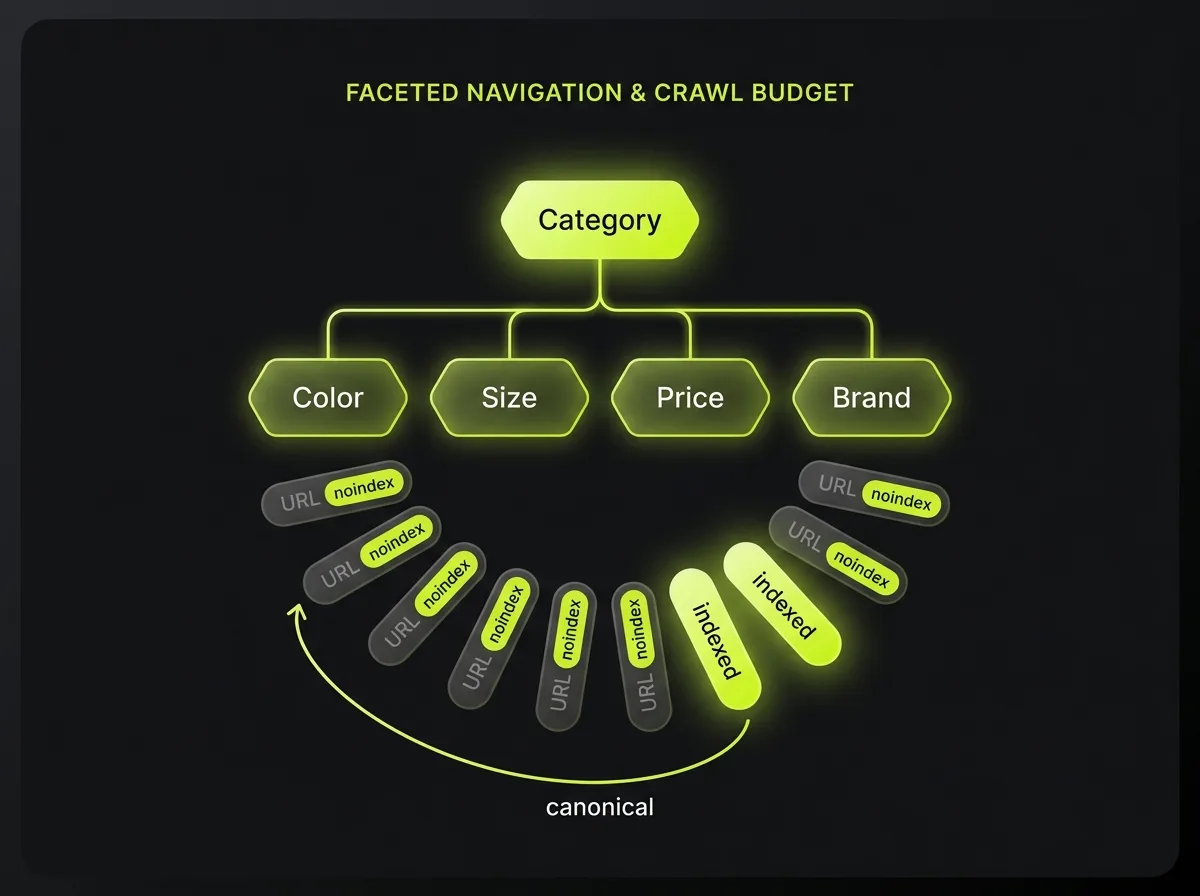
Technical problems quietly kill more store rankings than weak content does, and faceted navigation is the worst offender. Every filter a shopper can apply, color, size, price band, brand, multiplies into crawlable URL combinations. Left unmanaged, a few dozen filters generate millions of near-duplicate URLs that consume crawl budget and dilute ranking signals across endless variants of the same page, so Google never reaches the pages that matter.

The fix is a deliberate indexation policy, decided filter by filter. We index the filtered views with real search demand, a color plus category combination people actually search for, and block, canonicalize or noindex the rest. Canonicals point variant and parameter URLs back to the clean primary, robots rules keep crawlers out of the infinite parameter space, and pagination is handled so Google can crawl deep catalogs without getting trapped. The principle is simple to state and easy to get wrong: every URL Google is allowed to index should be a page you actually want to rank.

Faceted navigation diagram: category filters multiply into URLs, most set to noindex, a few indexed, with canonical pointing back to the clean page

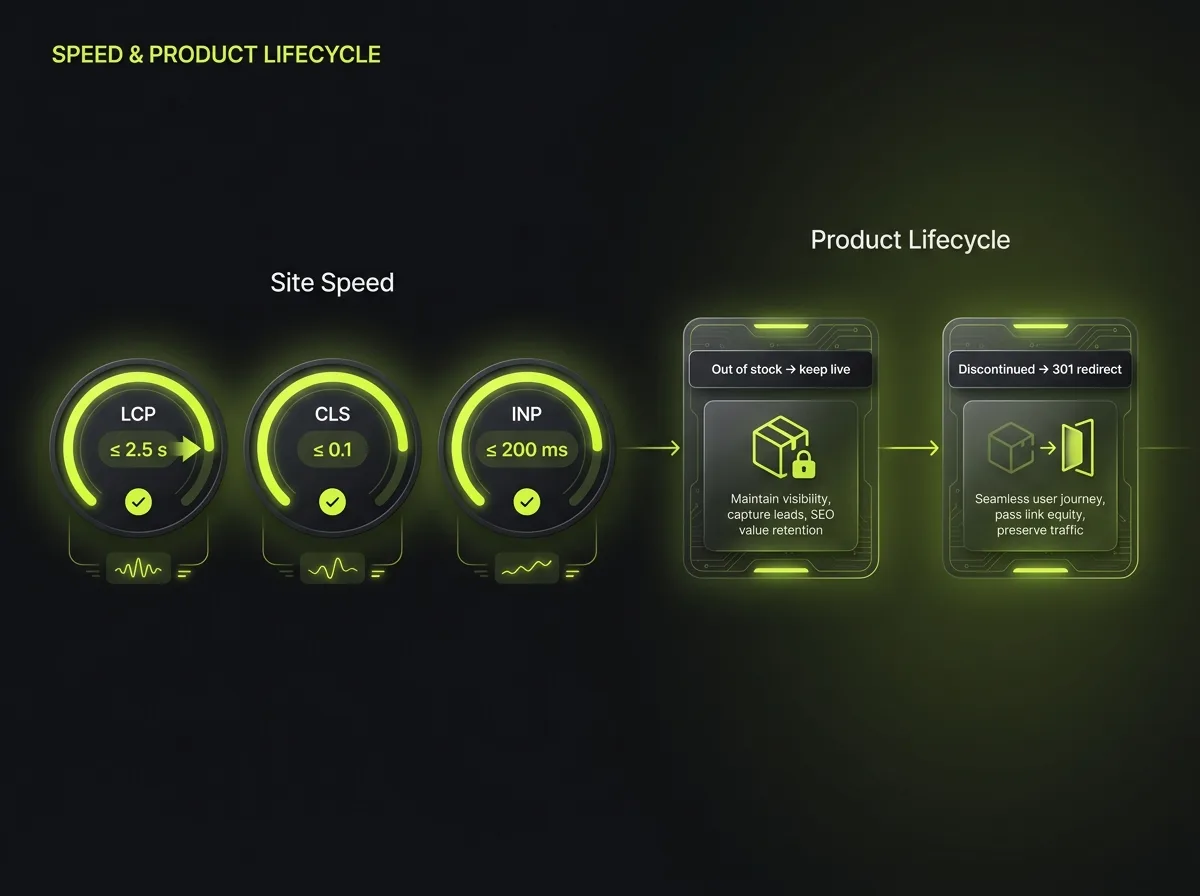
Site speed is a ranking and conversion factor at once, and stores are heavy: large product images, review widgets, and app scripts pile up until Core Web Vitals fail. We profile what is actually slowing pages down rather than guessing, compress and properly size imagery, defer non-critical scripts, and protect the largest contentful paint on the product and collection templates where the revenue sits. A page that loads a second faster does not just rank better; it abandons fewer carts, so the speed work pays back twice.

The out-of-stock and discontinued lifecycle is the last piece most teams ignore, and it bleeds value silently. A product that is temporarily out should stay live and indexed, holding its rankings until stock returns. A permanently discontinued one needs a deliberate decision: a 301 redirect to the nearest relevant product or category if one exists, or a 410 if nothing fits, never a silent 404 that throws away the link equity and rankings you spent months earning. We systematize this so it happens automatically as the catalog turns over. The heavier platform and crawl engineering overlaps with our web application development work.

Core Web Vitals gauges for LCP, CLS and INP beside product lifecycle handling: keep out-of-stock live, 301 the discontinued

Platform-Specific SEO: Shopify vs WooCommerce

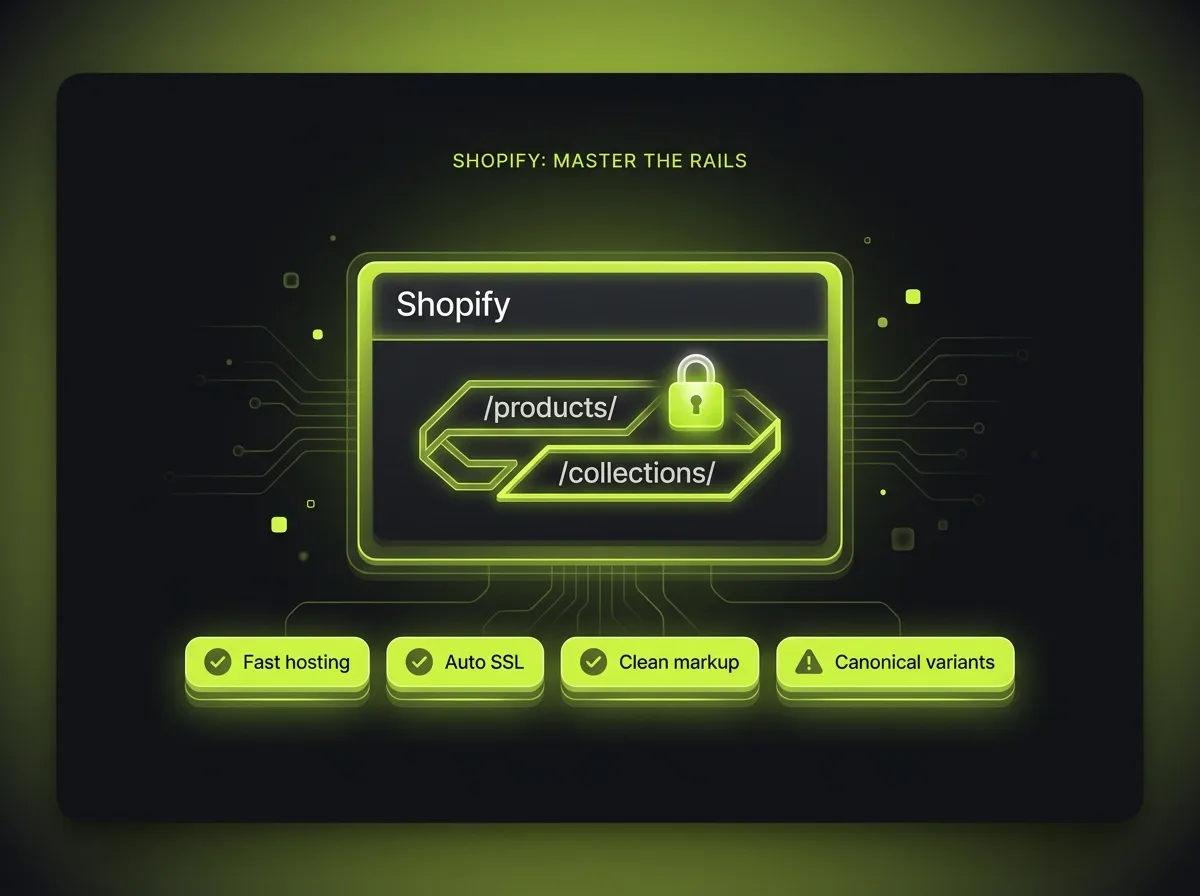
Most of the stores we grow run on Shopify, and Shopify makes a specific trade. It handles the basics well out of the box, fast hosting, clean enough markup, automatic SSL, but it forces structural decisions you cannot fully override. URLs are locked into Shopify's pattern: products live under /products/, collections under /collections/, and a product reachable through a collection generates a second URL that needs careful canonical handling to avoid duplication.

The blog and the URL structure are less flexible than a self-hosted setup, so the work is about mastering Shopify's constraints rather than fighting them. In practice that means variant canonicalization so color and size variants do not split ranking signals, a deliberate collection architecture, metafields to feed richer schema the default theme will not output, and theme-level speed work because many themes ship with render-blocking apps. None of these is exotic, but each is a development task, and getting all four right is what separates a Shopify store that ranks from one that merely loads fast.

Shopify SEO constraints: fixed /products/ and /collections/ URL structure with fast hosting, automatic SSL and canonical variant handling

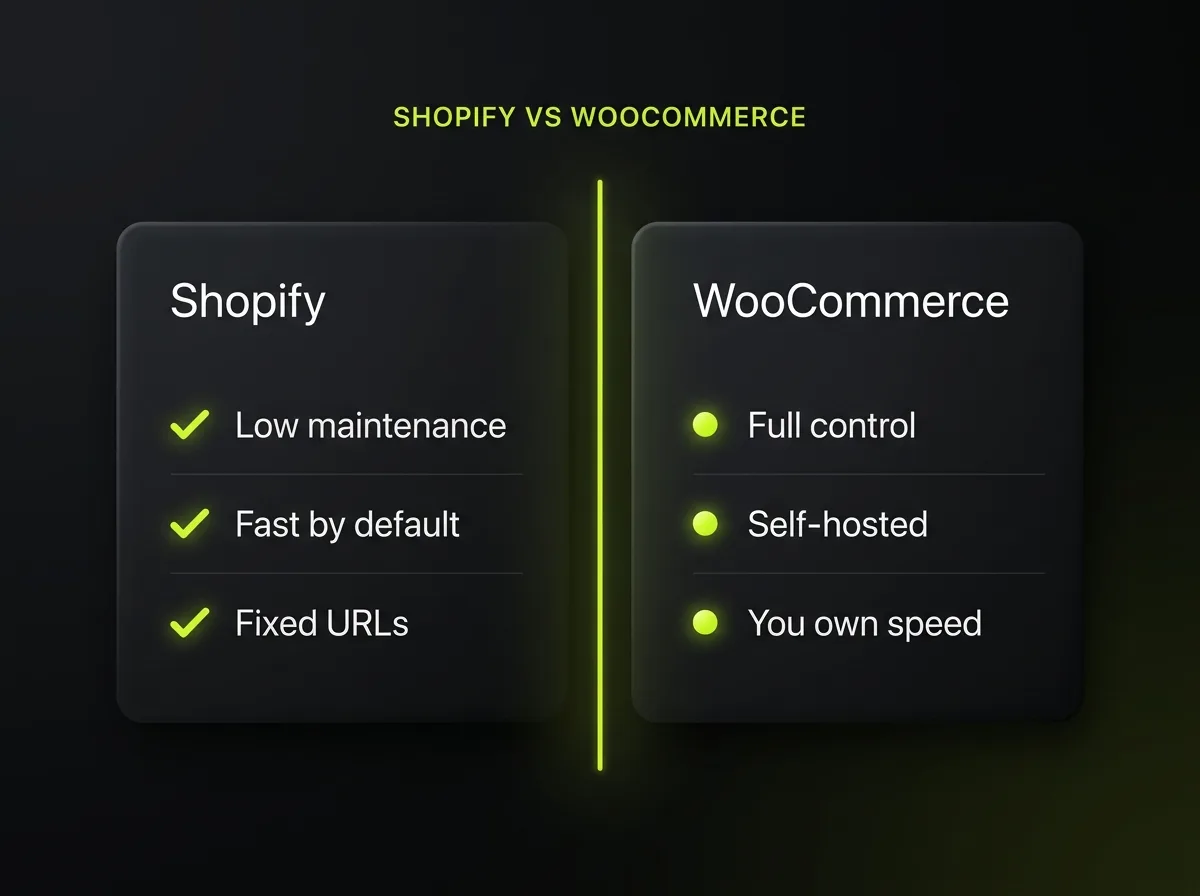
WooCommerce sits at the other end of the trade. Because it runs on WordPress and self-hosting, you control everything: URL structure, the full plugin ecosystem, custom content types, and unlimited tuning. That flexibility is also the catch. Nothing is optimized by default, you own hosting, speed, security and updates, and it is far easier to misconfigure into a slow or duplicate-heavy mess than most teams expect going in.

The honest rule of thumb: choose Shopify if you want a fast, low-maintenance store and will work within its rails; choose WooCommerce if you need deep customization or tight content-commerce integration and have the resources to maintain it properly. Neither is automatically better for SEO, the ceiling on both is high, but the floor on WooCommerce is lower because it punishes neglect. We run SEO on both platforms, and our Shopify development and WooCommerce development teams build and maintain the platform itself so the technical foundation never becomes the thing holding rankings back.

Shopify versus WooCommerce comparison: low maintenance and fast by default versus full control and self-hosted flexibility

Outrank your competitors with our seo service

Technical SEO
Keywords Planning
Competitor Research
Blog Optimization
Quality Link building
Meta optimization
GSC and GA4 Analysis
Google my business Optimization
Best Pricing

Affordable pricing checkout Now 

Most popular services

SX0 service icon — DigiRocket

SX0

Great rankings mean nothing without great user experience. Our SXO approach delivers both traffic and performance.

Performance Marketing service icon — DigiRocket

Performance Marketing

Results you can measure. We run data-driven campaigns that convert clicks into revenue across every platform.

Dropshipping service icon — DigiRocket

Dropshipping

From product research to fulfillment, our data-backed approach turns dropshipping into a real business.

Frequently Asked Questions

Yes. We work as a Shopify SEO agency and optimize Shopify and Shopify Plus stores end to end — collection and product page structure, theme speed, duplicate-content and faceted-navigation control, metafields, schema markup, and internal linking. The same approach applies to WooCommerce, BigCommerce and custom storefronts.

That is the core of what our Shopify SEO experts do. We rewrite titles and meta, set canonical tags to control duplicate variant URLs, add product and breadcrumb schema, improve image alt text and page speed, and build internal links from collections and blog content to your highest-margin products.

Ecommerce SEO is the process of optimizing your online store to rank higher in search engines like Google. It helps increase organic traffic, boost product visibility, and ultimately drive more sales without relying solely on paid ads.

Our Ecommerce SEO services are specifically tailored for online stores. We focus on optimizing product pages, category structures, technical SEO, user experience, and conversion rate optimization—strategies that directly impact ecommerce success.

Absolutely. We conduct thorough keyword research for your products and categories using advanced tools to identify high-intent, high-converting keywords your customers are actively searching for.

We measure against revenue, not just rankings. The headline metric is organic revenue, broken down by landing page so you can see which collections and products are actually earning. Underneath that we track assisted conversions, where organic search contributes to a sale that closes through another channel, category-level rank for your priority buying terms, and the blend of organic against paid so you can see organic taking share as it matures. A position climb that does not move organic revenue tells us we are ranking for traffic that does not convert, and we shift the targeting toward higher-intent terms.

Yes, and they perform better together than apart. Paid search buys instant visibility on high-intent terms while SEO builds the durable rankings that lower your blended cost per acquisition over time. The data flows both ways: paid campaigns surface the converting search terms worth targeting organically, and strong organic rankings let you pull back paid spend on terms you already own. We coordinate the two so they reinforce rather than cannibalize each other, which is part of how our wider marketing program is structured.

You cannot hand-write a unique page for every product at that scale, so the work becomes triage. The high-value collections and top products get real human investment: unique copy, buying-guide content and tight internal linking. The long tail gets a strong, scalable template that forces in the specifics Google and shoppers want rather than reusing manufacturer text. Products that are thin, out of stock or discontinued get a deliberate decision about indexing, canonicalization or redirects, so crawl budget flows to the pages that earn money instead of being wasted on junk.

It can, badly, if it is done without an SEO plan, and that is the single most common way stores lose rankings overnight. The risk is broken redirects and changed URL structures that strip the link equity you spent years earning. Done properly, a migration preserves rankings: we map every old URL to its new equivalent with 301 redirects, keep URL structures as close as possible, migrate metadata and schema, and monitor crawl and indexing closely through the transition. We treat a replatform as an SEO project first and a technical one second.

We prioritize. High-performing and high-potential product pages get individual, hands-on optimization because they justify the investment. The rest are handled through strong, unique templates that pull in real product specifics rather than duplicated manufacturer copy. This keeps the whole catalog working without diluting effort across pages that will never earn meaningful search traffic.

Technical fixes and on-page work on existing pages can move rankings within weeks because the pages already have history. Net-new content and authority building take two to four months to mature and keep compounding after that. Competitive head terms take longer than long-tail product and buying-guide terms, so we sequence the work to capture early wins on lower-difficulty terms while the harder category terms build.