



Thumb

Custom LLM and Fine Tuning

Custom LLMs and Fine-Tuning enable businesses to shape advanced language models around their unique needs and data. By training pre-trained models on domain-specific content, we enhance their ability to perform specialized tasks—whether it’s customer support, content creation, internal documentation, or code generation. Fine-tuning ensures outputs are not only more accurate but also context-aware and aligned with your brand voice and business objectives.

The result is a powerful AI system that understands your language, adapts to your workflows, and delivers relevant results with precision.

What We Offer:

  • Domain-Specific Intelligence
  • Enhanced Performance & Accuracy
  • Consistent Brand Voice

Key Features We Offer

Pre-Trained Model Adaptation

Build on top-tier models like GPT or open-source LLMs, customized for your industry and use case.

Secure Data Handling

Fine-tune using your internal data with strict privacy protocols and enterprise-grade security.

Multi-Language Support

Deploy models capable of understanding and generating content across various languages and dialects.

Task-Specific Optimization

Configure models for high performance in targeted tasks like summarization, classification, or Q&A.

Seamless API Integration

Easily plug your custom model into existing workflows, apps, or internal systems.

Continuous Improvement Loop

Monitor performance and re-train periodically to keep your model sharp, relevant, and up to date.

Challenges that Custom LLM can help you solve

Featured
1

Generic Responses from Public Models

Eliminate vague or irrelevant answers by training models on your proprietary data to generate highly specific, accurate, and context-aware outputs.

Featured
2

Lack of Industry-Specific Knowledge

Tailor your LLM to deeply understand your industry jargon, workflows, compliance needs, and customer queries..

Featured
3

Inconsistent Brand Voice

Maintain a consistent tone, terminology, and style in customer communications, marketing content, and support responses.

Featured
4

Poor Productivity in Manual Processes

Automate repetitive content generation tasks—reports, summaries, code snippets, legal drafts—tailored to your company’s standards.

How LLM Fine-Tuning Actually Works

When fine-tuning is worth it, when retrieval is enough, how a fine-tuning project runs, and what it costs in data and money.

Fine-Tuning vs RAG vs Prompting

Most teams ask for fine-tuning when they actually need one of the cheaper two options, so this is the first decision we work through honestly. Prompting is changing what you tell the model, including giving it examples in the prompt; it is free, instant, and solves a surprising amount. Retrieval-augmented generation, or RAG, adds your own knowledge to the model at query time by fetching relevant documents and feeding them in as context. Fine-tuning, supervised fine-tuning specifically, actually adjusts the model's weights by training it on hundreds or thousands of your input-output examples. The rule we live by: if the problem is the model does not know your facts, that is a RAG problem, because facts belong in retrieval where you can update them instantly, not baked into weights you would have to retrain.

Fine-tuning earns its place when the problem is behaviour rather than knowledge: a consistent format, tone or style you cannot reliably get from prompting, a narrow classification task you want to be fast and cheap, or compressing a capability onto a smaller open-weight model like Llama or Mistral to cut inference cost at high volume. The trade-offs are concrete. Prompting and RAG are cheap and updatable but bounded by the base model's behaviour. Fine-tuning bends behaviour and can lower per-call cost, but it needs quality data, costs money to train, and goes stale as your needs change. Our standard path is prompting, then RAG, and only fine-tune with a measured reason, the same framework we apply across our custom AI tool development.
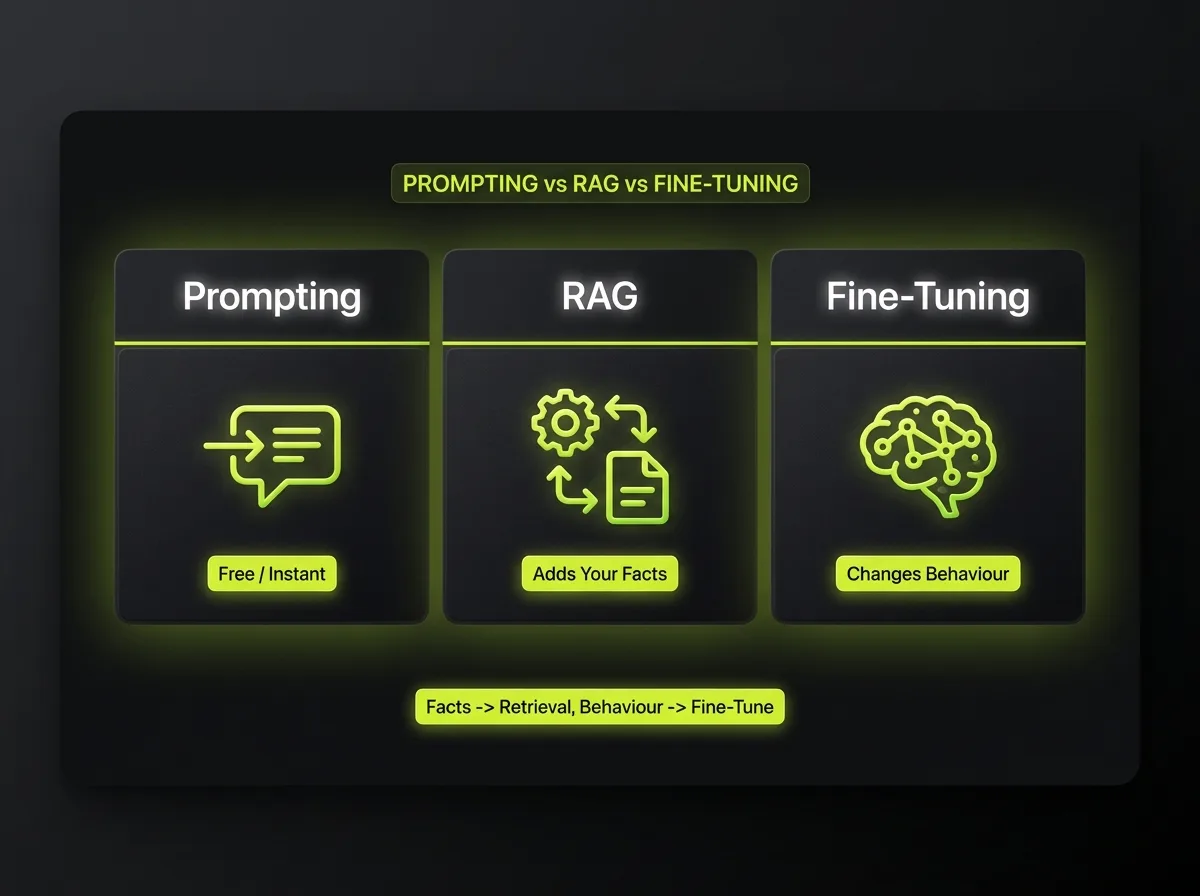
Decision diagram comparing prompting, retrieval-augmented generation and fine-tuning by cost, data need and what each fixes

Our Fine-Tuning Process

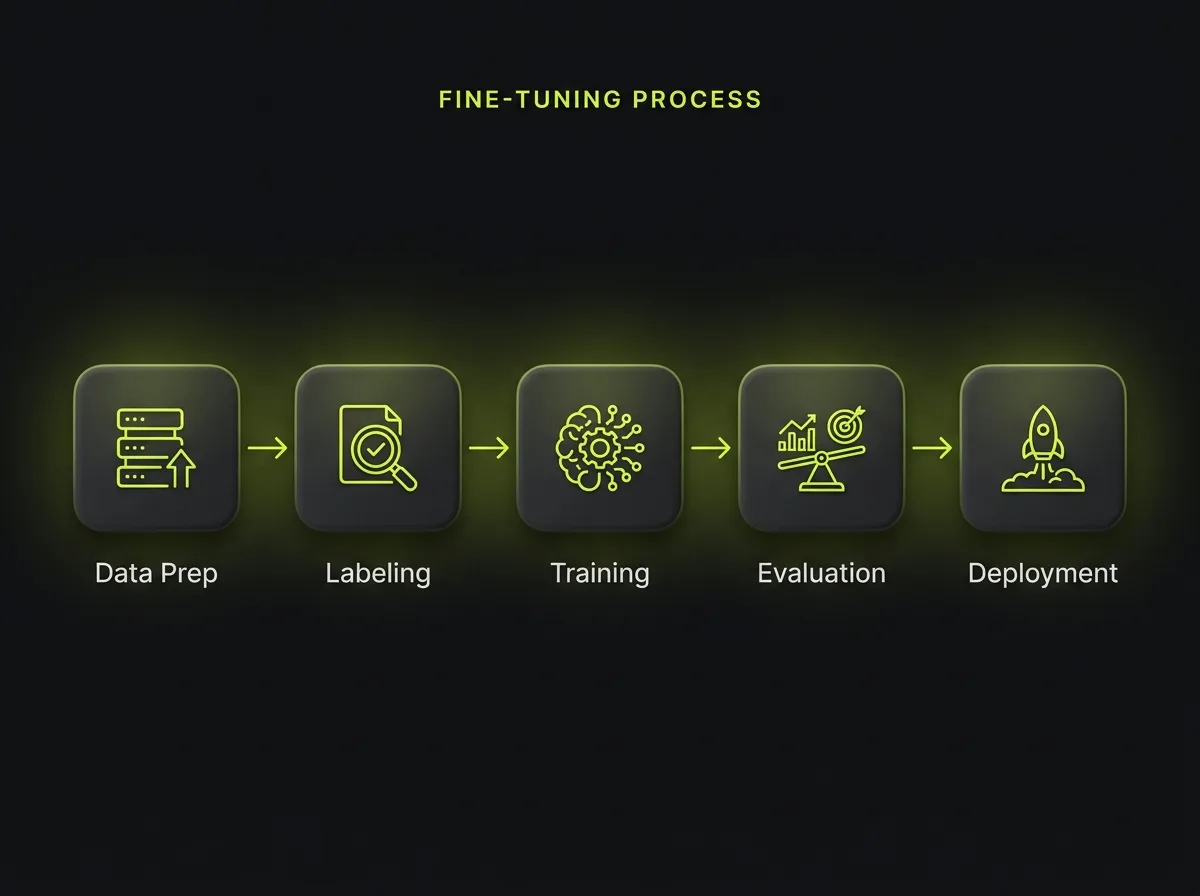
A fine-tuning project is mostly a data project. The first and longest phase is data preparation: assembling input-output pairs that show the model exactly the behaviour you want, cleaning them, removing duplicates and errors, and formatting them consistently. Quality beats quantity here, a few hundred excellent, representative examples routinely outperform thousands of noisy ones, because the model learns whatever patterns are in the data, including the mistakes. Where labels do not exist yet, we define a clear labelling guide and review a sample for consistency before scaling, because inconsistent labels teach the model to be inconsistent.

Training itself is the short, almost mechanical step: we run supervised fine-tuning on a chosen base model, holding back a validation set, and watch for overfitting, where the model memorises the training set instead of generalising. Then comes evaluation against a held-out test set of real cases the model never saw, scored on the metrics that matter to you rather than a generic benchmark. Only once it clears that bar do we deploy, behind the same guardrails and monitoring we use for any production model. We are upfront before we start about whether fine-tuning is even the right call, because the responsible-deployment discipline in our AI development services applies here too.

Fine-tuning project stages: data preparation, labeling, supervised training, evaluation, and deployment

Domain-Specific And Private LLMs

A domain-specific LLM is a model shaped to one industry or one business: its vocabulary, its document types, its brand voice and the answers its users actually need. We build these for teams where a general model keeps getting the nuance wrong, in legal, medical, financial or deeply technical domains where the right answer depends on specialist context. The build usually combines retrieval over your corpus with light fine-tuning for tone and format, which together produce a model that reads and responds the way your domain expects without you paying to train a model from scratch, something almost no business actually needs to do.

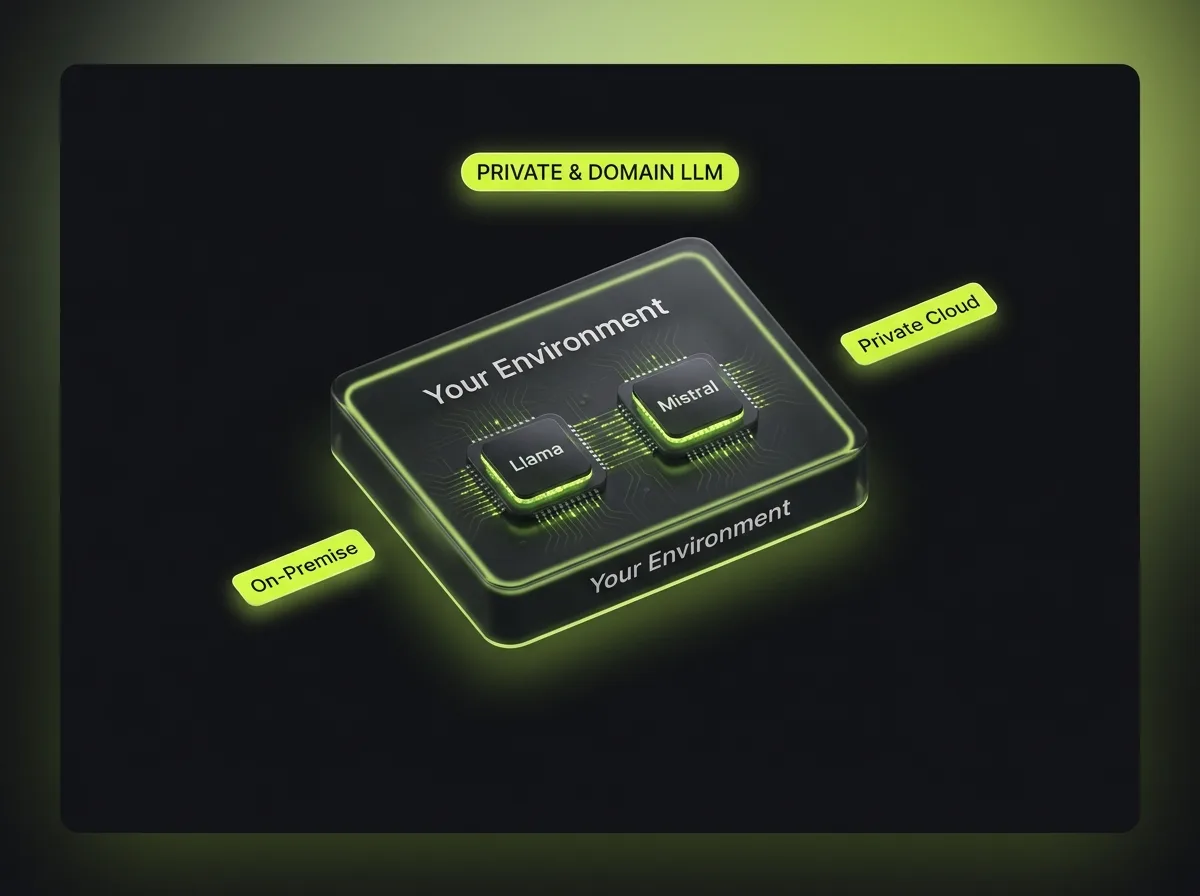
Privacy is the other big driver, and it is where open-weight models earn their keep. When data cannot leave your environment, for regulatory or contractual reasons, we deploy an open-weight model such as Llama or Mistral inside your own cloud account or on-premise, so prompts and your proprietary data never travel to a third-party API. You trade some raw capability against the largest hosted frontier models for full control over where data lives and who can see it, and for many regulated clients that trade is non-negotiable. A private model is also a natural backbone for autonomous workflows, which is exactly what our agentic process automation builds on.

Private LLM deployment options: open-weight models like Llama and Mistral running on-premise or in a private cloud

Evaluating And Maintaining A Custom LLM

A custom model is not a deliverable you hand over and forget; it needs evaluation and upkeep to stay useful. Evaluation starts with a representative test set, real inputs with known-good outputs, scored on the dimensions you care about: factual accuracy, format adherence, tone, and refusal of out-of-scope questions. For open-ended tasks where there is no single right answer, we use rubric-based scoring and, increasingly, a stronger model as an automated judge against that rubric, validated against human ratings. The point is to have a number you can track, because without one you cannot tell whether a change helped or hurt.

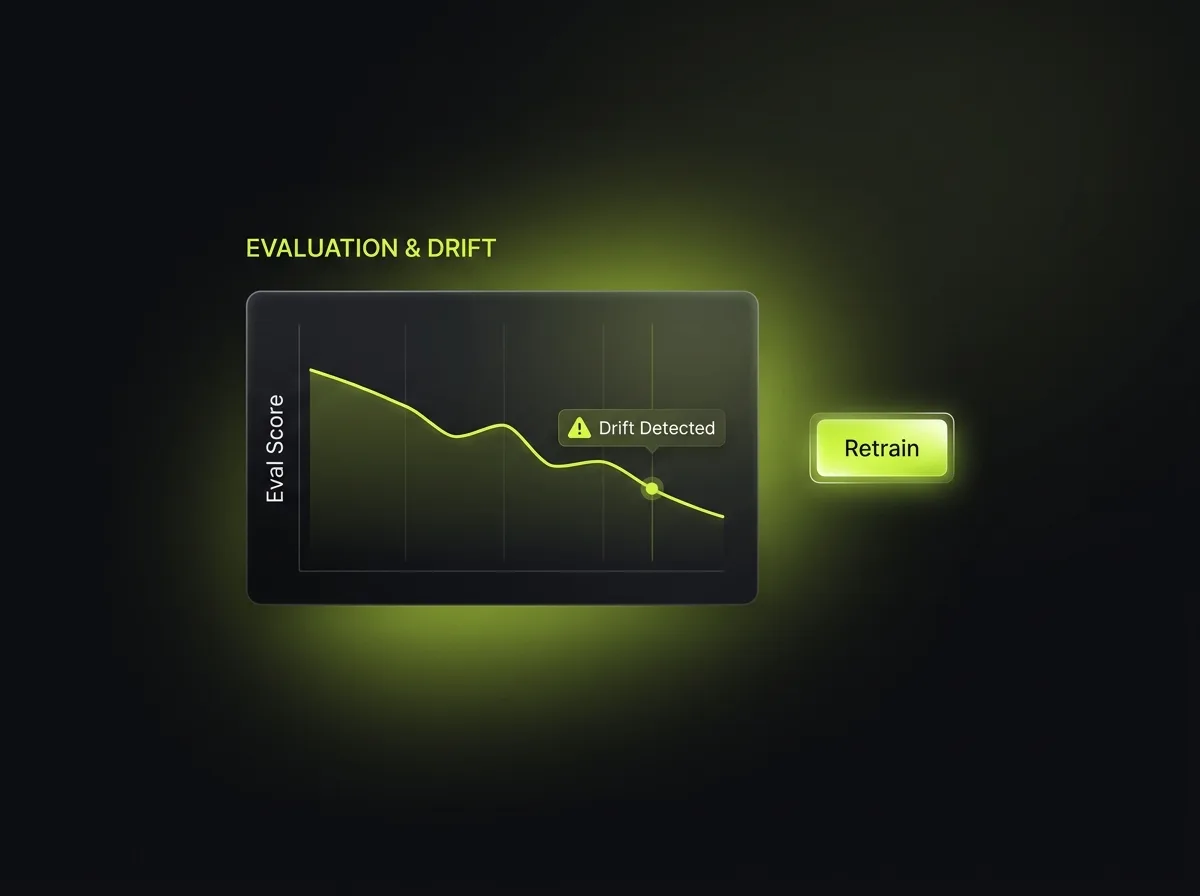
The threat to watch is drift. The world changes, your products and policies change, and the base models you build on are updated by their vendors, so a model that scored well at launch can quietly degrade. We re-run the evaluation suite on a schedule and whenever an underlying model changes, watch production logs for low-confidence and failed cases, and retrain or refresh retrieval when scores slip. Guardrails stay in place throughout to catch unsafe or off-scope outputs. This is the same maintenance loop we wrap around any custom tool, including those in our custom AI tool development, so the model keeps earning its place rather than slowly rotting in production.

LLM evaluation dashboard tracking benchmark scores over time and flagging model drift that triggers retraining

How Much Data Fine-Tuning Needs

Do we have enough data is the question that decides whether fine-tuning is even on the table, and the realistic answer surprises people: less than they fear, but cleaner than they have. For shaping tone, format or a narrow task, a few hundred high-quality, representative examples often move the needle, and a few thousand is plenty for most business tasks. You are not training a model from scratch, you are nudging an already-capable one, so the goal is a focused, consistent dataset rather than a giant noisy one. Many clients already have the raw material sitting in their support tickets, past documents, approved responses and historical decisions; the work is curating and labelling it, not gathering it from nothing.

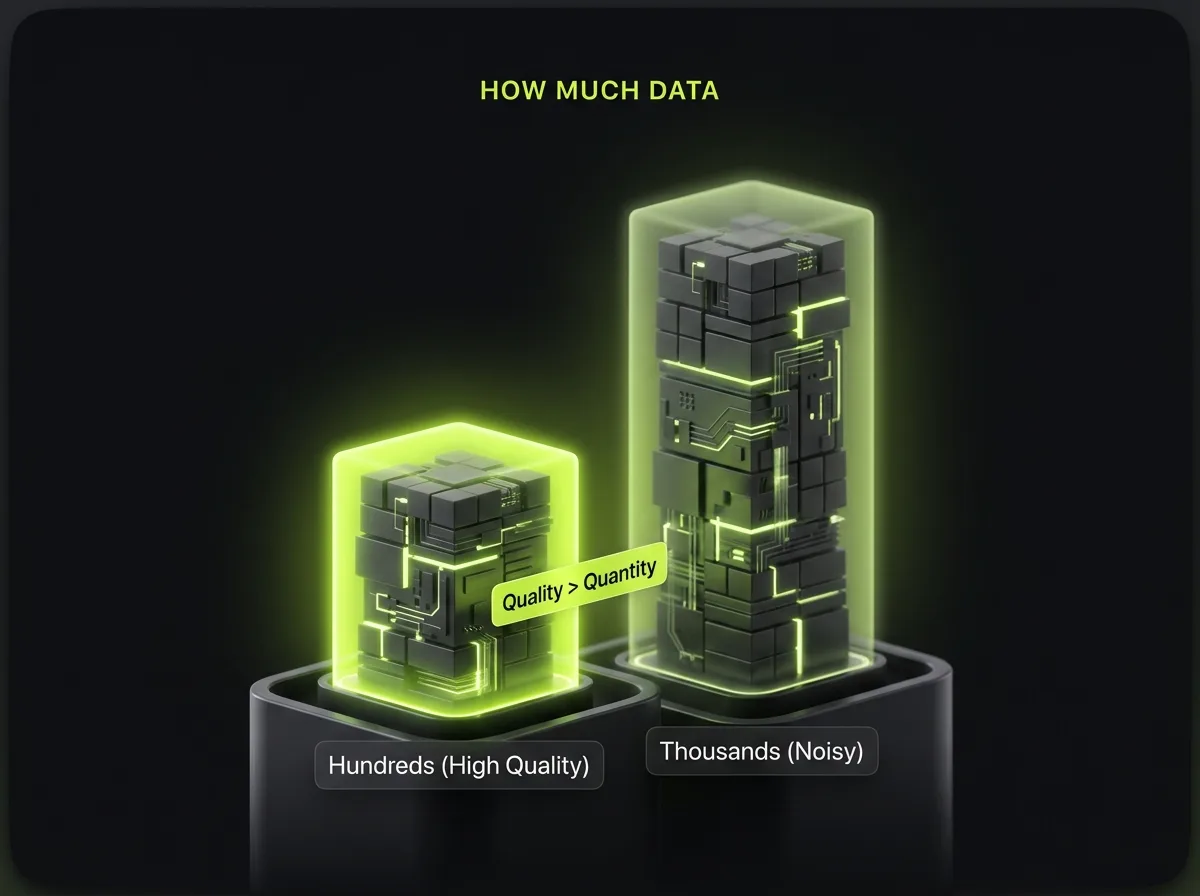
Quality dominates quantity because the model learns whatever is in the data, including contradictions and errors, so a hundred carefully reviewed examples beat a thousand inconsistent ones. Where you are short, there are honest ways to extend a dataset, careful augmentation and synthetic examples generated and then human-checked, but we are cautious here, because synthetic data that nobody verifies just teaches the model to imitate its own guesses. If after the audit there genuinely is not enough usable data, we say so and steer you to retrieval and prompting instead, which need almost no training data. That build-versus-fine-tune call is one we make openly across our AI development services.

Data volume bands for fine-tuning: a few hundred high-quality examples versus thousands, with quality outweighing quantity
Blog

Why Choose Us?

We combine deep AI expertise with real-world business insight to create language models that don’t just work, they work for you. Our fine-tuning process is rooted in understanding your data, industry, and goals, allowing us to build models that perform with precision and align seamlessly with your brand.

We don’t believe in one-size-fits-all AI; we believe in solutions that evolve with your needs. From secure data handling to post-deployment support, we ensure your custom LLM delivers consistent, accurate, and context-aware results that drive real business impact.

Frequently Asked Questions

Pre-trained LLMs offer general language understanding, while fine-tuning customizes the model on your domain-specific data—making it more accurate, relevant, and aligned with your use case.

You can use chat logs, knowledge base articles, product documentation, customer interactions, or any text data that reflects the language and knowledge specific to your business.

Data security is a top priority. We use encrypted environments, access control, and can work under NDAs to ensure your data stays private and protected throughout the process.

Yes. We support deployment on your cloud provider, on-premises servers, or via secure APIs—depending on your infrastructure and compliance needs.

Usually retrieval is enough. The rule we follow is that if the problem is the model does not know your facts, that is a retrieval-augmented generation (RAG) problem, because facts belong in retrieval where you can update them instantly, not baked into model weights you would have to retrain. Fine-tuning is the right tool when the problem is behaviour: a consistent format, tone or style you cannot get reliably from prompting, or compressing a task onto a smaller, cheaper model. We start with prompting, then RAG, and only fine-tune with a measured reason.

Less than most people fear, but cleaner. You are not training a model from scratch, you are nudging an already-capable one, so a few hundred high-quality, representative examples often move the needle and a few thousand is plenty for most business tasks. Quality dominates quantity, because the model learns whatever is in the data, including its mistakes, so a hundred carefully reviewed examples beat a thousand inconsistent ones.

Yes. When data cannot leave your environment for regulatory or contractual reasons, we deploy an open-weight model such as Llama or Mistral inside your own cloud account or on-premise, so prompts and proprietary data never travel to a third-party API. You trade some raw capability against the largest hosted models for full control over where data lives and who can see it.

We build a representative evaluation set, score the model against it before launch, and re-run that scoring on a schedule and whenever an underlying model is updated, so quality drift is caught early rather than discovered by a user. We watch production logs for low-confidence and failed cases, and retrain or refresh retrieval when scores slip, with guardrails in place throughout.

Most popular services

SX0 service icon — DigiRocket

SX0

Great rankings mean nothing without great user experience. Our SXO approach delivers both traffic and performance.

Performance Marketing service icon — DigiRocket

Performance Marketing

Results you can measure. We run data-driven campaigns that convert clicks into revenue across every platform.

Dropshipping service icon — DigiRocket

Dropshipping

From product research to fulfillment, our data-backed approach turns dropshipping into a real business.