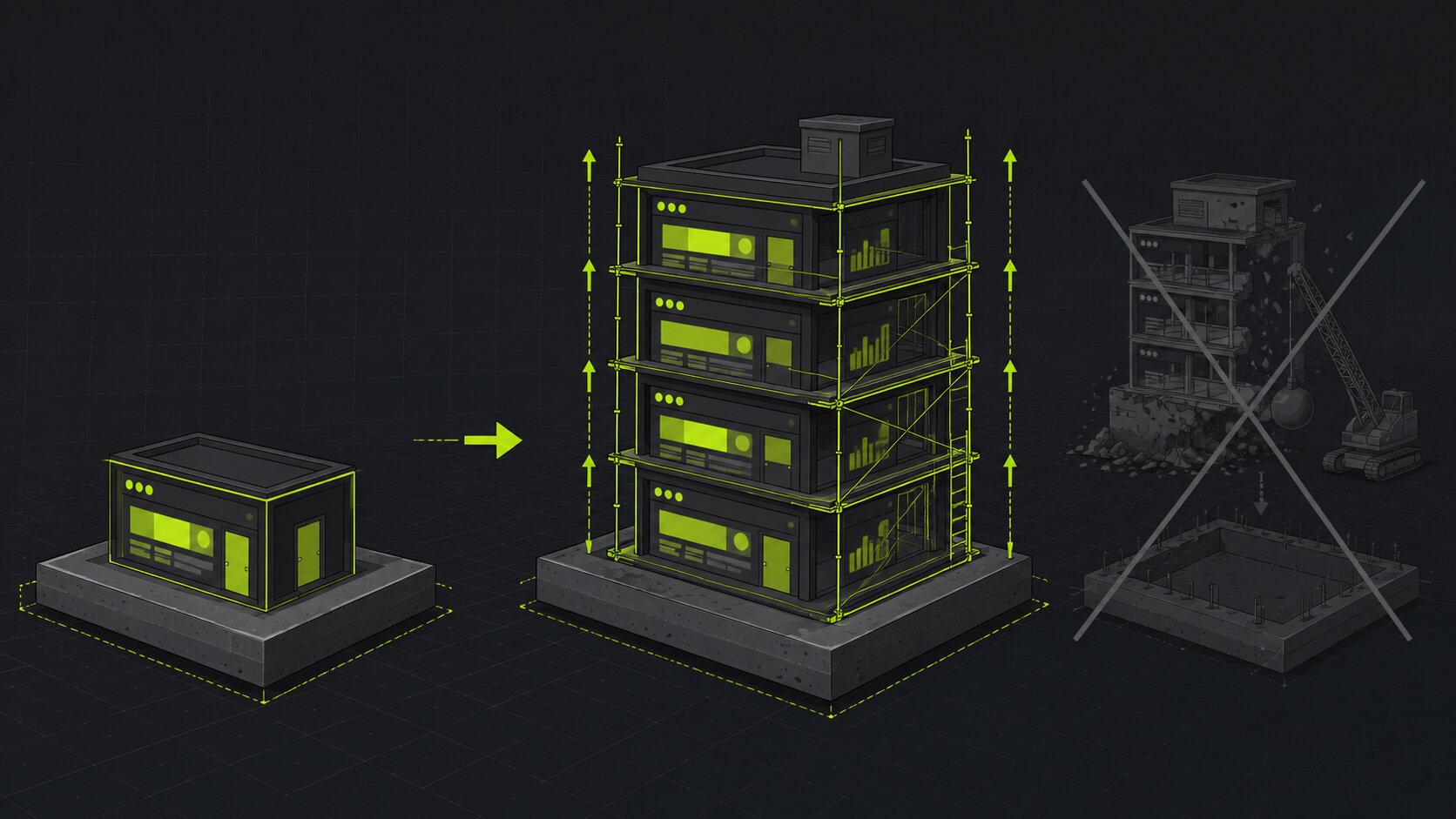
There is a moment that arrives in a lot of successful web applications, usually a year or two in, when the team concludes that the only way forward is to rebuild. Growth exposed something in the foundations that cannot be patched, and the choice becomes months of rewriting instead of months of building. It is one of the most expensive things that can happen to a software product, and it is almost always the delayed bill for decisions made in the first few weeks.
The frustrating part is that it is usually avoidable, and not by over-engineering. The apps that grow for years without a rewrite are rarely the ones that built for imaginary scale on day one. They are the ones that stayed small in scope while being deliberate about a handful of foundational choices that are genuinely hard to reverse. Knowing which choices those are is most of the skill.
Small is fine, fragile is not
An MVP is supposed to be small. That is the point: do less, ship sooner, learn from real users. The mistake is confusing a small scope with a flimsy foundation. Doing fewer things is a scoping decision and costs you nothing later. Doing those few things on top of a structure that cannot bend is a different decision entirely, and it is the one that comes back as a rebuild.
The useful mental model is that your MVP should be a small building on solid ground, not a temporary shed. You are not trying to construct the whole thing up front. You are trying to make sure that when you add the next floor, you are not tearing out the foundations to do it.
The decisions that are expensive to reverse
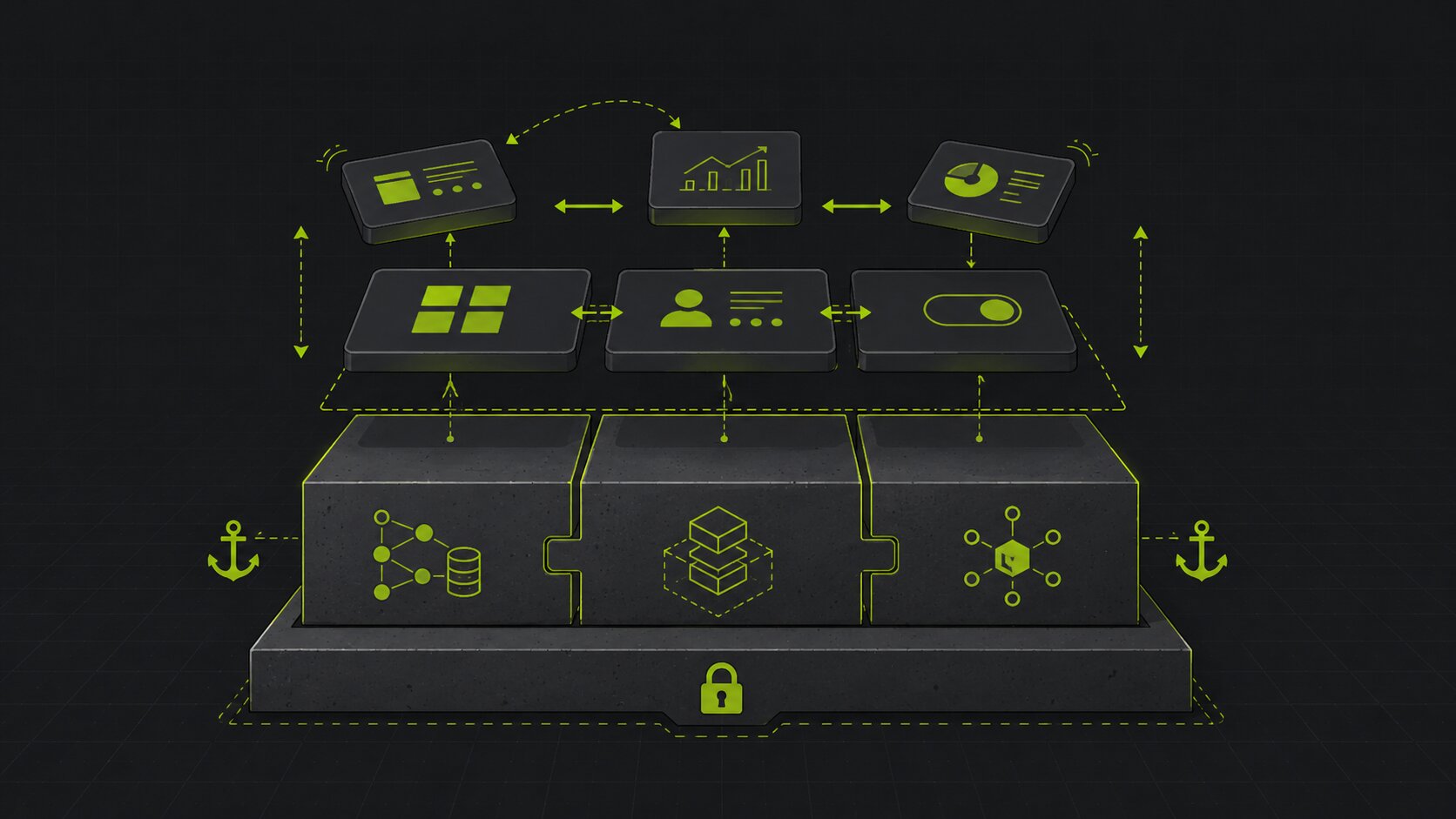
Only a few decisions genuinely deserve deep thought at MVP stage, and the first is your data model. How you represent the core things in your system shapes everything built on top of it, and once real customer data exists in that shape, changing it means migrating live data while the product runs. It is the single most expensive thing to get wrong.
Close behind are how the application is structured and how tightly its parts depend on one another. Code that is tangled together resists change everywhere at once, while code with clear boundaries lets you replace one piece without disturbing the rest. Add to that the core technology choices and anything touching authentication, permissions, or how customer data is kept separate, and you have essentially the full list of things worth being careful about early.
What you can safely defer
Almost everything else can wait, and deferring it is not sloppiness but good judgement. You do not need microservices, elaborate caching layers, multi-region infrastructure, or an architecture built for millions of users before you have a hundred. Those choices add cost and complexity immediately in exchange for benefits you may never need, and they slow down the learning that actually decides whether the product survives.
Features are cheap to change, and so is most infrastructure once boundaries are clean. Build the simplest thing that works, keep the seams tidy, and add complexity when a real constraint demands it rather than when you imagine it might. Premature scaling has killed more startups than slow servers.
Technical debt: the useful kind and the fatal kind
Not all technical debt is a problem. Deliberately taking a shortcut to ship and learn faster is often the right call, in the same way borrowing money can be sensible if you know the terms. The debt becomes dangerous when it is taken unknowingly, sits in the foundations, and compounds quietly until it blocks something you urgently need to do.
The practical distinction is where the shortcut lives. A rough implementation of a feature can be cleaned up later with contained effort. A rushed data model or a tangle of dependencies at the core spreads its cost through everything you build afterwards. Take debt in the features, be disciplined in the foundations, and keep track of what you owe.
Build for the next order of magnitude
A useful rule for how far ahead to build: aim to comfortably handle roughly ten times your current scale, not a thousand times. If you have a hundred users, the app should not fall over at a thousand. Whether it can serve a million is a problem worth solving when you are considerably closer to it, with the benefit of knowing how the product is actually used.
This keeps you honest in both directions. It stops you building an elaborate distributed system for traffic that does not exist, and it stops you shipping something that collapses the moment it succeeds a little. As you approach each new order of magnitude, you revisit, and because the foundations were kept clean, revisiting is an upgrade rather than a rewrite.
Signs you are heading for a rebuild
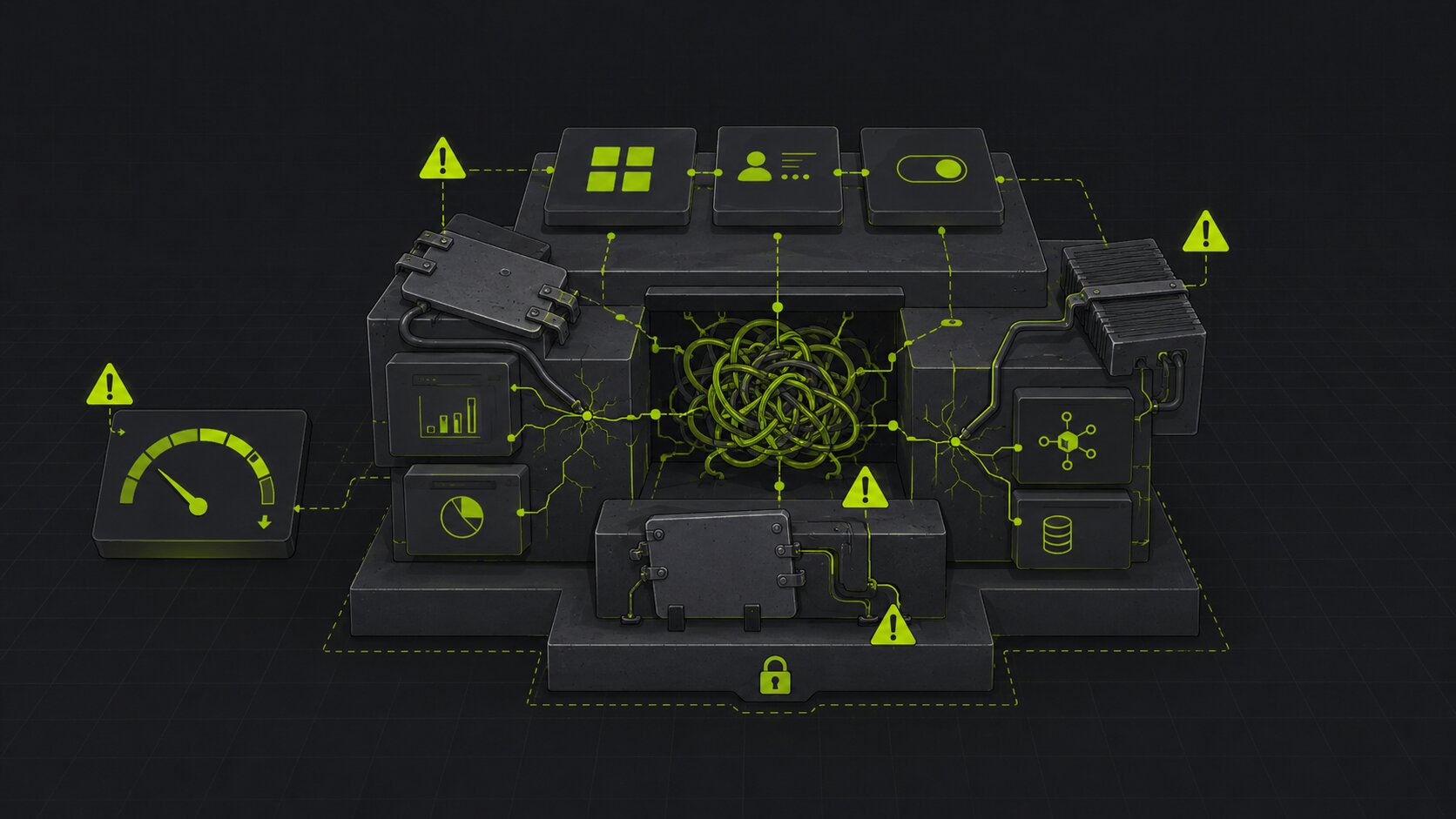
The warning signs are usually visible long before anyone says the word rewrite. Simple changes start taking far longer than they should. Touching one part of the system breaks something unrelated. The team begins routing around the core rather than working with it, and new features arrive as workarounds bolted to the side. Onboarding a developer takes weeks because nothing is where it should be.
Caught early, these are fixable: you can refactor the worst boundaries, clean up the data model before it hardens further, and pay down the debt that matters. Ignored, they compound into the point where a rewrite genuinely is cheaper than continuing. Watching for them is part of the job in web application development, because the cheapest rebuild is always the one you saw coming and avoided.
How we approach it
We keep the first version small in scope and careful in its foundations. That means real thought about the data model, clear boundaries between parts of the system, and sensible technology choices, while deliberately deferring the infrastructure complexity that most products never need. Then we revisit as the app approaches each new level of scale, upgrading rather than rewriting.
That balance is what we bring across more than 500 brands in the US, UK, and Canada. As a global company with our headquarters in Delaware and teams in London and Gurugram, the aim is the same every time: a web application that ships quickly, learns fast, and keeps growing on the same foundations instead of hitting a wall and starting over.
Where this leaves you
Rebuilds are rarely caused by shipping a small first version. They are caused by a few foundational decisions, mostly the data model, the structure of the system, and how tightly its parts are coupled, made carelessly and never revisited. Keep the scope minimal, keep those foundations sound, defer the complexity you do not yet need, take technical debt knowingly and in the right places, and build for the next order of magnitude rather than an imaginary one. Do that and your MVP becomes the first version of a product that grows, not a prototype you eventually throw away. If you are planning a build or worried about the one you have, tell us where it is straining and we will tell you honestly whether it needs a refactor or a rethink.
Frequently Asked Questions
What is a web application MVP?
An MVP is the smallest version of your web application that genuinely solves the core problem and can go live. It exists to get a real, usable product in front of users quickly so you learn from actual use rather than assumptions. Being minimal is about scope, not quality: an MVP should do less than the full vision, but what it does should work properly and rest on foundations that can carry the product forward rather than needing to be thrown away.
Why do so many web apps need a rebuild?
Because early decisions that were convenient became impossible to live with. Usually it is not the small feature set that forces a rebuild but a handful of foundational choices, how the data is modelled, how the app is structured, how tightly everything is coupled, made for speed and never revisited. Those are the decisions that are expensive to reverse. Get them roughly right early and the app can grow for years; get them wrong and no amount of later effort saves you from starting over.
What architecture decisions are hardest to change later?
The ones everything else depends on. Your data model is the most expensive to change, because every part of the application and all your existing data are shaped by it. Close behind are how your application is structured and how tightly its parts are coupled, your core technology choices, and anything that touches authentication, permissions, or how customer data is separated. These deserve real thought at MVP stage. Almost everything else can be decided later without pain.
Is technical debt always bad?
No, and treating it as always bad slows teams down unnecessarily. Deliberate, well-understood shortcuts that let you ship and learn faster are a sensible trade, as long as you know you have taken them and can pay them back. The dangerous kind is debt taken unknowingly in the foundations, a rushed data model or a tangle of dependencies, because it compounds silently and is often only discovered when it blocks something important. Shortcuts in features are cheap; shortcuts in foundations are not.
How do you build a web app that scales?
Keep the scope small but the foundations sound. Think carefully about the few decisions that are expensive to reverse, mainly the data model, the structure of the application, and how tightly its parts depend on each other, and keep those clean. Defer everything else, including most infrastructure complexity, until you actually need it. Aim to comfortably handle the next order of magnitude of growth rather than the traffic you imagine having in five years, and revisit as you approach it.
Want this done for your brand?
Tell us where you are and what you are trying to grow. We will reply with a straight read on your situation and what is worth doing first. No obligation, no lock-in.