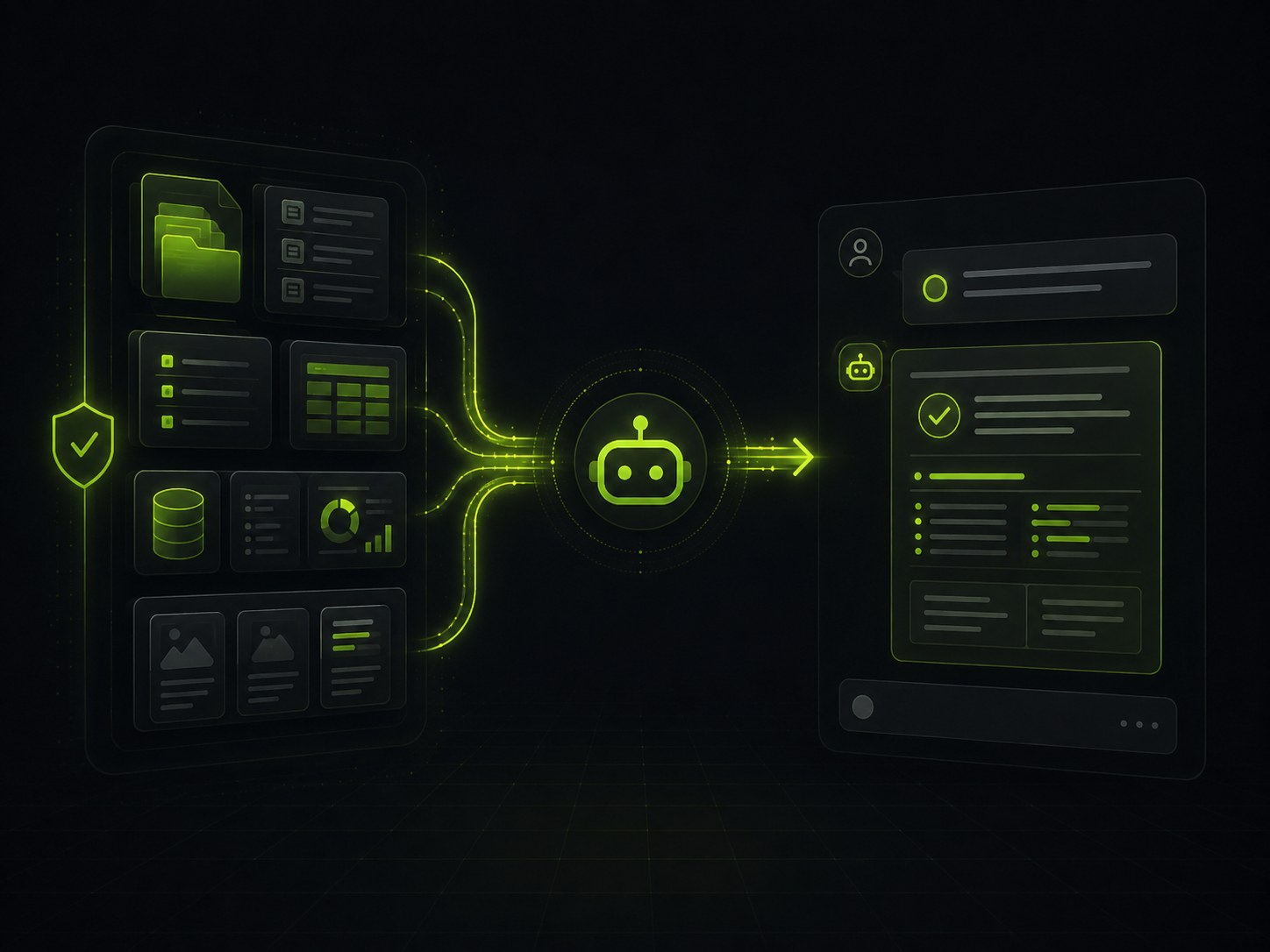
A modern AI model is remarkably capable and almost completely ignorant of your business. It can write, reason, and summarise at a high level, but it has never seen your product documentation, your policies, your support history, or the thousand internal details that make your company what it is. Ask it something specific to you and it will either admit it does not know or, worse, invent a confident answer.
That gap is exactly what a RAG system closes. Rather than hoping a general model somehow knows your business, or paying to train a custom one, you connect the model to your own information and let it look things up before it answers. The result is AI that speaks fluently and answers accurately about your specific world, which is where most of the practical value actually sits.
What a RAG system actually is
RAG stands for retrieval-augmented generation, which sounds technical but describes a simple idea. When a question comes in, the system first retrieves the most relevant pieces of your information, then hands them to the AI model to write an answer grounded in those facts. The model brings the language and reasoning; your documents bring the truth.
The important shift is that the knowledge lives outside the model, in your own content, not baked into its training. That means the model does not need to be taught your business at all. It simply needs to be given the right facts at the right moment, and RAG is the machinery that finds and delivers those facts for every question asked.
How retrieval-augmented generation works
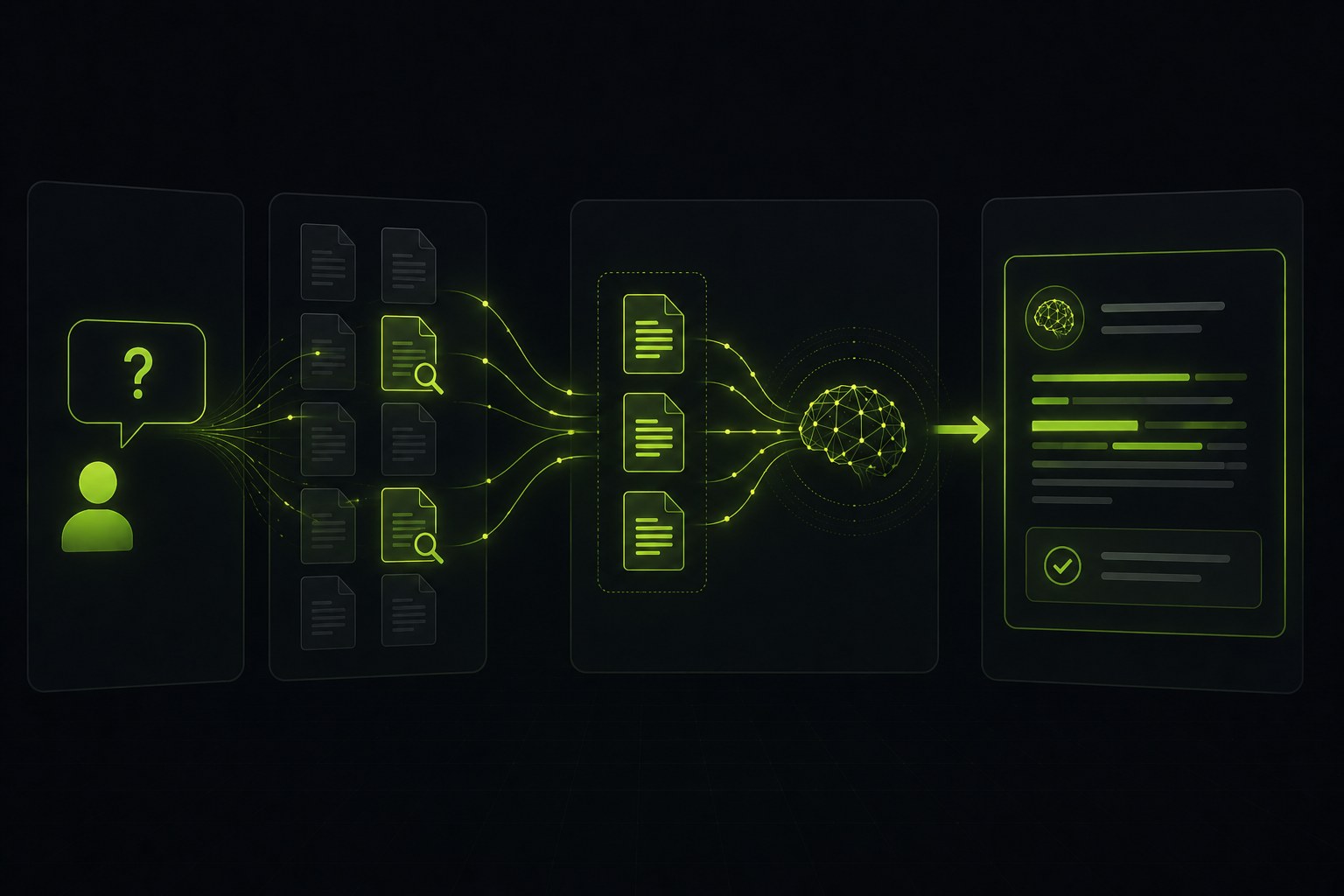
In practice it runs in three steps. First, retrieve: the system searches your knowledge for the passages most relevant to the question, by meaning rather than exact keywords, so it finds the right content even when the wording differs. Second, augment: those passages are added to the prompt as context. Third, generate: the model writes an answer using that context rather than its general memory.
The effect is an answer that is specific, current, and traceable to your own sources. Because the facts come from documents you control, you can point to where an answer came from, and when a document changes, the next answer reflects it. You get the fluency of a large model with the accuracy of your own records.
Why RAG beats fine-tuning for knowledge
The common alternative people reach for is fine-tuning, training the model further on company data. For teaching a model a style or a behaviour that has its place, but for knowledge it is usually the wrong tool. Fine-tuning is expensive, slow to redo, and bakes facts in at a point in time, so the moment a price or policy changes, the model is quietly out of date.
RAG sidesteps that. Because the knowledge lives in your documents rather than the model, updating an answer is as simple as updating the source: no retraining, no waiting, and no risk of a model confidently repeating something that stopped being true months ago. For anything that changes, which is most business knowledge, retrieval is the more honest choice.
Where RAG earns its keep
The strongest use cases share a shape: a lot of knowledge, and people who repeatedly need answers from it. Customer support is the obvious one, where an assistant grounded in your real documentation answers accurately instead of guessing. Internal knowledge is another, letting staff ask plain questions instead of hunting through folders, wikis, and old threads for a policy or a process.
Beyond those, any situation where correct, sourced answers matter more than creativity fits: product and technical questions, compliance and policy lookups, onboarding, and research across a large body of internal material. The common thread is that the value comes from being right about your specifics, which is what RAG is built to deliver.
Retrieval quality is everything
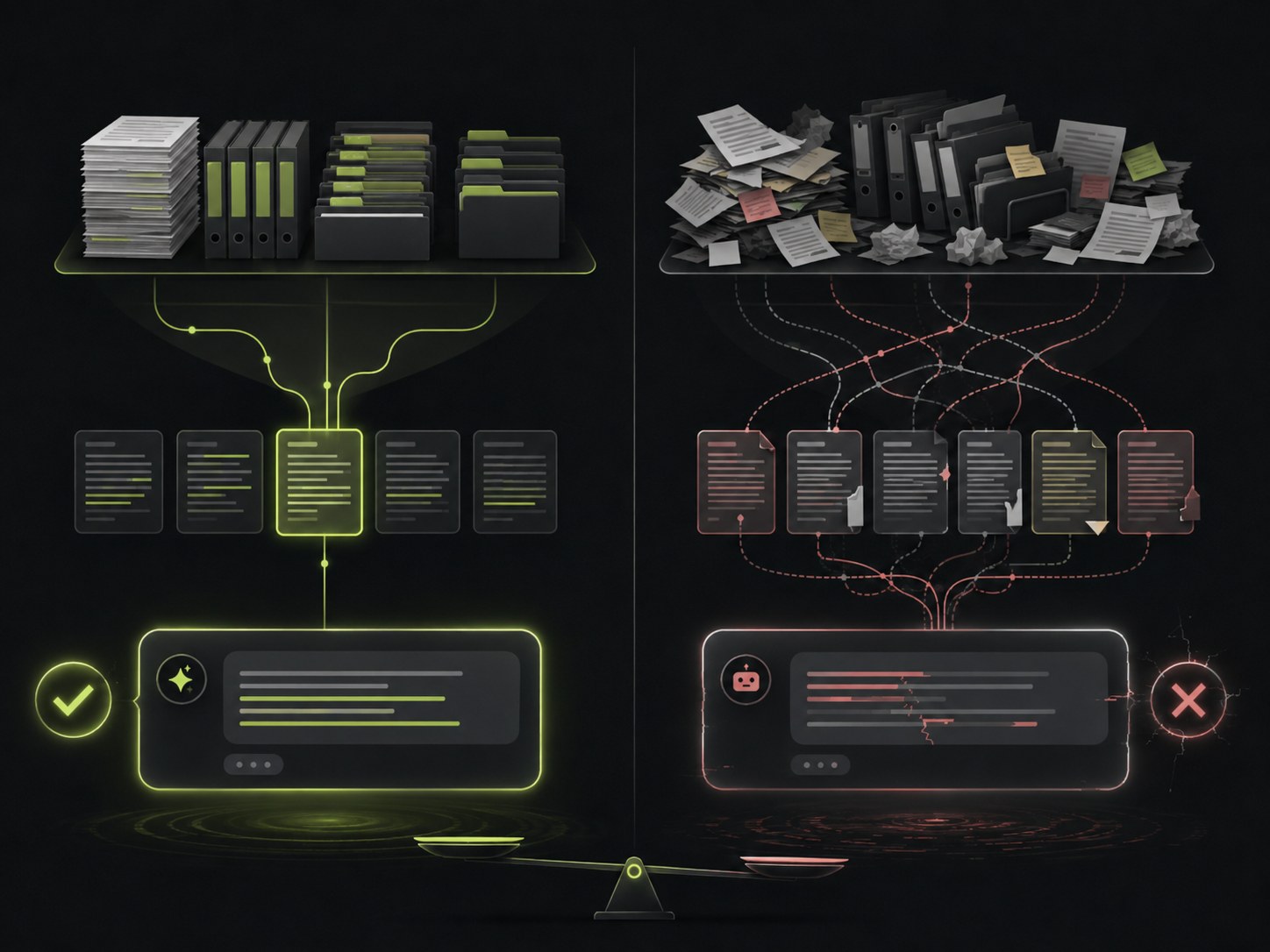
A RAG system is only ever as good as what it retrieves. If the right passage is found, the answer is usually excellent. If retrieval surfaces the wrong document, an outdated version, or nothing useful, the answer suffers no matter how capable the model is. Most of the difference between a RAG system that delights and one that disappoints is in the retrieval, not the model.
That is why the unglamorous work matters so much: organising your knowledge, removing contradictions and stale content, and structuring documents so the right parts can be found. The AI is the visible part, but the quality of the underlying knowledge and how findable it is quietly decides whether the whole thing works.
What RAG will not fix
It is worth being honest about the limits. RAG cannot invent knowledge you do not have; if the answer is not written down anywhere, retrieval has nothing to find. It cannot rescue a contradictory or badly maintained knowledge base, because it will faithfully retrieve the mess. And it is not a reason to skip good information hygiene, since the system amplifies whatever state your knowledge is in.
Understood properly, this is a feature, not a flaw. RAG rewards organisations that look after their knowledge and exposes those that do not, which pushes the useful work of tidying and maintaining information to the surface. The technology is powerful, but it works with your knowledge, not in place of it.
How we approach it
We start with your knowledge, not the model: what you have, where it lives, and what state it is in, because that decides everything downstream. Then we build the retrieval carefully, connect a suitable model, respect your existing access permissions and privacy needs, and test against the real questions people actually ask rather than tidy demos. That is the substance of our custom AI tool development work, where the goal is an accurate, trustworthy system rather than an impressive one that quietly gets things wrong.
That approach is what we bring across more than 500 brands in the US, UK, and Canada. As a global company with our headquarters in Delaware and teams in London and Gurugram, the aim is consistent: AI that genuinely knows your business because it is grounded in your own knowledge, rather than a clever model guessing about a company it has never seen.
Where this leaves you
A RAG system is how you turn a general model into one that actually knows your business, by connecting it to your own information and letting it retrieve the facts before it answers. Reach for it when you have real knowledge and people who need answers from it, prefer it to fine-tuning for anything that changes, and remember that the quality of your knowledge and its retrieval matters more than the model. Do that and you get AI that is accurate about your specifics and easy to keep current. If you want to know whether your knowledge is ready, tell us what you have and what you would want it to answer, and we will show you what is realistic.
Frequently Asked Questions
What is a RAG system?
RAG stands for retrieval-augmented generation. It is a way of connecting an AI model to your own information so that, before it answers, it retrieves the relevant facts from your documents and uses them to write the response. The model supplies the language and reasoning; your data supplies the facts. That combination lets a general model answer accurately about your specific business, using knowledge it was never trained on, without you building a model of your own.
How is RAG different from fine-tuning?
Fine-tuning changes the model itself by training it further on your data, which is expensive, slow to update, and better at teaching style or behaviour than facts. RAG leaves the model alone and instead looks up your information at the moment of answering. For knowledge that changes, a policy, a price, a product detail, RAG is usually the better fit: you update the underlying documents and the answers update with them. Fine-tuning and RAG solve different problems and are often used together.
Do you need RAG, or just a model with a big context window?
Large context windows help, but they do not replace RAG once your knowledge is sizeable. Pasting everything into every prompt is slow, costly, and eventually hits a limit, and the model can lose track of what matters in a wall of text. RAG retrieves only the handful of relevant passages for each question, which is faster, cheaper, and usually more accurate. The bigger and more varied your knowledge, the more retrieval beats simply stuffing the context.
What kind of data works best in a RAG system?
Clear, well-organised, up-to-date text works best: documentation, policies, product information, support articles, and structured records. The cleaner and better-maintained the source, the better the answers, because RAG can only retrieve what actually exists and is findable. Messy, contradictory, or outdated documents produce messy, contradictory answers. Often the most valuable early work is not the AI at all but tidying and organising the knowledge so that retrieval has something good to find.
Is our company data safe in a RAG system?
It can be, and safety is a design decision rather than an afterthought. A properly built RAG system keeps your documents in your control, respects existing access permissions so people only retrieve what they are allowed to see, and uses models and infrastructure chosen with your privacy requirements in mind. The risks come from careless implementation, not from the approach itself. Handled seriously, RAG lets you put sensitive internal knowledge to work without giving up control of it.
Want this done for your brand?
Tell us where you are and what you are trying to grow. We will reply with a straight read on your situation and what is worth doing first. No obligation, no lock-in.