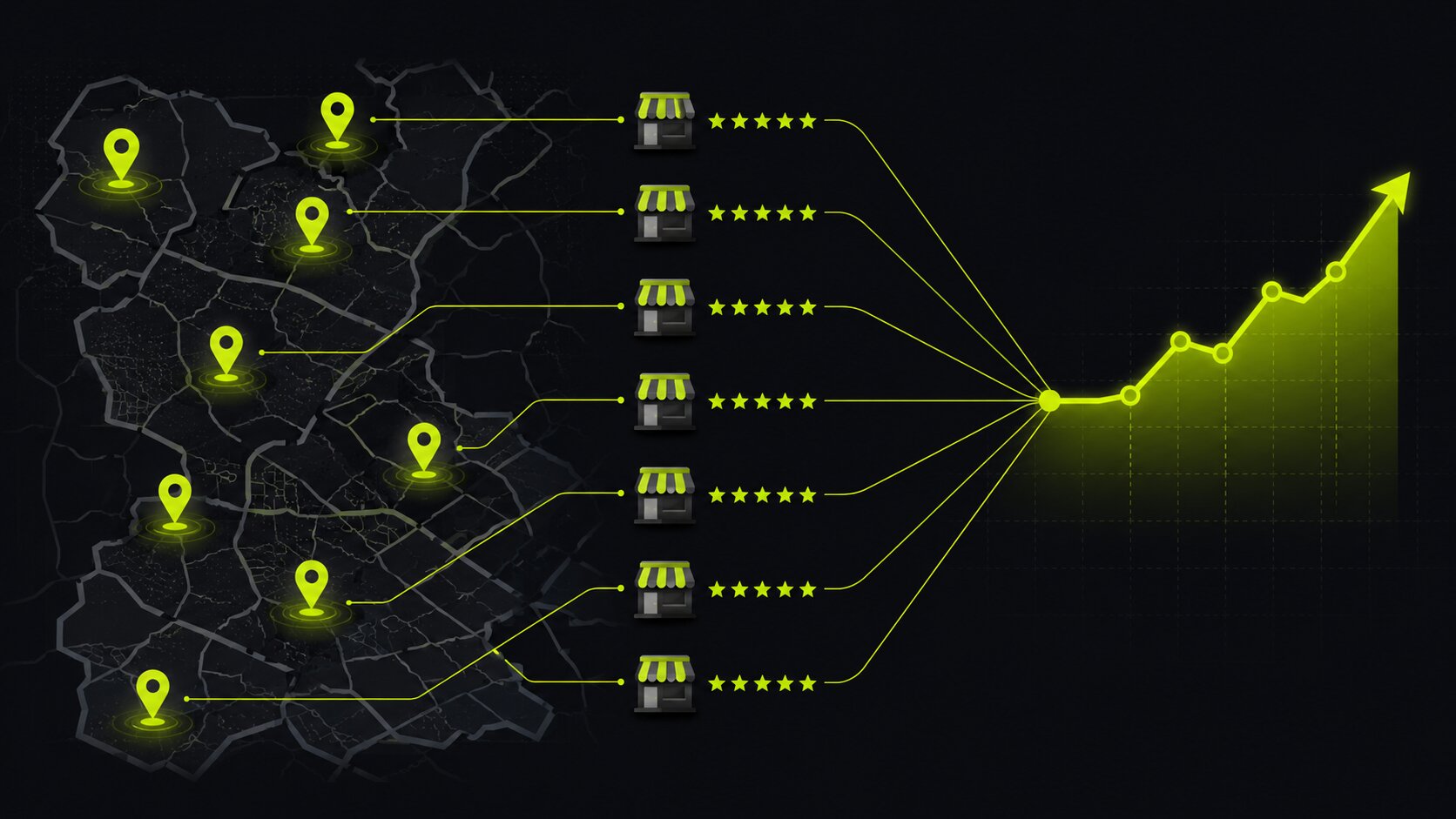
A brand can be a household name and still lose the customer standing two streets from one of its shops. National awareness does not automatically translate into showing up when someone nearby searches for what you sell and picks one of the three businesses Google drops at the top of the map. For a company with one location, winning that moment is a focused job. For a company with twenty, or two hundred, it becomes a very different kind of problem.
Multi-location local SEO is where a lot of otherwise strong brands quietly leak revenue. Each branch competes in its own market, against its own nearby rivals, judged on its own signals. Get it wrong and you can be dominant in one city and effectively missing in the next, without ever seeing why on a national dashboard.
Why multi-location local SEO is harder than it looks
The instinct is to treat local SEO as one campaign run from head office. The reality is that search evaluates each location more or less on its own. Your branch in one town has a separate listing, separate reviews, separate competitors, and a separate verdict on whether it deserves to appear when someone nearby searches. The brand's overall strength helps, but it does not carry a weak branch across the line.
That is what makes scale the real challenge. Doing local SEO well for one shop is a known set of tasks; doing it consistently for dozens of locations, each needing accurate details, its own page, and its own stream of reviews, is an operations problem as much as a marketing one. The work is not complicated so much as relentless, and the brands that win run it as a disciplined system rather than a one-off push.
The map pack is the prize and the battleground

When someone searches for a service near them, the block of three businesses on the map is what most people look at first. Those three spots capture the bulk of the clicks and calls, and everything below them fights for the remainder. Google decides the pack on relevance, distance, and prominence. You cannot move your branch, but you can strengthen relevance and prominence through a complete profile, accurate information, and genuine local reputation. For a multi-location brand the catch is that this contest runs separately in every market, so a place in the pack has to be earned location by location rather than declared once for the brand.
Google Business Profiles at scale
The Google Business Profile is the single most important asset in local SEO, and for a multi-location brand it multiplies into one of the biggest operational risks. Every branch needs its own profile, complete and correct: the right address, phone number, hours, categories, and photos, kept current as things change. A profile that is half-filled or out of date is a branch handing visibility to a competitor.
At scale the danger is inconsistency. A wrong phone number on one listing, mismatched hours on another, or duplicate profiles for the same branch all send confusing signals that can suppress a location. Keeping the details accurate and identical wherever they appear, across every profile and directory, is unglamorous work that quietly decides how many of your branches actually show up.
Local landing pages that actually rank
Each location also needs a page on your own site, and the temptation is to mass-produce them from a template with only the town name changed. Those thin, near-duplicate pages tend to rank poorly and can weigh down the wider site. A location page earns its keep when it reflects the real branch: its address and hours, the services it offers there, the areas it serves, local photos, and anything a nearby customer would genuinely find useful. The goal is a page that would be useful even if search did not exist, because that is the same page search rewards.
Reviews and reputation across locations
Reviews are both a ranking signal and a deciding factor for the human choosing between three options on the map. A branch with recent, genuine, well-handled reviews looks alive and trustworthy. One with a handful of old reviews, or unanswered complaints, loses the click even when it ranks. For a multi-location brand, reputation has to be cultivated at every location rather than centrally, because customers and search both judge the branch, not the logo. That means a steady, honest way of earning reviews from real customers at each site and actually responding to them, including the critical ones, which is one of the clearest separators between branches that dominate their market and those that blend into the background.
Measuring local SEO by revenue, not rankings

It is easy to get lost admiring rankings, but a position on a map is only a means to an end. The outcomes that pay the bills are the calls, direction requests, store visits, and enquiries each location generates. A branch that climbs the rankings but produces no extra calls has not moved the business, and that gap usually means the profile, page, or reviews are not converting visibility into action.
For a multi-location brand the right view is per location and bottom-line: which branches are generating local enquiries, which are visible but not converting, and which are still invisible in their market. That is the lens behind our approach to local SEO, because a national rankings report can look healthy while specific branches quietly underperform. Tie the work to enquiries and revenue per location and you can see exactly where attention will pay back.
How we approach multi-location local SEO
We treat it as a system, not a one-time cleanup: get every Google Business Profile complete and consistent, build location pages that genuinely serve their areas, establish a dependable way to earn and respond to reviews at each branch, and measure each location by the enquiries it produces rather than by rankings alone. The point is to make every branch carry its own weight in its own market.
That discipline is what we bring across more than 500 brands in the US, UK, and Canada. As a global company with our headquarters in Delaware and teams in London and Gurugram, the aim is consistent everywhere: turn local visibility into real enquiries, location by location, so the brand is strong on the map exactly where its customers are searching.
Where this leaves you
For a multi-location brand, local SEO is not one campaign but many, run as a single disciplined system. Each branch wins or loses its own map pack, on its own profile, page, and reviews, and the national brand cannot rescue a location whose local signals are weak. Get the profiles accurate, the pages genuinely local, the reviews flowing, and the measurement tied to enquiries per location, and you turn scattered visibility into dependable demand. If you would like to know where your locations actually stand, tell us where you operate and we will show you, branch by branch, where the money is being left on the table.
Frequently Asked Questions
What is local SEO for multi-location businesses?
It is the work of making every one of your locations findable in its own local search results, not just the brand as a whole. A multi-location brand has to win local visibility in every market it operates in at once: a Google Business Profile for each branch, location pages that rank in their own towns, and reviews managed across the whole estate. The brand can be famous nationally and still be invisible in a specific neighbourhood if that branch's local signals are weak.
How do I rank in the map pack for multiple locations?
Each location earns its place separately, so the work happens branch by branch. For every location you need a complete Google Business Profile, consistent name, address, and phone details everywhere they appear, a location page that genuinely serves that area, and a steady flow of real reviews. Relevance, distance, and prominence drive the map pack, judged per location. There is no single switch that lifts every branch at once, which is why doing this at scale is harder than it looks.
Do I need a separate Google Business Profile for each location?
Yes. Every physical location that serves customers needs its own profile, with its own address, phone number, hours, and photos. Trying to run several branches through one listing is one of the most common and most damaging mistakes in multi-location local SEO, because it confuses the systems deciding which branch to show for a given searcher. The challenge is managing many profiles consistently, since an error or an inconsistency on any one of them can quietly suppress that branch in local results.
Should each location have its own landing page?
Yes, and each page should earn its existence rather than being a template with the town name swapped in. A strong location page reflects the real branch: its address and hours, the services it offers, the area it serves, parking or access notes, local photos, and content that would actually help someone in that town. Thin, duplicated pages across dozens of locations tend to underperform and can drag the whole site down. Pages written for the place they represent are what rank and convert.
How long does local SEO take to work?
Some signals move sooner than others. Fixing an incomplete Google Business Profile can show results relatively quickly, while building the reviews and consistent presence that hold a top map position takes longer and compounds. Across many locations the picture is staggered, with some branches improving before others. Anyone promising a fixed date for top rankings is guessing, so the honest measure is steady progress in visibility and local enquiries rather than a countdown.
Want this done for your brand?
Tell us where you are and what you are trying to grow. We will reply with a straight read on your situation and what is worth doing first. No obligation, no lock-in.