
Most automation programmes fail in the same quiet way. Not because the technology did not work, but because the organisation picked the wrong thing to automate first. A big, visible, complicated process gets chosen for its impressiveness, takes a year to build, and by the time it launches nobody can prove it was worth doing. Meanwhile the dull, repetitive work that could have paid for itself in a quarter is still being done by hand.
Intelligent process automation is genuinely one of the most reliable investments a business can make, but only if you point it at the right processes. The technology question is largely solved. The remaining skill is knowing where the return is fastest, and having the discipline to start there rather than where the org chart or the executive enthusiasm suggests.
What makes it intelligent
Ordinary business process automation handles the parts of a workflow that can be written as rules. That covers a lot, and it leaves out the steps where someone has to read something, interpret it, or make a small judgement, which is precisely where the workflow used to stop and wait for a person.
Intelligent process automation closes that gap by adding AI to those steps: reading an unstructured document, extracting the right fields from an inconsistent form, deciding which of several paths applies. The significance is not the cleverness of any one step but that whole processes can now run end to end, instead of being automated in tidy fragments with human handoffs in between.
Where the payback is fastest
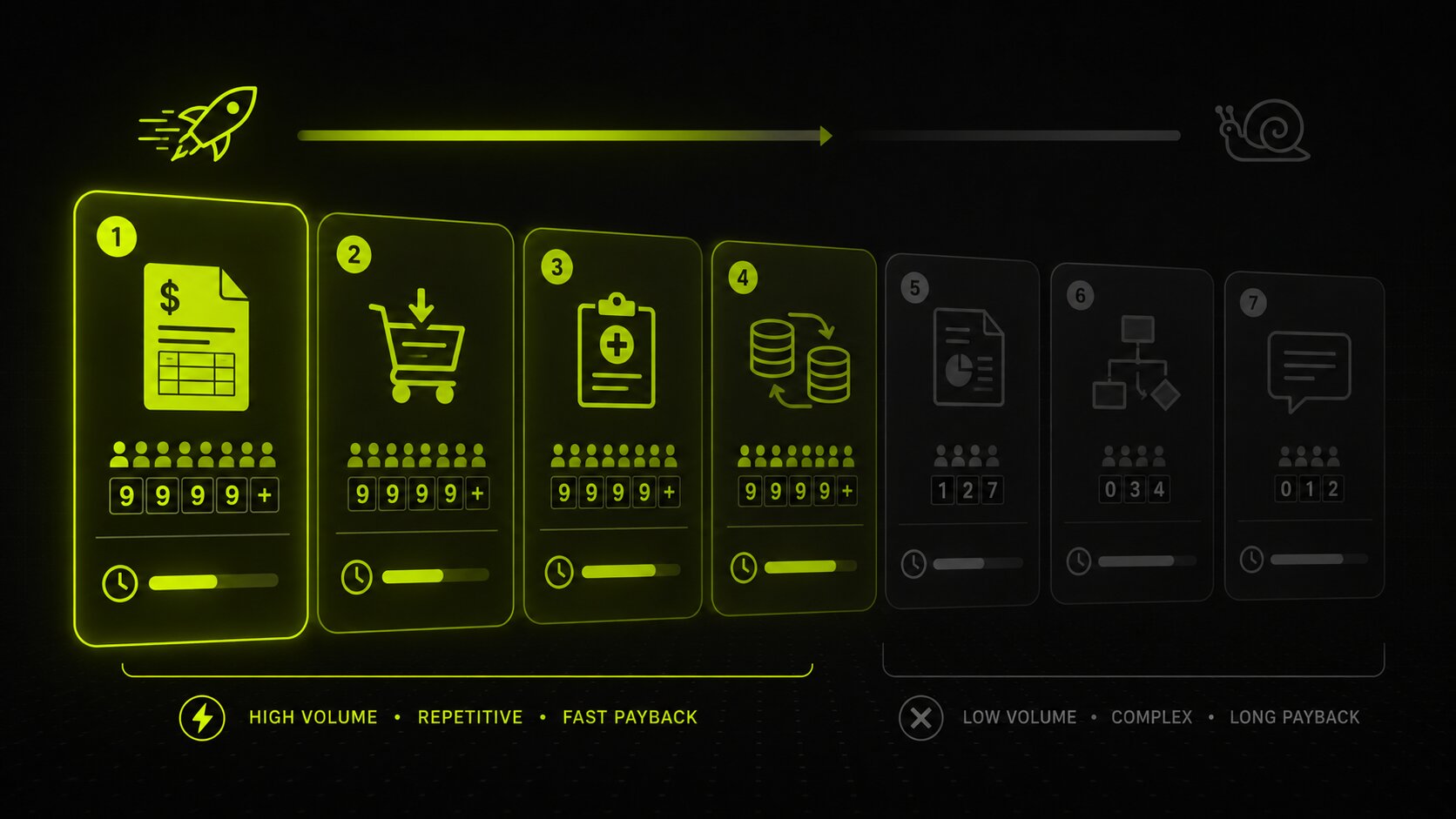
The processes that repay effort quickest share a profile: high volume, highly repetitive, currently manual, well understood, and mostly rule-based with only a little judgement in the middle. In most companies that describes the document-heavy back office, invoice processing, order entry, claims and application intake, and the endless transfer of data between systems that do not talk to each other.
These are unglamorous, which is exactly why they are underexploited. Nobody presents a slide about invoice handling, but the volume is enormous, the errors are costly, the rules are stable, and the work is deeply unpleasant for the people doing it. Automate one of these and the savings accrue every single day, which makes the business case obvious within months rather than years.
The arithmetic of a good candidate
The reason volume matters so much is that automation costs are mostly fixed while savings are per-execution. Building a workflow costs roughly the same whether it runs fifty times a month or fifty thousand, so the return is decided by how often it runs. A modest saving on a very frequent process beats a large saving on a rare one, almost every time.
Stability matters just as much. A process whose rules change constantly means rebuilding the automation as fast as you deploy it, and the maintenance quietly eats the return. The ideal candidate is boring and busy: it happens constantly, it works the same way it did last year, and everyone involved would be delighted never to do it manually again.
How to calculate the return honestly
The comparison is the fully loaded cost of the process today against what it costs once automated. Today's side is bigger than people assume: not just the hours, but the errors and the rework they cause, the delays while work sits in a queue, and the cost of capable people spending their week on mechanical tasks. The automated side is the build, the software, and, importantly, the ongoing maintenance.
Two inputs make this credible: hours spent per month and error rates, measured before and after. Both are countable, which keeps the business case out of the realm of estimates nobody believes. And counting the upkeep rather than only the build is what separates an honest projection from one that looks brilliant on the day it is presented and disappointing a year later.
What not to automate
Some processes are simply poor candidates, and recognising them early saves a great deal of money. Low-volume work rarely repays the build. Processes that change constantly turn into a maintenance treadmill. Work that genuinely depends on relationship, negotiation, or human accountability should stay human, and dressing it in automation tends to damage the thing that made it valuable.
There is also the trap of automating a broken process. If a workflow is convoluted because it grew by accident, automating it locks in the mess and makes it run faster. Fix or simplify the process first, then automate the version worth keeping. Automation is an amplifier, and it amplifies whatever it is pointed at.
Start narrow, then expand
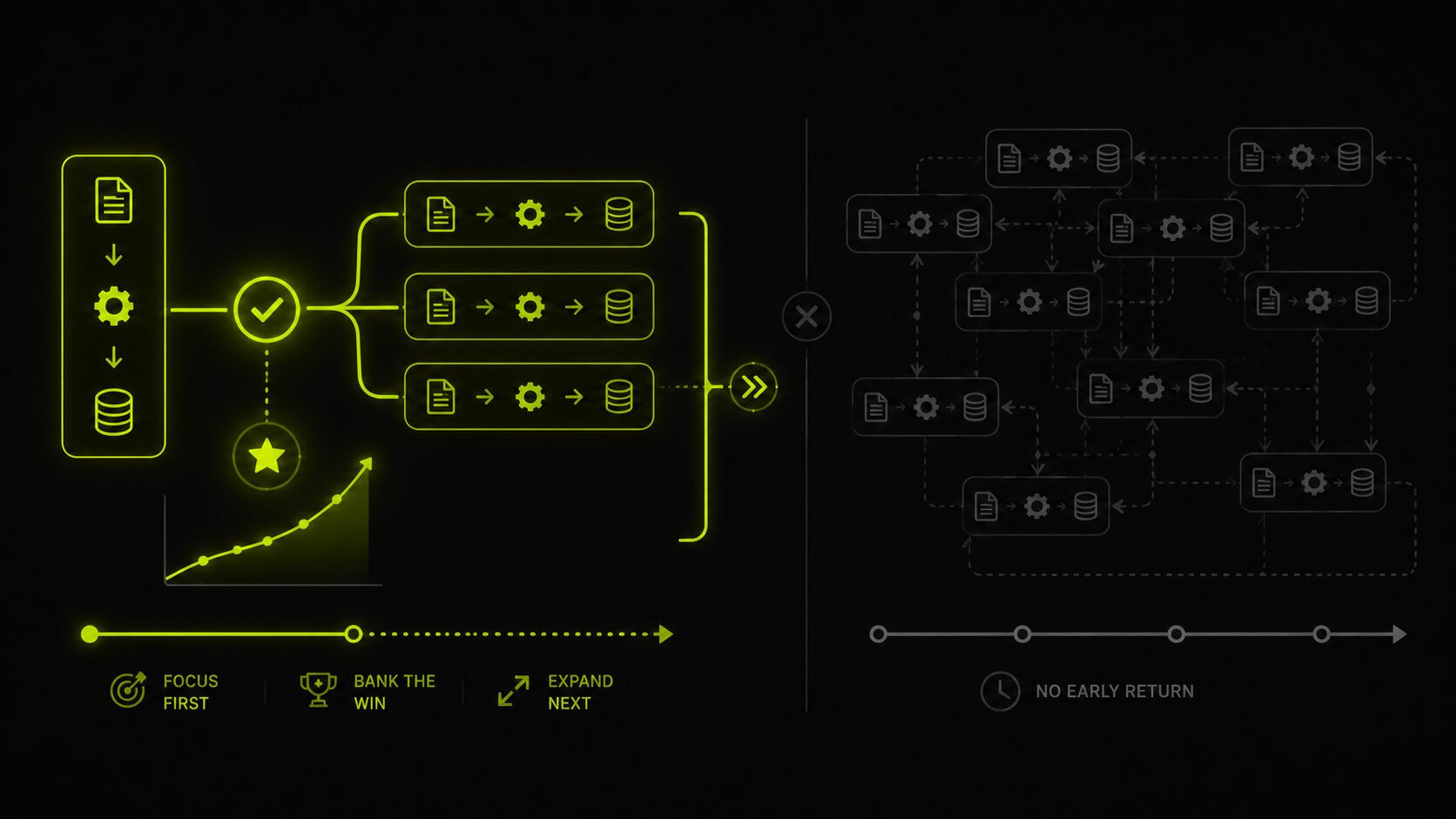
The most common structural mistake is scope. Committing to a sweeping transformation programme means nothing works until a great deal works, and the return arrives, if at all, long after patience has run out. Picking one well-defined, high-volume process and automating it properly produces a measurable result in months.
That first win does more than save money. It proves the approach, teaches the organisation how this work actually goes, builds trust with the people whose jobs it touches, and funds the next one. Expanding from a proven base is how automation programmes compound instead of stalling, and it is the sequence we follow in agentic process automation work: earn the return early, then widen.
How we approach it
We start by mapping where the volume and the manual effort actually sit, which is rarely where people assume. Then we pick the process with the clearest payback, simplify it if it needs simplifying, automate the rule-based steps conventionally and the judgement steps with AI, and measure hours and errors before and after so the return is provable. Only then do we expand.
That discipline is what we bring across more than 500 brands in the US, UK, and Canada. As a global company with our headquarters in Delaware and teams in London and Gurugram, the aim is the same every time: automation that pays for itself quickly and visibly, rather than a programme that consumes a year before anyone can say whether it worked.
Where this leaves you
Intelligent process automation pays back fastest on the work nobody wants to talk about: high-volume, repetitive, document-heavy back-office processes that are stable and currently manual. Judge candidates on frequency and stability, count the full cost of the process today including errors and delays, leave alone the low-volume and constantly changing work, fix broken processes before automating them, and start with one narrow win rather than a transformation programme. Do that and automation becomes a compounding investment with a business case you can actually prove. If you want to know where yours would pay back fastest, tell us how the work flows today and we will show you the shortest route to a return.
Frequently Asked Questions
What is intelligent process automation?
Intelligent process automation is business process automation with AI added to the parts that need judgement. Traditional automation handles the steps that can be described as rules; intelligent automation adds the ability to read unstructured documents, interpret messy inputs, and make decisions inside a workflow. The result is that whole processes can be automated end to end rather than the tidy portions only, which is where most of the remaining manual effort in a business actually sits.
Which processes should you automate first?
The ones that are high volume, repetitive, currently manual, and mostly rule-based with only a little judgement involved. Document-heavy back-office work such as invoice processing, order entry, claims intake, and data transfer between systems tends to top the list, because the volume is large, the work is well understood, and the errors are expensive. Start where the payback is quick and measurable rather than with the most impressive-sounding process, because early wins fund and justify everything after them.
How do you calculate ROI on process automation?
Compare the fully loaded cost of the process today with what it costs once automated. Today's cost includes the hours spent, the errors and rework, the delays, and the opportunity cost of skilled people doing mechanical work. The automated cost includes the build, the software, and the ongoing maintenance. The most reliable inputs are hours saved per month and error rates before and after, because they are measurable, and the honest calculation includes the upkeep rather than treating the build as the only cost.
What processes should not be automated?
Anything low volume, constantly changing, or dependent on judgement that is hard to specify. Automating a process that runs a few times a month rarely repays the effort, and automating one whose rules change every quarter means rebuilding it every quarter. Processes that genuinely require human relationship, negotiation, or accountability should also stay human. And a broken process should be fixed before it is automated, because automation makes a bad process faster, not better.
How long does it take to see returns from automation?
For well-chosen, high-volume back-office processes, returns usually show up quickly, often within the first few months of running, because the savings accrue every time the process executes. What delays payback is scope: an ambitious end-to-end programme takes far longer to deliver anything than a single well-defined workflow. This is the practical argument for starting narrow, banking the return, and expanding from there rather than committing to a long transformation before anything has proved itself.
Want this done for your brand?
Tell us where you are and what you are trying to grow. We will reply with a straight read on your situation and what is worth doing first. No obligation, no lock-in.