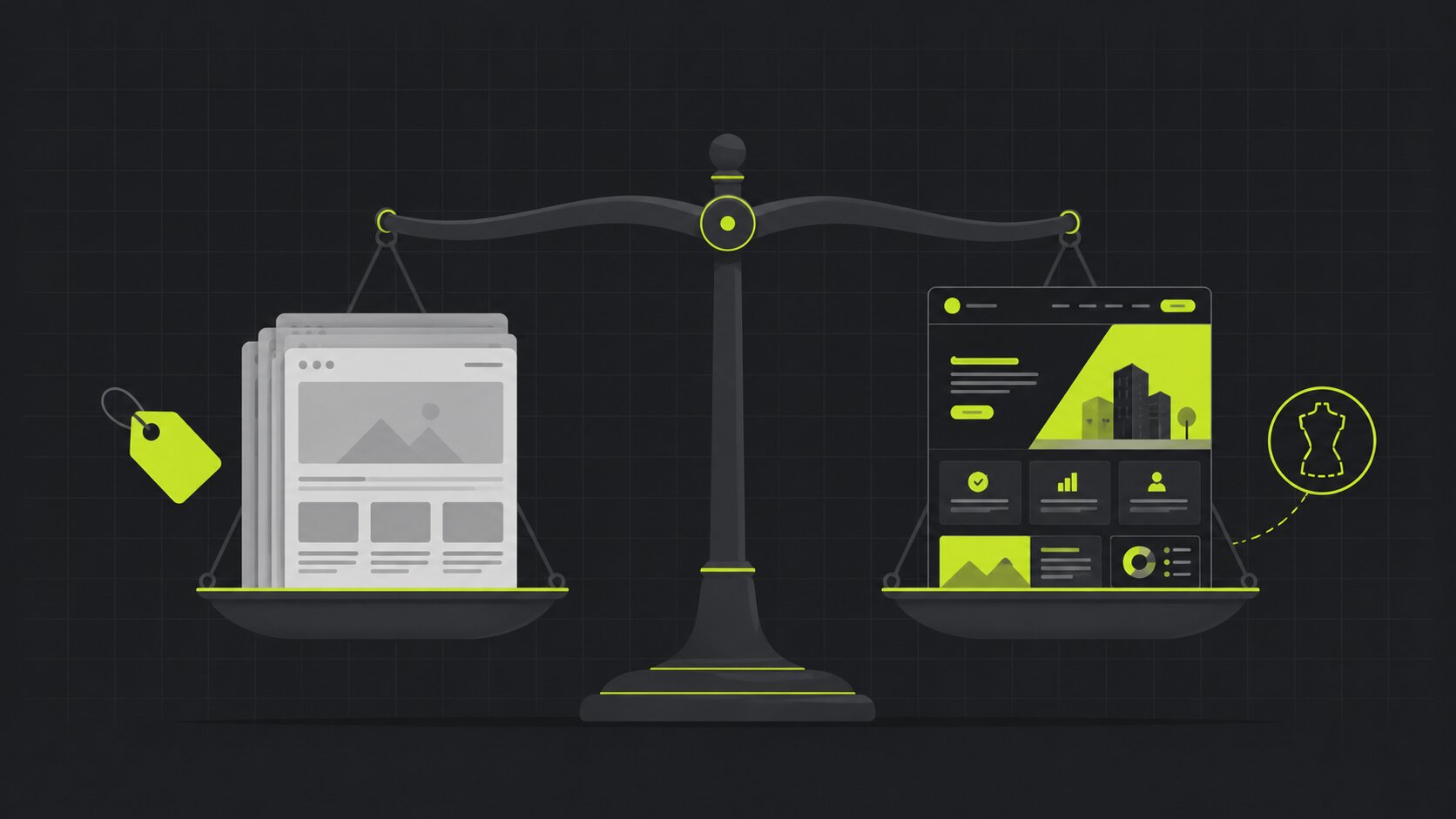
The template versus custom question usually gets framed as cheap against expensive, which is why so many businesses answer it badly. They pick the template because it is affordable, or the custom build because it feels serious, and neither decision has much to do with what their website actually needs to accomplish. The price difference is real, but it is the least interesting part of the comparison.
What you are really choosing between is speed and constraint on one side, and cost and control on the other. A template hands you a working site quickly, along with all the decisions someone else already made. Custom development hands you a site shaped entirely around your business, along with a bigger bill and a longer timeline. Both are correct answers for different situations, and knowing which situation you are in is the whole skill.
What a template actually gives you
Templates are genuinely good, and dismissing them is a mistake that costs businesses money. A well-made theme gives you a professional-looking site quickly and cheaply, built on patterns that are already proven to work. You are buying design decisions that someone competent has already made and tested, which is worth a great deal if your requirements are ordinary.
For a large share of businesses, that is completely sufficient. If your site's job is to present who you are, what you do, and how to get in touch, credibly and clearly, a good template does that job well. Paying for a custom build to achieve exactly the same outcome is spending money for the satisfaction of having spent it.
What custom actually gives you
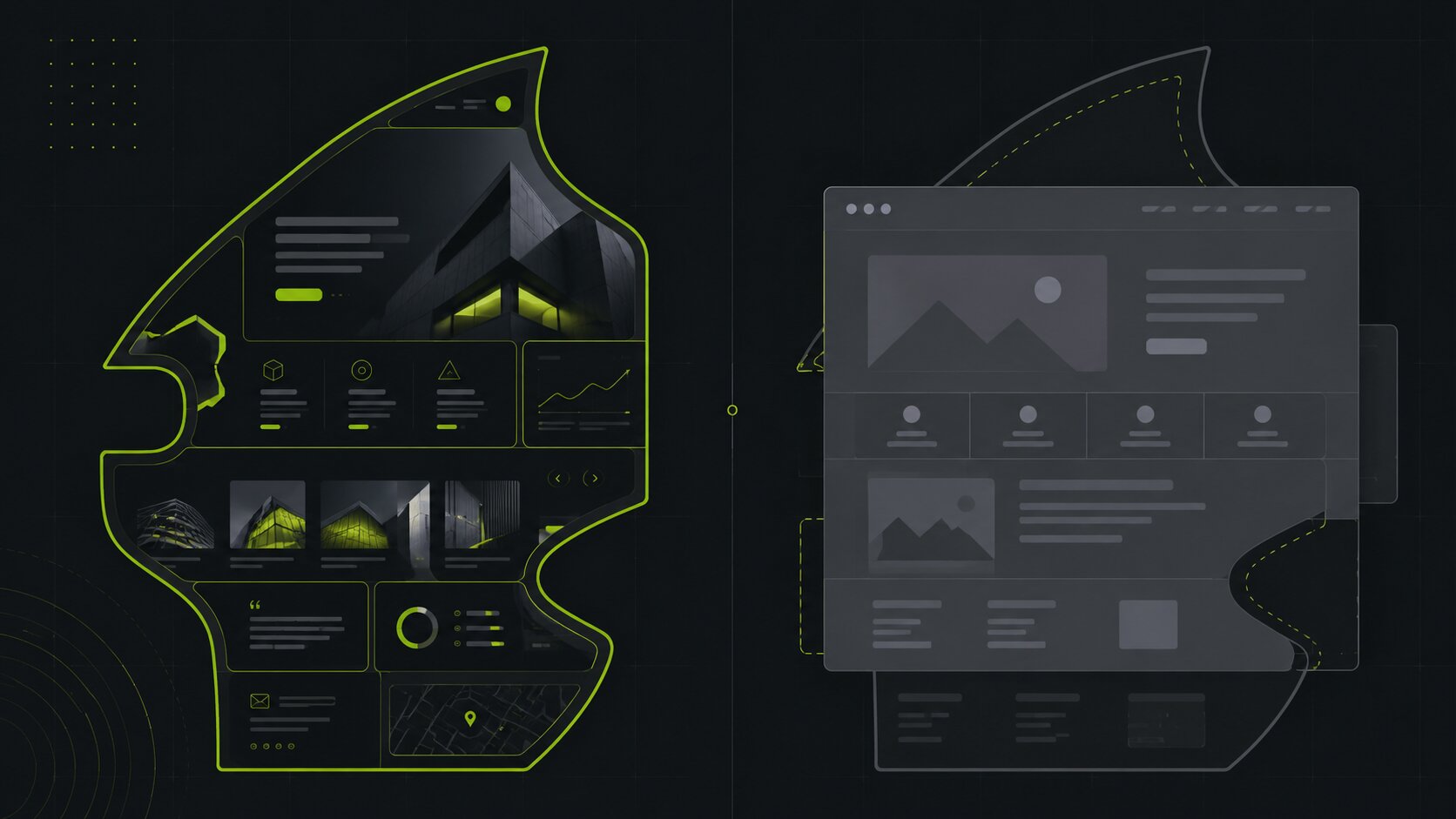
Custom development gives you a site with no inherited assumptions. The structure follows how your business actually works, the design expresses your brand rather than a theme's, and the functionality is whatever you need rather than whatever was included. Nothing is bolted on to compensate for a decision made by someone who had never heard of your company.
That control matters most when your website is doing real work: a distinctive experience that supports your brand, a specific customer journey, an integration into your systems, or performance that has been tuned rather than inherited. When a site is central to how you make money, being able to shape it precisely stops being a luxury and starts being the point.
The hidden costs of templates
The template bill does not stop at the purchase. The real cost arrives as your requirements drift from what the theme expected, and you begin paying in workarounds: plugins to add missing pieces, code patched around the design, compromises in how things work because the template will not bend that way. Each is small; together they add up to a site that fights you.
There is a performance cost too, since templates carry everything they might need for every kind of business, not just yours. And there is a ceiling: past a certain amount of customisation, modifying a theme becomes harder and more expensive than building from scratch would have been, which is how businesses end up paying for a template, years of workarounds, and then a custom rebuild anyway.
The hidden costs of custom
Custom has its own honest downsides. It costs more up front and takes longer before anything is live, which is a real opportunity cost when speed matters. It depends on the people who build it being good, because a badly built custom site is worse than a well-made template in every way, with none of the safety net of a proven design.
It also carries an ongoing responsibility. Nobody else is maintaining, updating, or securing your custom code, so that becomes your commitment rather than the theme author's. For a business that genuinely needs custom, this is a fair trade. For one that does not, it is complexity purchased for no reason.
When a template is genuinely right
Choose a template when your site's requirements are ordinary and the site is not the product. If you need a credible presence, some clear pages, a contact route, and a blog, a good theme delivers that quickly and lets you spend your money on the things that actually differentiate your business. Speed and budget constraints are legitimate reasons, not compromises to apologise for.
It is also the right call when you are early and still learning what you need. Committing to a custom build before you know what the site should do is how expensive assumptions get baked in. Start on a template, find out where it constrains you, and let that evidence justify the next step.
When custom earns its cost

Custom becomes the right answer when the constraints start costing you more than the build would. That happens when your site is central to revenue, when you need functionality or integrations a template cannot support, when the experience itself is part of your differentiation, or when you are spending real money and patience fighting a theme every time you want to change something.
The clearest signal is that unmistakable feeling of working around your own website rather than with it. At that point a template is no longer saving you anything, and building properly is the cheaper path forward. Recognising that moment honestly, rather than early or far too late, is most of what good judgement looks like in custom web development.
How we approach it
We start from what the site actually has to do, not from a preference for building. If a template will genuinely serve the business, we say so, even though it is the smaller project. When the requirements, the brand, or the integrations mean a template would constrain something that matters, we build custom and make sure the foundations are worth the extra cost.
That judgement is what we bring across more than 500 brands in the US, UK, and Canada. As a global company with our headquarters in Delaware and teams in London and Gurugram, the aim is the same every time: the right level of investment for what the website is really being asked to do, whether that is a well-chosen template or a build shaped entirely around you.
Where this leaves you
Custom versus template is not a question of ambition or budget but of fit. Templates buy speed and proven design at the price of inherited constraints; custom buys control and exact fit at the price of money and time. Choose a template when your needs are ordinary and the site is not the product, and choose custom when the site is central to how you make money or when a theme's limits are already costing you more than a build would. Judge by total cost over years rather than the launch invoice, and either choice can be the smart one. If you are weighing it up, tell us what your site needs to do and we will tell you honestly which way we would go.
Frequently Asked Questions
What is custom website development?
Custom website development means building a site around your specific business, users, and goals rather than adapting a ready-made template. The structure, design, and functionality are decided by what you actually need, not by what a theme was designed to do. It costs more and takes longer than a template, and in return you get a site that fits your business exactly, can do things templates cannot, and is not constrained by someone else's assumptions about how a website should work.
Is a custom website worth it compared with a template?
It depends on how much your website has to do. If you need a credible presence that presents your business clearly, a good template does that well and cheaply. Custom earns its cost when the site is central to how you make money, when you need functionality or an experience a template cannot deliver, or when fighting a theme's constraints is costing you more than building properly would. The honest test is whether the template is limiting something that actually matters to your business.
What are the disadvantages of website templates?
You inherit someone else's decisions. Templates are built to suit many businesses, so they carry features you do not need and lack ones you do, and the workarounds start as soon as your requirements diverge from the design. They can be heavier and slower than necessary because of everything bundled in, they often look recognisably like the theme they came from, and customising them past a point becomes harder and more expensive than building from scratch would have been.
How much more does a custom website cost than a template?
Meaningfully more up front, and how much depends entirely on what the site has to do, so any figure quoted before that is understood is a guess. The more useful comparison is total cost over time rather than the initial build. A template is cheaper to launch but can accumulate costs in plugins, workarounds, and eventual replacement, while custom costs more at the start and less to live with if the site is genuinely central to your business. Compare the years, not the launch.
Can you start with a template and move to custom later?
Yes, and for many businesses that is the sensible path. A template gets you online quickly and cheaply while you learn what your site actually needs, and you move to custom when the constraints start costing you real money or opportunities. The one caution is to keep your content and data portable so the move is a migration rather than a rebuild from nothing. Starting simple is not a mistake; staying on a template long after it has stopped fitting is.
Want this done for your brand?
Tell us where you are and what you are trying to grow. We will reply with a straight read on your situation and what is worth doing first. No obligation, no lock-in.