
Somewhere in most companies right now, someone is asking whether they need their own AI. The pitch is appealing: a model trained on your data, tuned to your business, a capability competitors cannot simply copy. It sounds like the serious, ambitious choice, and the word custom does a lot of quiet flattering. For a small number of companies it is exactly right. For most, it is an expensive answer to a question a far cheaper option already solves.
The build-versus-buy decision for AI is not about ambition, it is about fit and economics. Off-the-shelf models have become extraordinarily capable, and reaching for a custom build when a ready-made one would do is one of the most expensive mistakes in this space. The useful question is not whether custom AI is impressive, but whether your specific problem actually needs it, and that has a clearer answer than the hype suggests.
What buying AI gets you now
Buying, in practice, means using a powerful general-purpose model through an API. You send it your request and it sends back a result, and you pay for what you use without owning or maintaining the model itself. The leap in quality here over the last few years is the single biggest reason the build-versus-buy maths has shifted: tasks that once needed a bespoke model are now handled well by a general one you can switch on in an afternoon.
The advantages are speed, low upfront cost, and no machine-learning team to keep it running. You get a capability that improves as the provider improves it, with none of the maintenance burden. For the large majority of business problems, summarising, classifying, drafting, answering questions, extracting information, this is not a compromise; it is simply the right tool.
What building actually means
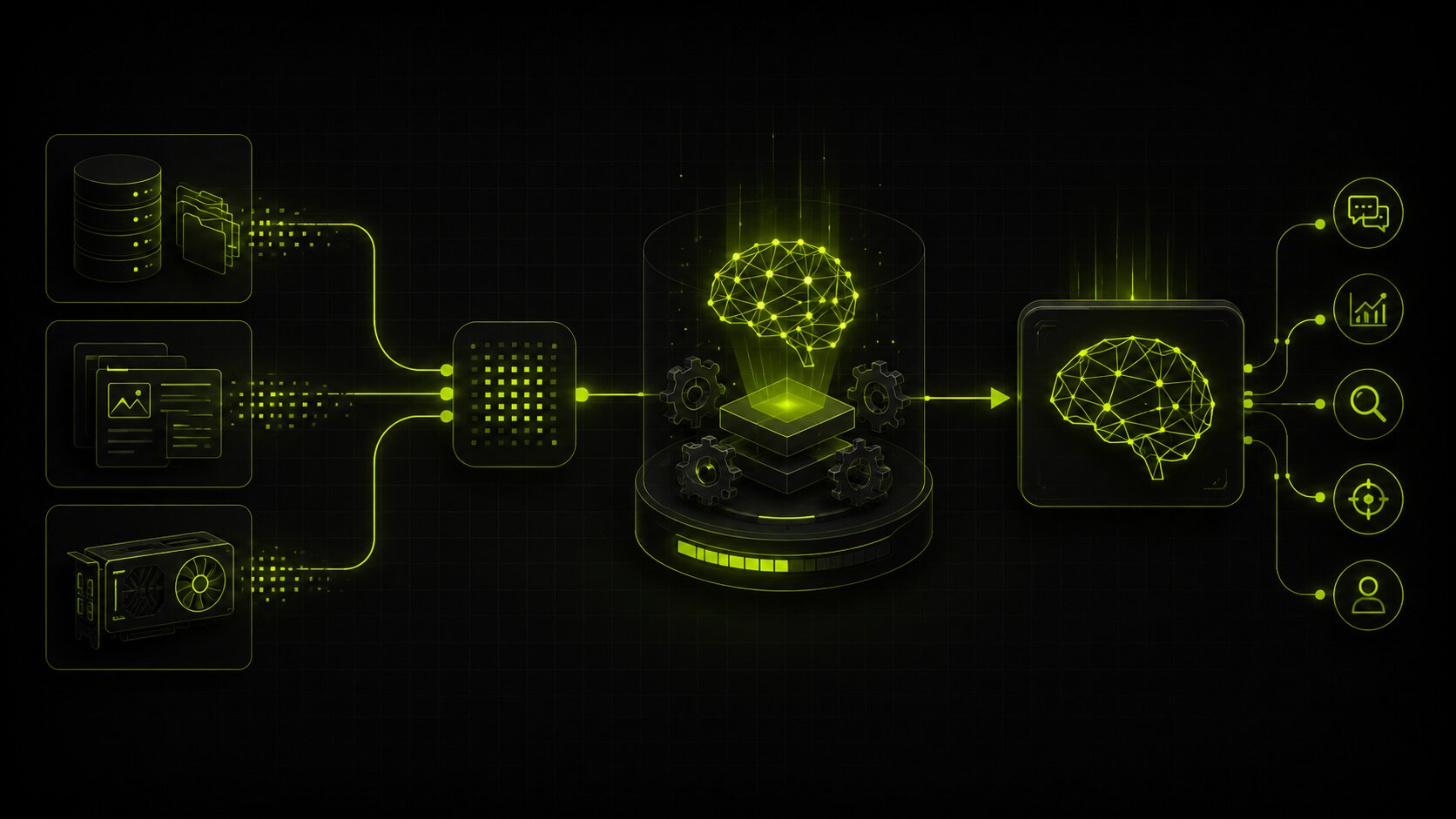
Building covers a spectrum, and the word hides a lot of difference. At the lighter end is fine-tuning, where you take an existing model and train it further on your own examples so it behaves the way you need. At the heavier end is training a more specialised model on a large body of your own data. The first is accessible to many companies; the second is a serious undertaking in data, computing power, and expertise.
What all building shares is ownership, and ownership cuts both ways. You gain control, the ability to bake in proprietary knowledge, and behaviour a general model cannot reliably produce. You also take on responsibility for data, training, evaluation, hosting, and keeping it working as the world shifts. Pretending the upside comes without the burden is how custom projects quietly overrun.
When an API is enough
For most use cases, a general model through an API is not just enough, it is the better choice. If your problem is a common one, if a capable model already does it well in testing, and if the task is useful but not the unique core of your business, buying wins easily. The honest test is simple: try the off-the-shelf option first and see how far it gets you. Very often it gets you all the way, and the custom project that felt necessary turns out to be solving a problem you no longer have.
When a custom model earns its cost
There are real cases where building is the right call, and they share a shape. The work is central to your business rather than a supporting task. It depends on proprietary data that only you hold, which a general model has never seen. It requires behaviour or accuracy a general model cannot reliably reach, or it carries privacy and control requirements that rule out sending data to an outside service. Sometimes the use case is so central and high-volume that owning the capability is simply better economics than renting it forever. When several of those are true at once, a custom model stops being an indulgence and becomes an advantage worth paying for.
The hidden costs of building
The expense that catches companies out is rarely the initial build. It is everything after. A custom model needs data prepared and kept current, careful evaluation so you actually know it works, somewhere reliable to run it, monitoring to catch when it drifts, and retraining as the world changes. It also needs scarce, expensive specialists to look after it, without whom a model degrades quietly until it is doing more harm than good. Counting only the cost of getting to launch, and ignoring the years of upkeep, is how a custom AI project looks affordable going in and painful later.
A practical way to decide
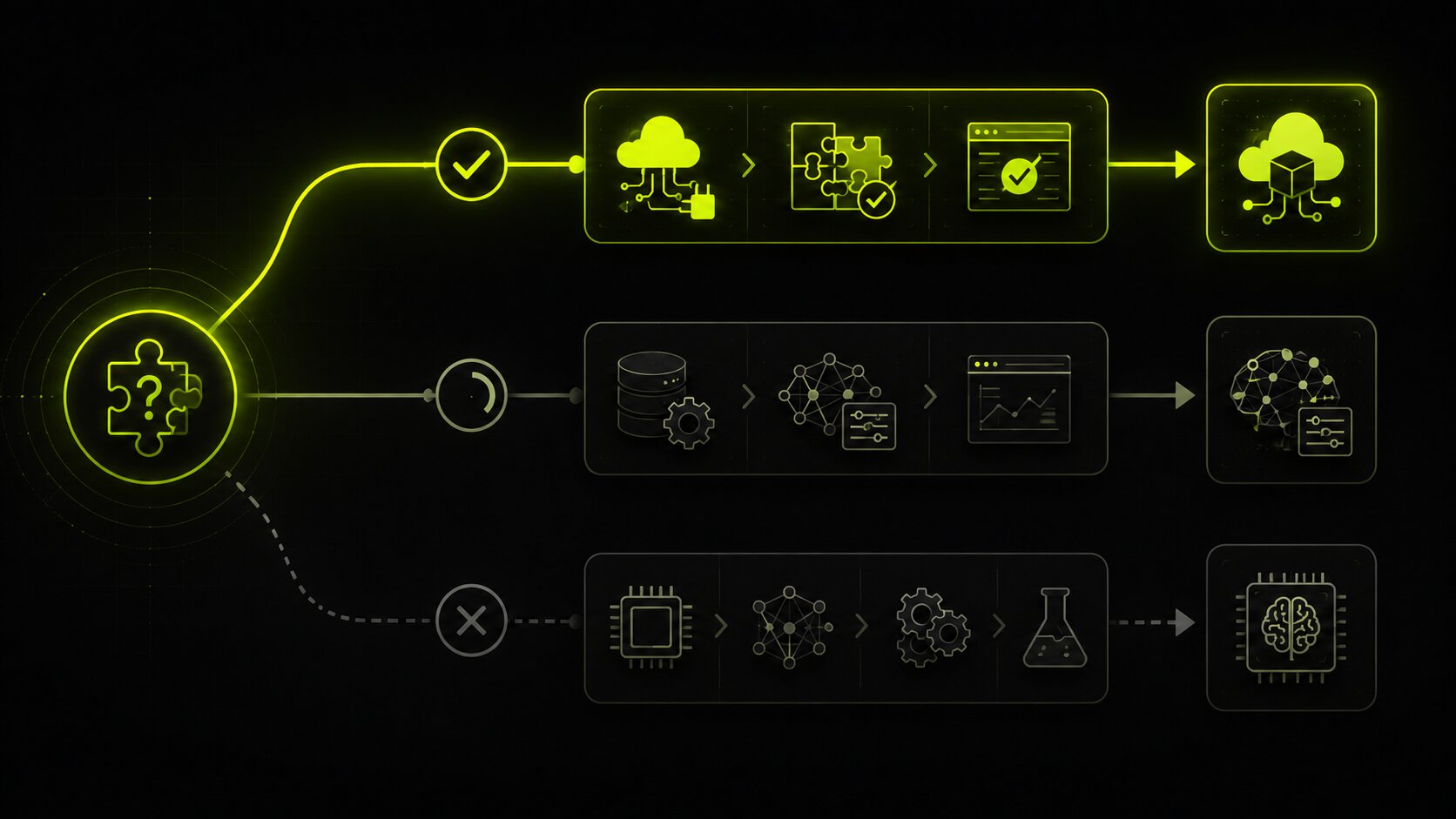
A clear way through is to work in order rather than starting from the answer you want. Begin with the problem, not the technology. Try the bought option first and measure honestly how it does; if it solves the problem, stop there. If it falls short, ask whether fine-tuning an existing model closes the gap before considering anything more bespoke. Only when the task is genuinely core, depends on data only you have, or demands control a service cannot offer does building from scratch earn its place.
Walked in that sequence, the decision usually makes itself, and you avoid both expensive mistakes: building what you could have bought, and stretching a general tool past where it can reliably go. That ordered thinking is what shapes our approach to custom AI tool development, where the first job is often to talk a client out of building something they do not need.
How we approach it
We start from the business problem and the economics, not from a preference for building. Most of the time the right recommendation is to buy and integrate a capable model well, sometimes with light fine-tuning, and we say so even though it is the smaller project. When the case for a custom model is real, that the task is core, the data is yours, and the control matters, we build it properly, with the data, evaluation, and maintenance plan that keep it valuable rather than turning it into a liability.
That judgement is what we bring across more than 500 brands in the US, UK, and Canada. As a global company with our headquarters in Delaware and teams in London and Gurugram, the aim is the same: the AI approach that fits the problem and the economics, not the one that sounds the most ambitious in a pitch.
Where this leaves you
Custom AI is a powerful option and the wrong default. For most problems, a capable model bought through an API solves the job quickly and cheaply, and that is the right choice, not a lesser one. Building earns its cost only when the work is core, depends on data only you hold, or demands control an outside service cannot give, and even then the real expense is the upkeep, not the launch. Start from the problem, buy first, fine-tune where that falls short, and build from scratch only where genuinely warranted. If you are weighing this, tell us the problem you are trying to solve and we will tell you, honestly, whether it calls for building or buying.
Frequently Asked Questions
What is custom AI development?
Custom AI development is building an AI capability tailored to your business rather than using a general tool out of the box. That covers a spectrum: at one end, taking a powerful existing model and adapting it to your data and workflows; at the other, training a more specialised model for a narrow, high-value task. The common thread is a result shaped around your specific problem and data, instead of a one-size-fits-all product.
Should my company build or buy AI?
For most companies and most use cases, buy first. The general-purpose models available through an API are remarkably capable, quick to adopt, and need no specialist team to maintain, so they solve a large share of problems at a fraction of the cost of building. Building makes sense only when an off-the-shelf model genuinely cannot do the job, or when the capability is so central that owning it is a real advantage. Start by buying, and build only where buying falls short.
When is a custom AI model worth it?
When the work is core to your business and an off-the-shelf model cannot do it well enough, or when owning the capability gives you a durable edge. Good signs include a task that depends on proprietary data only you have, behaviour a general model cannot reliably produce, strict privacy or control requirements, or a use case so central and high-volume that owning beats renting. If a general API already handles the job, a custom model is usually solving a problem you do not have.
How much does it cost to build a custom AI model?
It varies enormously with what you mean by build. Lightly adapting an existing model to your data is far cheaper and faster than training a specialised model from a large dataset, which demands significant data, computing power, and expert time. The cost that surprises people is the ongoing one: data preparation, evaluation, hosting, monitoring, and retraining. Any honest estimate starts with the specific use case, not a headline figure.
What is fine-tuning, and is it the same as building a model?
Fine-tuning is taking an existing, already-trained model and further training it on your own examples so it performs better on your specific task. It is a middle path between buying and building from scratch: behaviour shaped to your needs without the enormous cost of training from the ground up. It is not the same as building from nothing, and for many companies that need more than a general API but less than a bespoke model, it is the most sensible, cost-effective option.
Want this done for your brand?
Tell us where you are and what you are trying to grow. We will reply with a straight read on your situation and what is worth doing first. No obligation, no lock-in.