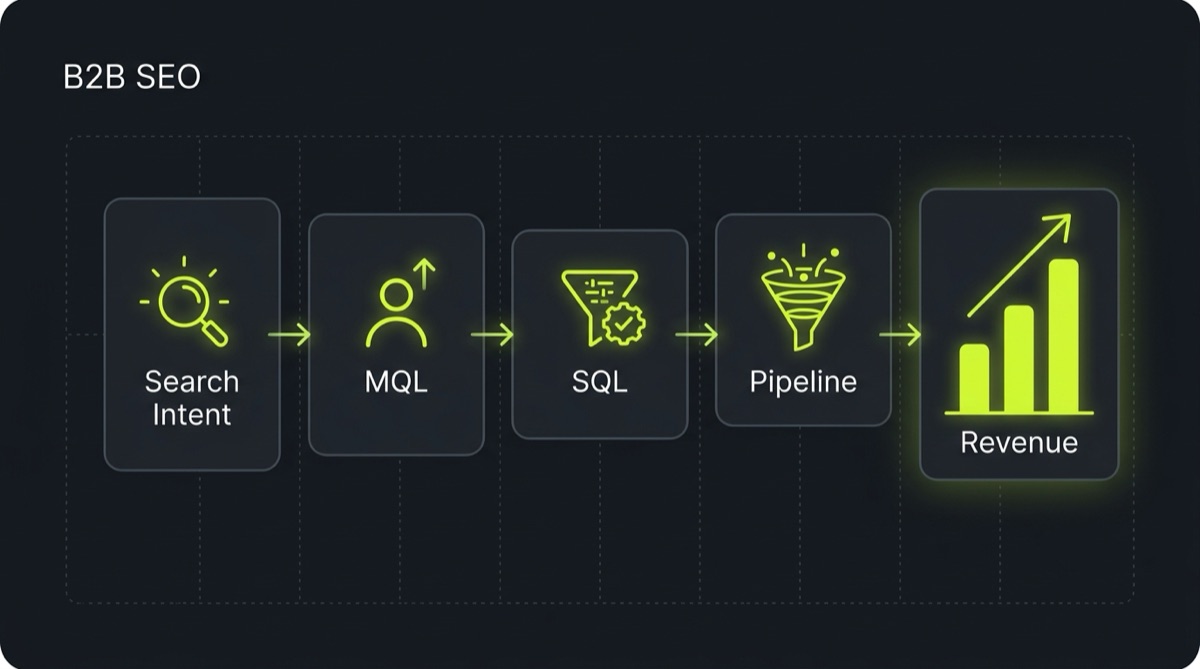
Most of the SEO advice you can find online quietly assumes you are selling to a single person who makes up their mind in an afternoon. Pick the keyword, write the page, win the click, get the sale. That model describes a lot of consumer shopping reasonably well. It describes almost nothing about how one business buys from another.
When a company chooses a payroll platform, a manufacturing supplier, or a managed security partner, the decision rarely belongs to one person and almost never happens in an afternoon. It moves through weeks or months of research, a handful of colleagues with competing priorities, and at least one conversation where someone asks why this option and not the cheaper one. B2B SEO is the practice of being useful and visible across that whole stretch, not just at the moment a single buyer types a query. Get the difference wrong and you end up ranking for terms that look impressive in a report and produce nothing a salesperson can use.
Why B2B SEO is its own discipline
The clearest way to see the gap is to follow a real purchase. Imagine a mid-sized firm replacing the software its support team lives in. A team lead notices the current tool is slowing everyone down and starts reading about alternatives. A few weeks later a manager gets pulled in and begins comparing two or three vendors in detail. Finance arrives with questions about contracts and total cost. Somewhere near the end, a director who has barely touched the research signs off on the spend.
Four people, four sets of questions, one decision. The team lead searched for the problem. The manager searched for comparisons. Finance searched for pricing and terms. The director wanted reassurance that the company was credible. A consumer SEO playbook optimised for a single high-volume keyword would have spoken to maybe one of them. Good B2B SEO speaks to all four, because any one of them can stall the deal.
This is also why B2B keyword volumes can look discouraging at first glance and still be worth far more. A search done a few hundred times a month by people evaluating vendors in your category can be more valuable than one done tens of thousands of times by the general public. Volume is easy to measure and easy to over-value. Intent is what pays.
The long sales cycle changes the whole plan
Because a B2B purchase unfolds over a long period, the content has to meet buyers wherever they happen to be standing. Early on they do not know your brand and may not have named their problem yet. Later they are weighing you against a shortlist and looking for reasons to rule options out. Treating those as the same audience is the most common mistake we see.
A workable way to think about it is a small number of stages. There is the stage where someone is just learning, searching for the shape of their problem and the language to describe it. There is the middle stage where they are comparing approaches and starting to compare vendors. And there is the late stage where they are close to a decision and want specifics: pricing logic, how implementation works, what switching costs look like, whether your other customers resemble them.
Most companies over-invest in the first stage and neglect the last. Broad educational articles are satisfying to publish and they pull in traffic, but a lot of that traffic is not buying anything soon. The late-stage pages, the unglamorous ones about pricing, comparisons, and implementation, are where intent is highest and competition is often thinnest. They tend to be the highest-return work in a B2B programme, which is part of what a focused B2B marketing approach is built to surface.
Start with bottom-of-funnel intent
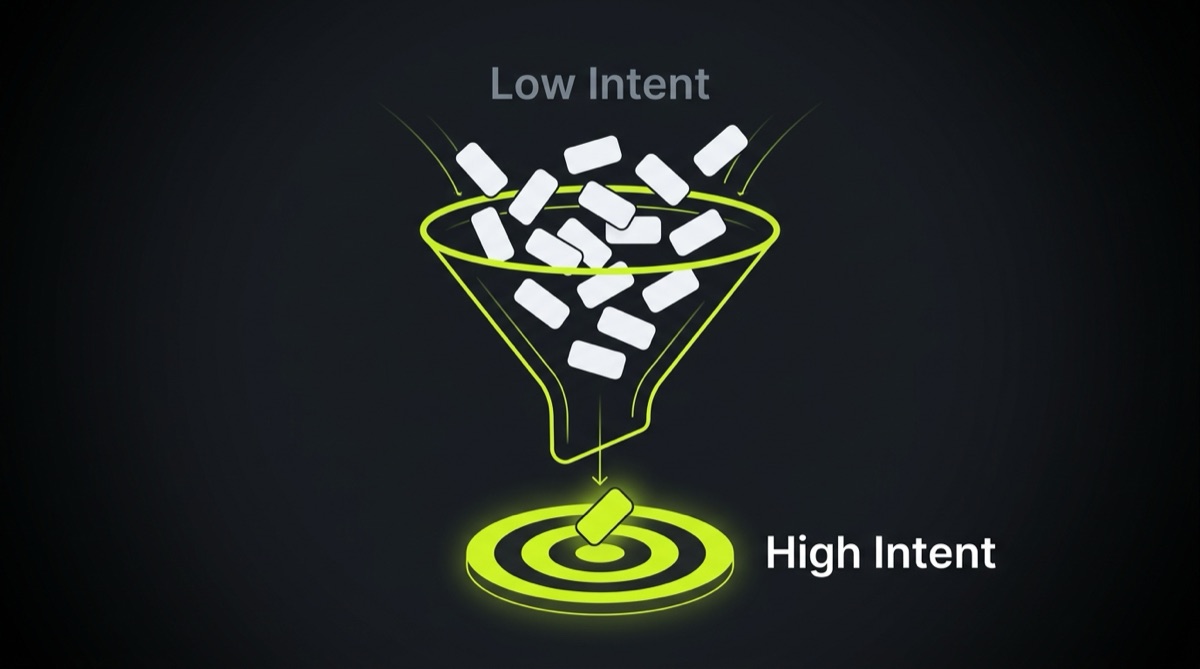
If you only had budget for one thing, it would be the searches that signal someone is close to buying. These are the queries where a person has stopped wondering whether to solve a problem and started deciding who solves it for them.
They follow recognisable patterns. Someone searches for one vendor against another. Someone looks for alternatives to a tool they already use and have grown tired of. Someone wants to understand pricing, or how a product integrates with the systems they already run, or what moving away from their current setup actually involves. Each of these is a buyer leaning forward. A page that answers the question honestly, including where you are not the right fit, earns trust precisely because it does not pretend every reader is a perfect match.
Only after those pages exist does it make sense to climb toward the broader, earlier questions. Done in that order, the educational content has somewhere to send a reader who warms up, instead of attracting visitors and then leaving them with nowhere useful to go.
Content for a committee, not a single reader
Once you accept that several people influence the purchase, your content strategy stops being a list of articles and becomes a question of coverage. Have you given the hands-on evaluator the technical detail they need to trust the product? Have you given the executive sponsor something that signals credibility without drowning them in specifics? Have you answered the finance owner's questions about cost and commitment somewhere they can actually find them?
Coverage like that is rarely one long page trying to please everyone. It is a connected set of pages, each written for a particular reader, linked so that a person can move from the question they came in with to the next one they will inevitably ask. The same instinct that helps a human reader navigate also helps search engines and AI assistants understand how your material fits together, which matters more every year.
Technical foundation and earned authority
None of the strategy survives a site that engines cannot read cleanly. The technical layer is dull and non-negotiable: pages that load quickly, a structure that lets a crawler reach everything important without guesswork, clean handling of duplicate URLs, and structured data that states plainly what each page is. There is no clever content move that rescues a site search engines struggle to crawl.
Above that sits authority, which in a serious B2B category is harder to fake than in most consumer niches. Buyers here are paid to be skeptical, and so are the search and AI systems trying to decide who to surface. Authority comes from genuinely useful material that other credible sources reference, from clear signals of real experience and expertise, and from being mentioned in the places your buyers already trust. It builds slowly and then, past a certain point, stops feeling slow. The same depth that earns a human reader's confidence is what makes an AI assistant comfortable citing you when a buyer asks it for options.
Measure pipeline, not just traffic
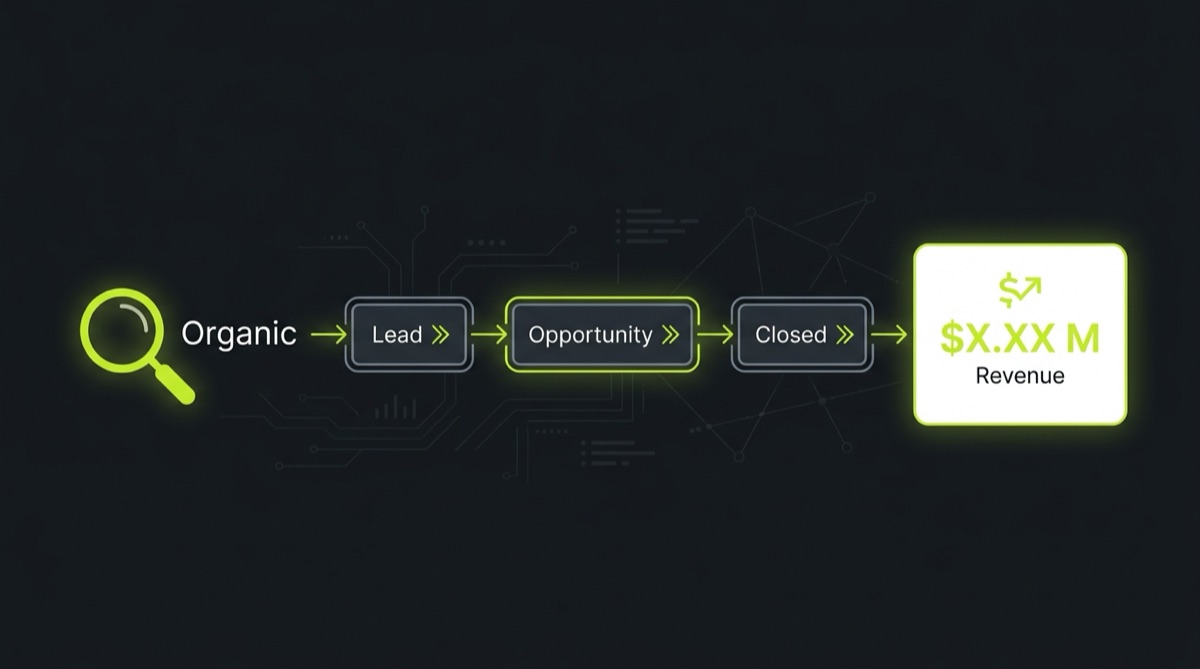
This is where a lot of B2B SEO quietly fails, even when the traffic charts look healthy. Visits can climb while pipeline stays flat, because the wrong visitors are arriving or the right ones have nowhere to convert. If the only number anyone reports is sessions, you can spend a year congratulating yourselves on a graph that never reaches sales.
Tie the work to the business instead. Watch how many leads and qualified opportunities organic search produces, and judge their quality by whether sales actually pursues them. Track rankings on the commercial keywords that lead to demos and quotes, not vanity terms. Account for the deals where organic search was an early or assisting touch even if the close happened elsewhere, since in a long cycle a single deal is usually influenced by several channels. The honest question is not how much traffic came in. It is how much of the pipeline this channel helped create. Connecting search to revenue this way is the same discipline behind sound performance marketing, and the two reinforce each other.
How to choose a B2B SEO agency
If you are evaluating partners, the early conversation tells you most of what you need to know. A firm that opens by asking about your sales cycle, your buying committee, and the customers you most want more of is thinking the right way. One that opens with a list of keywords it can rank you for, without understanding who buys from you, is selling a B2C playbook with a B2B label on it.
Ask directly how they define and report success, and listen for whether pipeline appears in the answer or only traffic. Ask what they would tell you to stop paying for, because a good partner is as clear about waste as about opportunity. Treat guaranteed rankings and fixed timelines as warnings rather than reassurances, since the channel does not offer that kind of certainty and anyone claiming otherwise is managing your expectations rather than your results. The same scrutiny applies whether the need is national reach, local SEO for specific markets, or category authority across the board.
Where this leaves you
B2B SEO is not consumer SEO with a slower clock. It is a different practice built around a longer decision, several decision-makers, and the kind of intent that smaller search volumes can hide. Cover the buying committee, lead with the bottom-of-funnel searches where buyers are closest to a choice, get the technical foundation right, earn authority that skeptical buyers and AI systems both respect, and measure the channel by the pipeline it builds. Do that and search becomes a dependable source of qualified demand rather than a chart that goes up while sales stays quiet.
If you would rather have a team handle it, that is the work we do, and it sits naturally alongside our ecommerce SEO and broader marketing services. Tell us how your buyers actually decide, and we will tell you, plainly, where your search presence stands against that.
Frequently asked questions
What does a B2B SEO agency actually do?
A B2B SEO agency works backward from your sales pipeline rather than from raw traffic. In practice that means mapping the keywords your buyers and their colleagues search across a long evaluation, building content for each stage of that evaluation, fixing the technical issues that keep your pages out of search and out of AI answers, and earning the kind of authority that makes a procurement team trust you. The aim is more qualified opportunities for sales, not a bigger visitor count, so the work and the reporting both point at revenue.
How is B2B SEO different from B2C SEO?
The mechanics overlap, but the buyer does not. A B2C shopper often decides alone and quickly. A B2B purchase usually runs for months and involves several people who each search for different things, so the same product gets researched by a technical lead, a finance owner, and an executive sponsor with very different questions. B2B keyword volumes are smaller but the intent is far more valuable, and the content has to satisfy a committee rather than win a single click. That changes which keywords matter, what you publish, and how you measure success.
Why does B2B SEO take longer to show results?
Two reasons. The sales cycle itself is long, so a lead that organic search produced this quarter may not close until much later, which delays the revenue signal. And authority in a serious B2B category builds gradually, because you are earning the trust of buyers who are paid to be skeptical. Technical fixes can register reasonably soon, while content depth and authority compound over a longer stretch. Anyone promising a fixed date for rankings is guessing, so the honest measure is direction and momentum rather than a countdown.
What keywords should a B2B company prioritise?
Start with bottom-of-funnel terms that signal someone is close to buying: comparison searches, alternatives to a competitor, pricing questions, integration and implementation queries, and the specific problem language your best customers use. These have lower volume than broad industry terms, but they convert. Once those are covered, move up the funnel to the educational questions buyers ask earlier, so you are present before a shortlist exists and still present when it forms.
How do you measure B2B SEO if not by traffic?
By how organic search contributes to pipeline and revenue. Useful measures include organic-sourced leads and opportunities, the quality of those leads judged by whether sales pursues them, rankings on the commercial keywords that actually drive demos and quotes, and assisted conversions where organic touched a deal that closed through another channel. Traffic is an input worth watching, but on its own it can rise while pipeline stays flat, which is why a good agency reports on the money, not just the visitors.
How do I choose a B2B SEO agency?
Look for a firm that asks about your sales cycle, your buying committee, and your best-fit customers before it talks about rankings, because that framing decides everything downstream. Ask how it measures success and make sure the answer involves pipeline, not only traffic. Check that it has worked with businesses that sell to other businesses, since B2C tactics translate poorly. Be wary of guaranteed rankings or fixed timelines, both of which are signs someone is selling certainty that the channel cannot offer.
Want this done for your brand?
Tell us where you are and what you are trying to grow. We will reply with a straight read on your situation and what is worth doing first. No obligation, no lock-in.