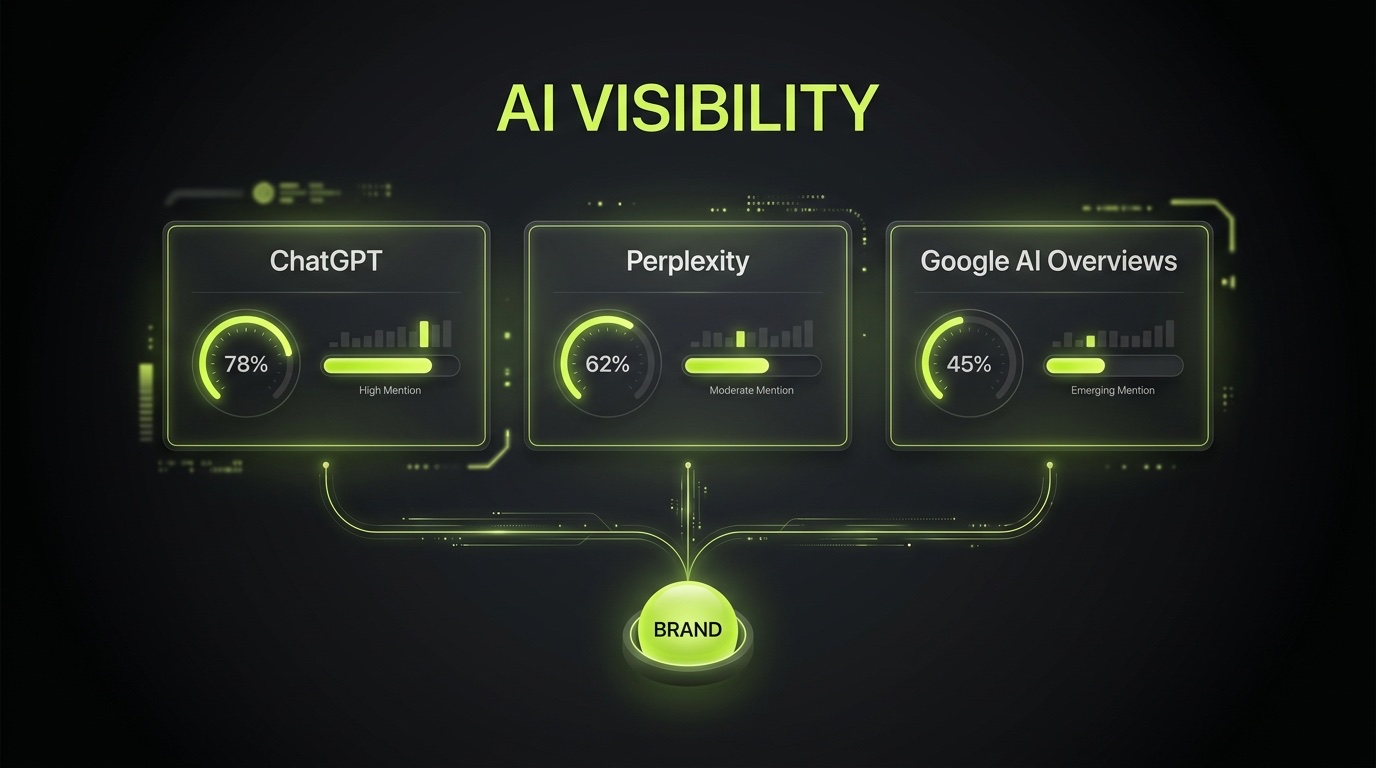
There is a quiet test running on your brand right now, and nobody sent you the results. Every time a potential customer asks ChatGPT which tool to use, or types your category into Perplexity, or sees one of Google's AI Overviews answer their question before they scroll, a model decides whether you exist in that answer. Most companies have no idea how they are doing on that test. They still watch their Google rankings, feel reassured by a green arrow, and never notice that the assistant sitting above those rankings has been recommending someone else.
AI visibility is the measure of how present your brand is inside those answers. Not where you sit on a results page, but whether the model names you, recommends you, or cites your pages when a real buyer asks a real question. It matters because the answer is increasingly the destination. A growing share of people read what the assistant says and act on it without ever clicking through to a website. If you are not in the answer, for those people you are not in the running, and a ranking you cannot see being summarised away is worth less every month.
The good news is that this is measurable. You can turn "does AI know us" from a nagging worry into a small set of numbers you watch move. That is the whole point of treating it as AI visibility work rather than a vibe.
Why your Google ranking no longer tells the whole story
For two decades the question was simple: where do we rank? You picked a keyword, you watched the position, and a higher number meant more clicks. That logic assumed a results page where every link gets a fair shot at the eye. AI answers break the assumption. The model reads dozens of sources and then writes a single response, choosing what to include and what to leave on the floor. You can rank well in classic search and still be missing from the paragraph the buyer actually reads.
That gap is the thing to internalise. Ranking is about being findable; AI visibility is about being chosen. A competitor who ranks below you can still be the one the assistant names, because the model weighed clarity, corroboration, and trust rather than position alone. Watching only your rankings now is like watching ticket sales while the cinema quietly switches to streaming. The number can look fine right up until it stops mattering.
The four metrics that actually prove it
Most of the panic around AI search comes from not having numbers to point at. So here are the four that turn it into something you can manage. None of them require special access to the models. They require asking good questions consistently and writing down what comes back.
Presence rate. Take the questions your buyers actually ask, run them through the assistants, and count how often your brand shows up at all. If you sell project-management software, your prompts are things like "best project management tool for a small agency", not "tell me about [your brand]". Presence rate is the percentage of those buyer-intent prompts where you appear. It is the most honest single number you have, because it ignores how you feel about your visibility and just counts whether the model reached for you.
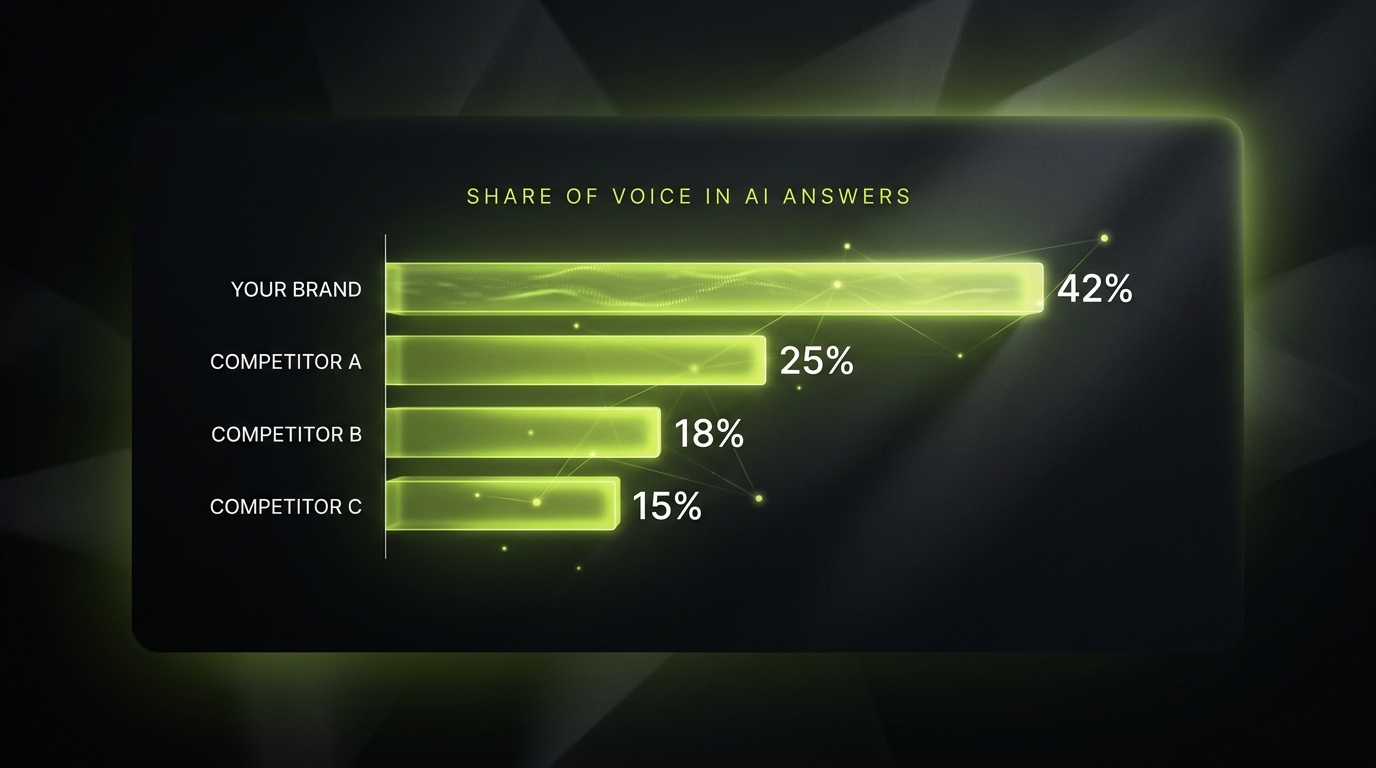
Share of voice. Presence on its own can flatter you. Share of voice puts it in context by counting how often you appear against the competitors who appear in the same answers. Showing up in four of ten prompts sounds decent until you learn a rival shows up in nine. This is the number that tells you whether you are winning the category in AI answers or merely present in it, and it is usually the one that gets a leadership team to pay attention.
Sentiment and accuracy. Being mentioned is not automatically good. Models make confident mistakes: an out-of-date price, a feature you dropped two years ago, a strength attributed to the wrong product. So when you appear, record whether the mention is positive, neutral, or simply wrong. A brand that shows up often but is described inaccurately has a different and more urgent problem than one that rarely shows up at all, and you only see the difference if you read the answers rather than counting them.
Citation rate. Some engines, Perplexity and Google's AI Overviews in particular, link to the sources behind their answers. Citation rate is how often your own pages are among those sources. It matters for two reasons: a citation can still earn you a click in a world where most do not, and being cited is strong evidence that the model treats your content as a trustworthy source rather than something to summarise from elsewhere. When your citation rate climbs, you are not just being mentioned, you are being believed.
Which engines to watch, and what to ask them
You do not need to track every model that gets a launch post. You need the few that sit between your buyer and their decision. For most brands that means ChatGPT for broad questions, Perplexity for the research-style queries where citations carry weight, and Google's AI Overviews because they now sit on top of the search results people were already looking at. Add Gemini if your audience lives inside Google's tools. Beyond that, you are usually adding noise, not signal.
The harder discipline is the prompts. Vanity questions about your own name will always return something flattering and tell you nothing. The prompts that matter are the ones a buyer with a problem would actually type: the comparisons, the "best X for Y" questions, the "alternatives to [competitor]" searches, the "is [your brand] any good" checks. Build a fixed list of those, keep it stable so your numbers are comparable week to week, and resist the urge to quietly drop the prompts where you do badly. Those are the ones worth fixing.
Tracking it over time, not once
A single reading is a photograph; what you need is the film. Models update, their sources shift, and a competitor's content push can move the answers within weeks. Check a snapshot once a quarter and you can easily miss a slide that began the day after you looked. A weekly cadence is a reasonable default for an active brand: frequent enough to catch movement and tie it to changes you made, infrequent enough that you are watching a trend rather than reacting to the daily jitter every model has.
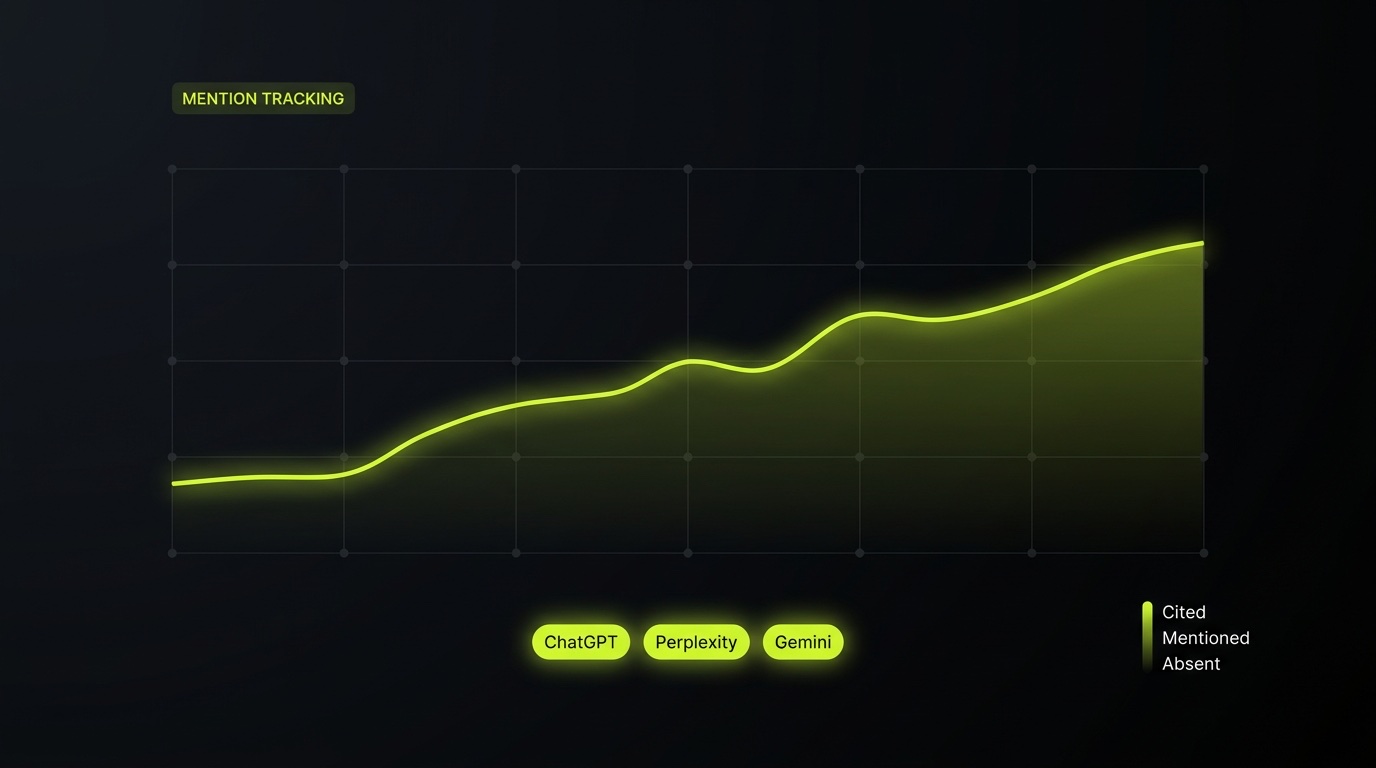
This is also where mention tracking quietly becomes the new rank tracking. The old dashboard watched a position on a results page. The new one watches presence, share of voice, sentiment, and citations across a handful of engines, on the prompts that lead to revenue. The instinct is the same one behind any honest approach to applied AI: decide what good looks like, measure it on a schedule, and let the trend tell you whether your work is paying off.
What to do once you can see the numbers
Measurement is only useful if it points at action, and the encouraging part is that the levers are familiar. AI assistants build answers from sources that are clear, consistent, and corroborated, so improving visibility looks a lot like building a credible entity on the open web. State plainly, on your own pages, what you do and who you do it for, in language a model can lift without guessing. Keep the facts about your company consistent everywhere they appear, because contradictions make a model hedge or skip you. Earn third-party mentions and genuine reviews, since corroboration from sources the model already trusts does more than any amount of self-description. And use structured data to remove ambiguity about your products, prices, and identity.
None of that is a trick that survives one update and dies at the next. It is the same reputation-and-clarity work that has always made a brand legible, now pointed at a reader that happens to be a model. Done well, it is indistinguishable from sound search and content strategy, which is exactly why it compounds instead of evaporating.
Where this leaves you
The shift is not that search died. It is that a layer got added on top of it, one that reads everything and answers in a sentence, and that layer is now where a lot of buying decisions quietly start. You cannot manage what you refuse to measure, and right now most brands are flying blind into it. Pick your engines, write the prompts your buyers actually use, and track presence, share of voice, sentiment, and citations over time. The brands that win the next few years of search will be the ones that knew, week by week, whether the machines knew them.
If you would rather have a team stand this up and run it for you, that is the work we do. Tell us your category and the competitors you watch, and we will show you, plainly, where you stand inside today's AI answers and what is worth fixing first.
Frequently asked questions
What is AI visibility?
AI visibility is how present your brand is inside the answers that AI assistants give. When someone asks ChatGPT, Perplexity, or Google's AI Overviews about your category, AI visibility is the question of whether your brand gets named, recommended, or cited at all, and how favourably. It is the AI-answer equivalent of where you rank in classic search, except the result is a written answer rather than a list of ten blue links, so being absent from it is far easier to miss and far more costly.
How do you measure whether AI knows your brand?
You measure it by asking the AI assistants the questions your buyers ask, on a fixed schedule, and recording what comes back. The core numbers are presence rate (how often your brand appears across a set of buyer prompts), share of voice (how often you appear versus named competitors), sentiment (whether the mention is positive, neutral, or wrong), and citation rate (whether the assistant links to your own pages as a source). Tracked over time across several engines, those four turn a vague worry into something you can actually watch move.
Which AI platforms should I track for brand visibility?
Start with the ones your buyers actually use: ChatGPT for general questions, Perplexity for research-style queries that lean on citations, and Google's AI Overviews because they now sit on top of ordinary search results. Gemini is worth adding if your audience lives in Google's ecosystem. You do not need to track every model that exists. You need the handful that sit between your buyer and their decision, and you need to check them on the prompts that map to real buying intent rather than vanity questions about your own name.
Why does AI visibility matter if I already rank well in Google?
Because a strong Google ranking and a strong AI answer are no longer the same thing. An AI assistant reads many sources and then writes one answer, so it can rank you tenth in classic search and still leave you out of the paragraph it hands the buyer, or rank a competitor lower and still recommend them. Increasingly people ask the assistant and act on the answer without ever scrolling a results page. If you only watch your search rankings, you are watching a channel that is quietly being summarised away above it.
Can you improve how often AI mentions your brand?
Yes, though not by gaming a single ranking signal. AI assistants assemble answers from clear, well-structured, trustworthy sources, so the work is making your brand legible and credible across the web: pages that state plainly what you do and for whom, consistent facts about your company in the places models read, third-party mentions and reviews that corroborate your claims, and structured data that removes ambiguity. It is closer to reputation and entity-building than to keyword tricks, which is also why it holds up rather than evaporating at the next model update.
How often should AI visibility be measured?
Often enough to catch movement, not so often that you drown in noise. Weekly is a sensible default for an active brand, because models and their sources change frequently and a once-a-quarter snapshot can hide a slide that started in week two. The point of a regular cadence is direction rather than a single reading: you want to see presence and share of voice trending the right way after you make changes, and to get an early warning when a competitor starts showing up where you used to.
Want this done for your brand?
Tell us where you are and what you are trying to grow. We will reply with a straight read on your situation and what is worth doing first. No obligation, no lock-in.