Most of what gets sold as "AI automation" is really task automation wearing a nicer suit. A chatbot here, a drafting assistant there, a lead score that used to take a rep a minute and now takes a second. Each one is genuinely useful, and each one, on its own, changes surprisingly little about how fast the actual work gets done. The reason is not the AI. It is that the work was never slow inside the task. It was slow in the gaps between tasks, the handoffs where something sits in an inbox, gets copied from one system to another, or waits for someone to notice it.
An AI automation agency that is worth hiring is one that understands this and aims a level higher. It does not automate your tasks. It automates your processes, end to end, so the whole sequence runs without a person carrying it across each gap. That is a harder thing to do and a far more valuable one, and it is the difference this playbook is about.
Task automation versus process automation
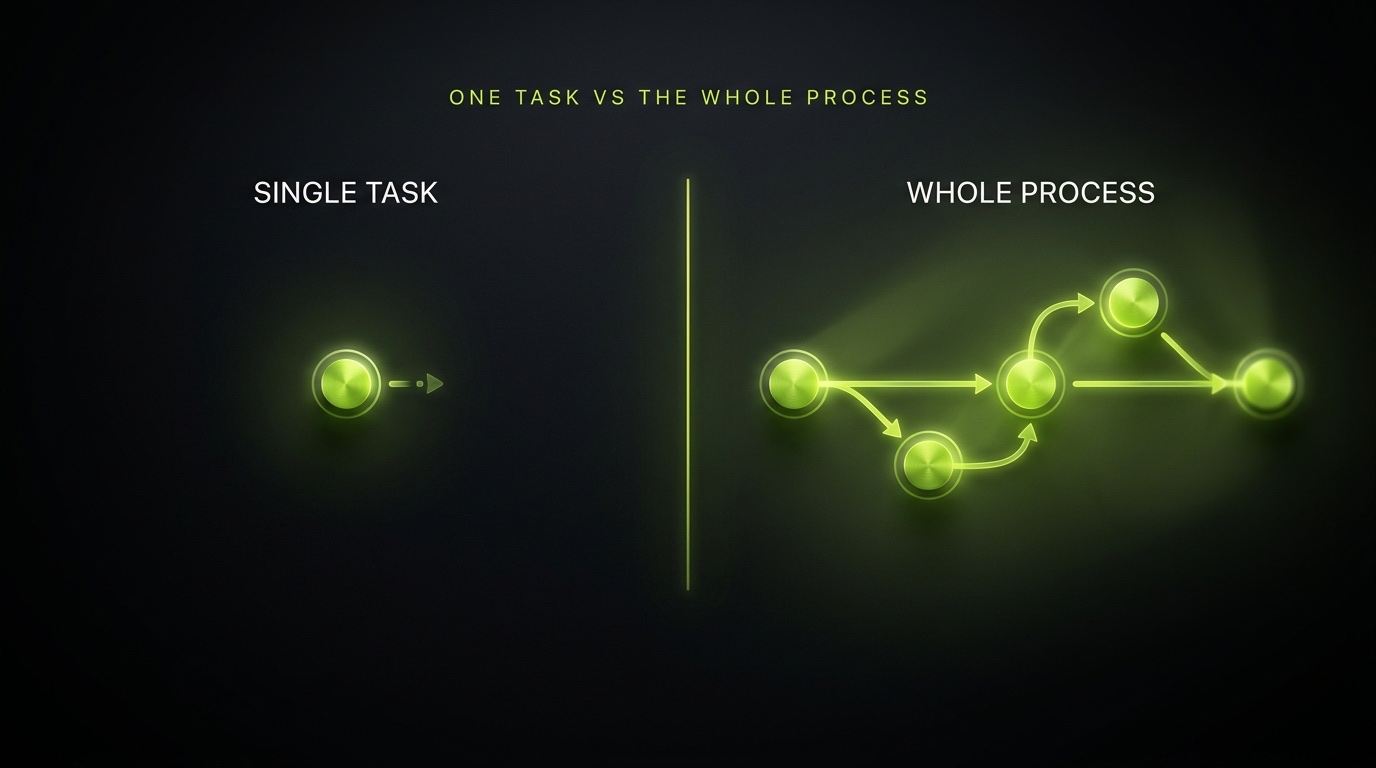
Picture how a lead actually moves through most companies. A form is filled in. It lands somewhere. Eventually a person sees it, looks the company up, decides whether it is worth pursuing, assigns it to a rep, and logs the whole thing in the CRM. Bolt an AI tool onto the "look the company up" step and you have made one part faster. But the lead still waits to be noticed, still waits to be assigned, still waits to be logged. You sped up a single island in a chain that is mostly water.
Process automation goes after the water. The form submission becomes a trigger. An agent enriches the lead from the data you already have, scores it, decides whether it clears the bar, routes it to the right rep, writes the CRM record, and sends the first follow-up, all without anyone moving it along by hand. A person enters only where judgment is needed or where the agent flags something it is unsure about. The minutes saved inside any one step were never the prize. Removing the waiting between steps is.
Why most AI projects quietly disappoint
There is a gap in the numbers that tells the whole story. McKinsey's 2025 State of AI research found that nearly 88 percent of companies now use AI in at least one business function, but roughly 94 percent report they have not yet seen significant value from it. Almost everyone has adopted something. Almost no one is getting the return they expected.
The explanation is not that the models are weak. It is that most companies automated tasks and left the process alone. A tool gets dropped onto one step, the steps around it still rely on people to relay work, and the time the tool saved leaks straight back out at the next handoff. McKinsey's own read is that the companies actually capturing value, the ones it labels high performers, treat AI as a redesign of the entire workflow rather than a faster version of one step inside the old one. The failure is almost never the technology. It is the scope of the ambition.
The wider market is moving in the same direction whether individual projects succeed or not. Gartner expects 40 percent of enterprise applications to embed task-specific AI agents by the end of 2026, up from under 5 percent in 2025, and notes that only about 17 percent of organisations have deployed agents so far while more than 60 percent intend to within two years. The capability is arriving fast. The advantage will go to whoever points it at whole processes instead of scattering it across isolated tasks.
What "automating a whole process" actually looks like
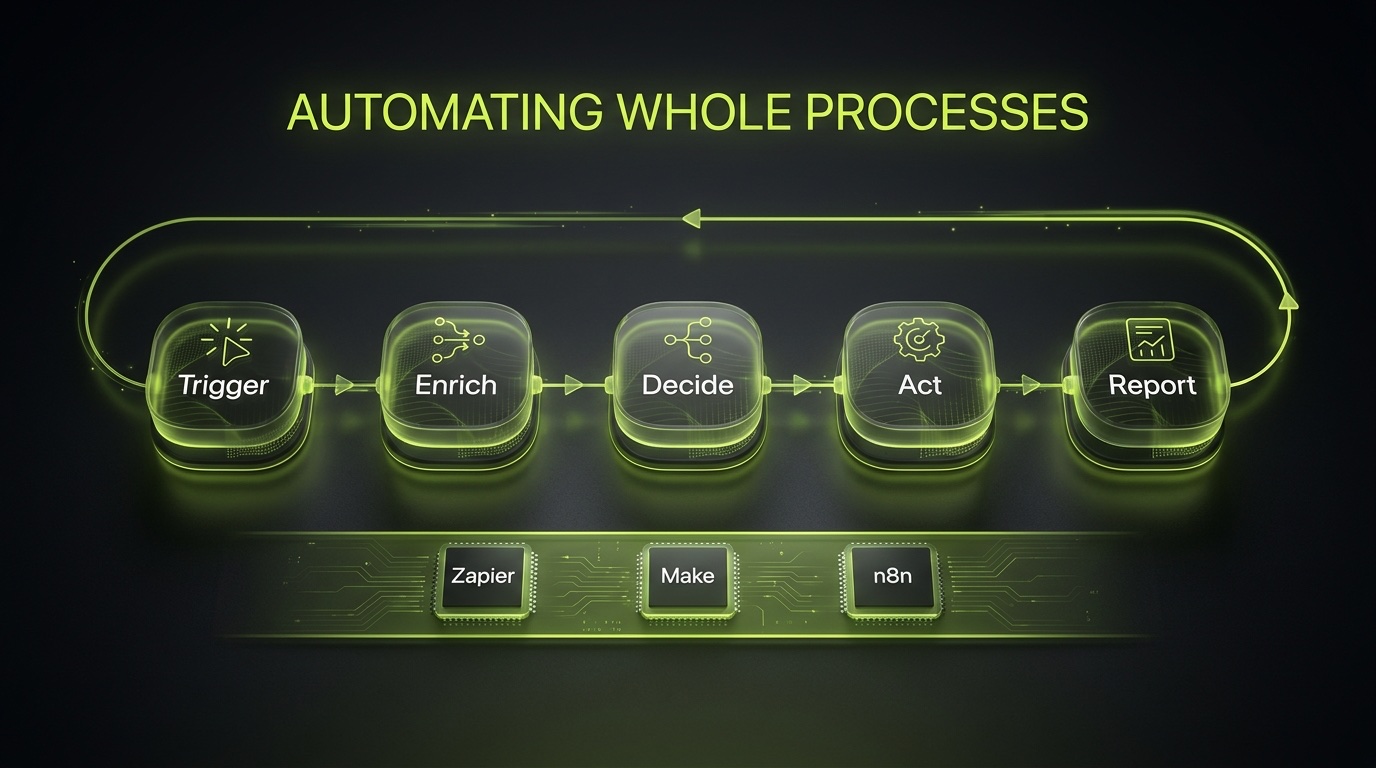
Strip away the jargon and an automated process is a loop with five recognisable stages. A trigger starts it, a form, an email, a new order, a calendar event. An enrich step gathers the context the process needs, pulling from your CRM, your records, or an outside source. A decide step applies judgment: does this clear the bar, which path does it take, is this an exception. An act step does the thing, updates the system, sends the message, books the slot, raises the ticket. And a report step writes down what happened so the next run, and the humans watching, can see it. Then it loops.
The wiring underneath is less exotic than it sounds. Orchestration platforms such as Zapier, Make, and n8n move data between your tools and fire each step in order. The agent, the reasoning layer, sits inside the decide and enrich stages, handling the parts that used to need a person to read, interpret, and choose. The work an agency does is less about any single clever model and more about connecting these pieces into a chain that runs reliably, handles the cases that do not fit, and tells someone when it gets stuck. That is the unglamorous craft underneath the demos. If you want to see how we frame the agent side of it, our agentic process automation work goes deeper on where reasoning agents replace brittle rule-based steps.
Where the payback comes fastest
Not every process is a good first candidate, and choosing badly is how automation programmes lose their credibility before they have earned any. The processes that pay back fastest share three traits: they run often, so the saved time compounds; they have clear inputs and a checkable output, so you can prove the agent is right before you trust it; and they touch systems you already own, so the wiring is short. Pick something frequent, measurable, and well understood, and the first win arrives quickly enough to fund the next one.
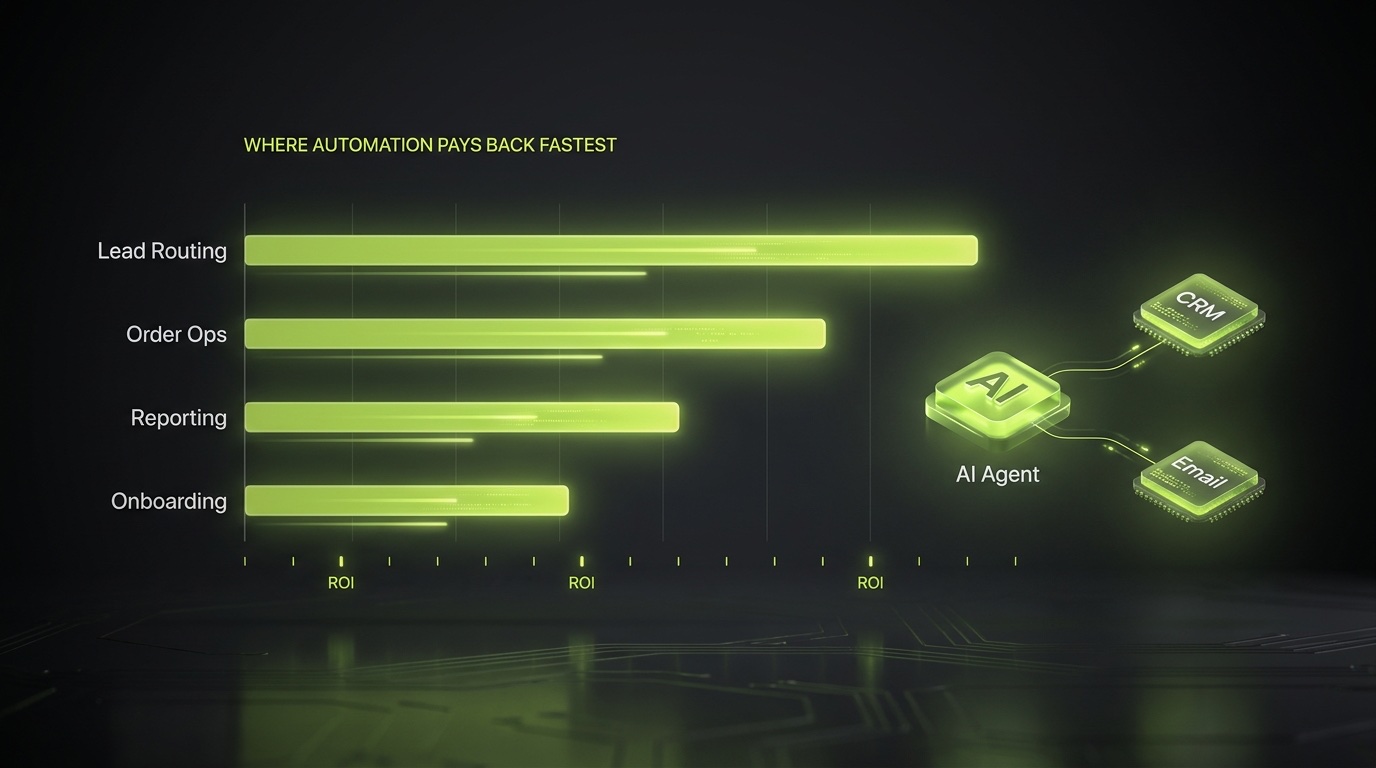
In practice that points to a familiar shortlist. Lead routing and qualification, because every inbound lead follows the same shape and the cost of a slow or misrouted one is obvious. Order and fulfilment operations, where the steps are repetitive and the handoffs between systems are exactly the kind of relay work agents remove well. Recurring reporting, the weekly and monthly pulls that eat skilled hours and produce the same artefact every time. And parts of customer onboarding, the predictable setup steps that happen with every new account. These are not the only places automation works, but they are where a first project is most likely to land a clean, measurable win. The harder, messier processes come later, once the approach has proven itself on the easy ones.
The part you should not automate
The honest version of this playbook has a boundary in it. Agents are excellent at the routine path and genuinely bad at knowing when the routine path is the wrong one. They will act on a confident wrong answer with exactly the same fluency as a correct one, which is why every process worth automating has named points where a human signs off. The skill is not removing people. It is placing them precisely: at the decisions where being wrong is expensive, at the exceptions the agent flags, and at the strategy and relationships no model can own.
So a well-built automated process is not an empty room. It is a tighter loop. The agent runs the high-volume path at speed and pulls a person in by name at the few points that need them, instead of a person carrying every item across every gap by hand. That is also the difference between automation that survives contact with reality and automation that gets switched off the first time it does something embarrassing. The same discipline shows up in how serious teams run AI across marketing and operations more broadly, which is the thread running through our artificial intelligence work.
How to tell a serious agency from a hopeful one
Because almost everyone now claims to be AI-powered, the label tells you nothing. The questions do. Ask which whole process an agency proposes to automate, and listen for whether they name a process or reach for a tool. Ask where a human still signs off and why that point and not another. Ask how they stop an agent acting on a wrong answer, and what the process does when it meets a case it has never seen. Ask which of your systems they will wire into, and who owns the workflows once the work is done.
Good answers are specific and a little boring. They talk about the handoffs, the exceptions, the guardrails, the one report that proves the loop is healthy. Bad answers are exciting and vague, heavy on what AI can do and light on what this particular process needs. The difference is not enthusiasm. It is whether the agency has actually built things that had to keep running on a Monday morning when an edge case showed up. The way performance is measured matters just as much as the automation itself, which is the same instinct behind disciplined performance marketing: build the thing, then watch the number that proves it is working.
How DigiRocket approaches it
Our starting point is never a tool. It is a process you can describe in a sentence and that costs you something real today, usually in waiting and re-keying rather than in any single hard task. We map how it runs now, mark every handoff, and decide deliberately which steps an agent can own and which stay with a person and why. Then we wire the loop, trigger, enrich, decide, act, report, into the systems you already use, prove it against real cases before it touches anything that matters, and stay on to fix it as reality drifts from the plan. As a company that has shipped this kind of work across more than 450 projects for over 500 brands in the US, the UK, and Canada, the lesson we keep relearning is the one this playbook opened with: the value is in the whole process, not the clever step.
If you have a process in mind, the kind that runs constantly and quietly drains hours into handoffs, tell us what it is and we will tell you plainly whether it is a good first candidate and what the automated version should look like. You can see how we think about it on our agentic process automation page, or just describe the process and we will take it from there.
Frequently asked questions
What does an AI automation agency actually do?
A real AI automation agency takes a whole business process, end to end, and rebuilds it so it runs with little or no human relay. Not a single chatbot or one writing assistant bolted onto the side, but the full chain: the trigger that starts the work, the steps that gather and check information, the decision, the action, and the report back. The agency maps how the process runs today, decides which steps an agent can own and which a person must keep, wires it into your existing tools, and stays on to fix it when reality drifts from the plan. The test of a serious one is simple: it can tell you exactly where a human still signs off and why.
What is the difference between automating a task and automating a process?
Automating a task speeds up one step, such as drafting a reply or scoring a lead. Automating a process means the whole sequence runs on its own, with each step handing off to the next without a person carrying it across. The difference matters because most of the cost and delay in real work is not inside any single task, it is in the waiting and re-keying between tasks, the handoffs where things sit in an inbox or get copied from one system to another. Automate one task and you have a faster island. Automate the process and you remove the gaps between the islands, which is where the time actually goes.
Where does AI process automation pay back the fastest?
The fastest payback tends to be in high-volume, rules-heavy processes that already follow a predictable shape: lead routing and qualification, order and fulfilment operations, recurring reporting, and parts of customer onboarding. These share three traits that make them ideal first projects. They run often, so the time saved compounds; they have clear inputs and outputs, so an agent can be checked against a right answer; and they touch systems you already own, so wiring is straightforward. Start where the process is frequent, measurable, and well-understood, prove it works, then move to the messier ones with that credibility behind you.
Do AI agents replace employees in an automated process?
Usually not, and the agencies that promise they will are the ones to be wary of. What agents replace is the relay work, the copying, chasing, re-keying, and waiting that fills the gaps between real decisions. People stay on the judgment calls, the exceptions the agent flags, and the relationships and strategy a model cannot own. The healthiest setups are explicit about this split: the agent runs the routine path at speed, and a person is pulled in by name at the points where being wrong is expensive. The goal is a smaller, faster loop with humans at the decisions that matter, not an empty office.
Why do so many AI automation projects fail to deliver value?
Because they automate tasks instead of processes. McKinsey's 2025 research found that nearly 88 percent of companies use AI in at least one function, yet about 94 percent report they have not seen significant value from it. The pattern behind that gap is consistent: a tool gets bolted onto one step, the surrounding process still depends on people to carry work between steps, and the saved minutes leak away at the handoffs. The companies that do see value, McKinsey calls them high performers, treat it as redesigning the whole workflow end to end rather than dropping AI onto the old one. The failure is rarely the model. It is the scope.
What should I ask an AI automation agency before hiring one?
Ask which whole process they are proposing to automate, not which tool they will use. Ask where a human still signs off and why that point was chosen. Ask how they stop an agent from acting confidently on a wrong answer, and what happens when the process hits a case it has not seen. Ask which systems they will wire into and who owns the workflows once they are built. Specific, slightly unglamorous answers, naming the process, the handoffs, and the guardrails, are the sign of an agency that has actually done this. Vague talk about being AI-powered is the sign of one that has not.
Want this done for your brand?
Tell us where you are and what you are trying to grow. We will reply with a straight read on your situation and what is worth doing first. No obligation, no lock-in.