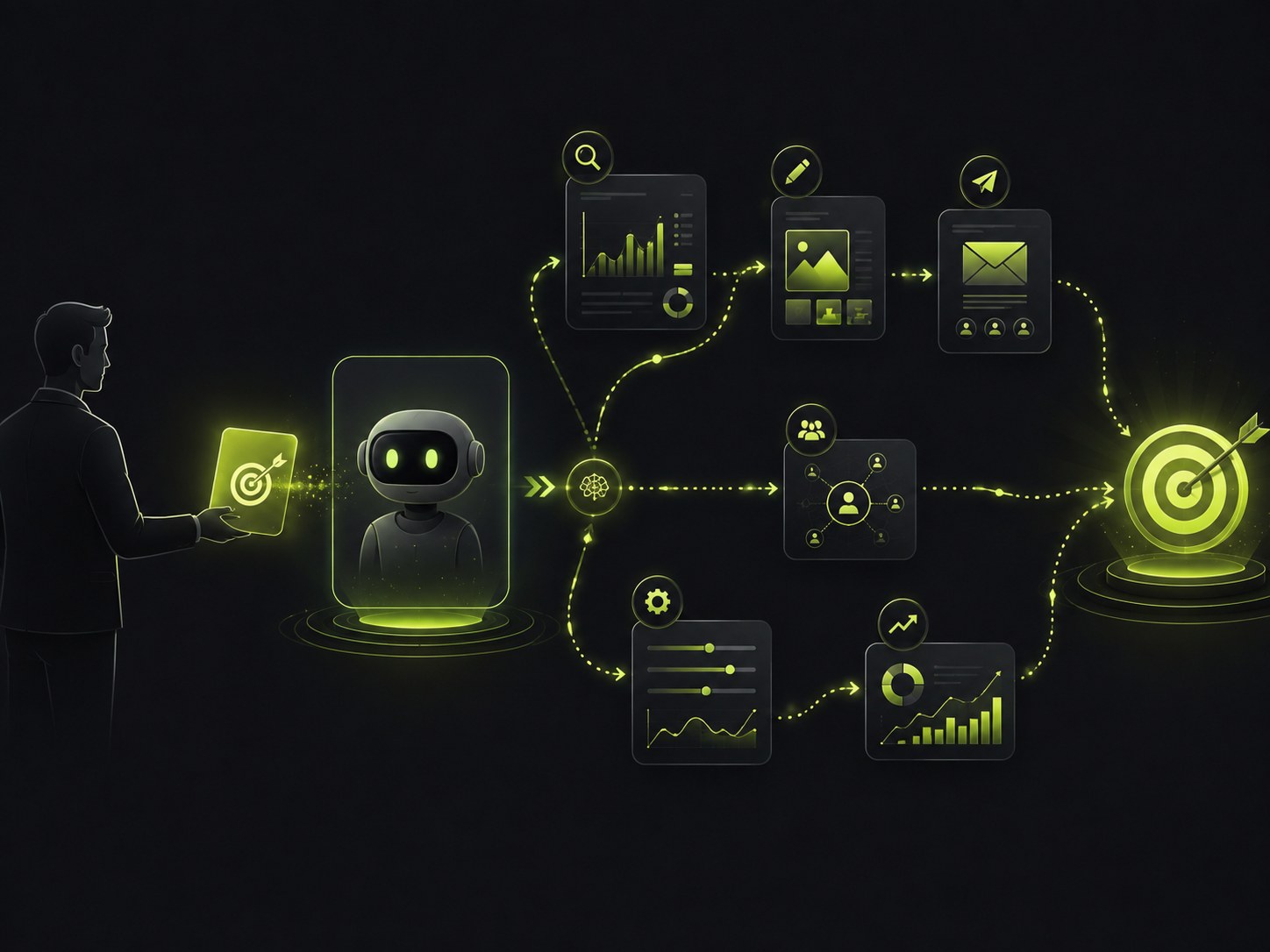
For years, using AI in marketing meant operating tools. You set up an automation, wrote the rule, pressed the button, and the software did exactly what you told it to, no more and no less. Useful, but it was always you doing the thinking and the tool doing the typing. The intelligence lived in the person; the software just executed.
Agentic marketing describes a real shift in that relationship. Instead of operating a tool step by step, you give an AI agent a goal and some limits, and it works out the steps itself. It is an early technology, wrapped in a lot of hype, but the underlying change is genuine, and it is worth understanding what it actually means before deciding what to do about it.
What makes marketing "agentic"
The word that matters is autonomy. An agent is not just a smarter automation; it is software that is given an objective rather than a script, and then decides how to pursue it. It can take an action, look at the result, and choose what to do next, adjusting as it goes rather than following a fixed path you laid out in advance. You move from specifying every step to setting a direction and letting the agent find the steps, which is a genuinely different way of working, not just a faster version of the old one.
Automation versus agents: the real difference

Traditional marketing automation is rule-based: when someone signs up, send this email; when a metric crosses a line, raise an alert. It is reliable and valuable, but it is fixed. It only ever does the thing you defined, and if the situation changes in a way you did not anticipate, it keeps doing the same thing regardless.
An agent is handed a goal instead of a rule and figures out the steps on its own. Told to improve the performance of a campaign, it can look at what is happening, try adjustments, see what works, and keep going, without you scripting each move. Automation executes your plan; an agent forms and revises its own inside the limits you set. That shift from executing rules to pursuing goals is the heart of what agentic means.
What agentic marketing can actually do today
Stripped of the hype, the current reality is genuinely useful. Agents can research topics and draft content, watch campaigns and flag or tune what is underperforming, handle routine optimisation, assemble reporting, and run multi-step workflows that used to need a person nudging them along at every stage. This is real work, taken off real plates, and it is available now rather than someday.
It is just as important to be clear about the limits. Agents today do not own strategy, cannot be trusted to nail brand nuance unsupervised, and should not be left alone on high-stakes decisions. The accurate picture is a capable assistant that handles a lot of the legwork well, not an autonomous marketer you can hand the keys to and walk away from. Treating it as the former is smart; treating it as the latter is how it goes wrong.
Where it is hype, and where it is real
Agentic AI attracts enormous excitement, and some of the promises being made are well ahead of what the technology can deliver. The vision of a fully autonomous marketing department that runs itself is not here, and pretending otherwise leads to disappointment and bad decisions. Healthy scepticism is the right starting posture.
What is real, though, is worth taking seriously. Agents that reliably handle defined, repetitive, multi-step work under supervision exist and add value today. The trick is separating the grounded capability from the marketing gloss around it, and judging tools by what they demonstrably do rather than what the pitch claims they will do next year.
You set the goals and the guardrails

Agentic marketing does not remove the marketer; it changes the job. The most important work becomes defining the right goal, setting clear guardrails, and deciding what the agent is and is not allowed to do. A vague goal or loose limits produce poor results quickly, while a sharp objective and sensible boundaries let an agent be genuinely useful without going off the rails.
This is why strategy and judgement matter more, not less, in an agentic world. The agent supplies the execution; you supply the direction, the standards, and the taste. Getting good at briefing and bounding an agent, telling it precisely what success looks like and where the edges are, becomes one of the core skills, and it is a human one.
Start narrow, keep a human in the loop
The sensible way in is small and supervised. Choose one well-defined area where the work is repetitive and the stakes are moderate, give an agent a clear goal and clear limits, and keep a person reviewing what it produces before anything goes live. Prove the value there, build trust in how it behaves, and then expand from a foundation that works.
The failure mode is the opposite: handing an agent something vague, high-stakes, or brand-critical on day one and hoping. That is how confidence gets burned early. As with any automation, the fastest route to real value is a small, measurable win that earns the right to widen, with a human staying in the loop wherever the decisions carry weight.
How we approach it
We treat agentic marketing as a powerful tool to be used deliberately, not a magic box to be trusted blindly. We start by finding the areas where an agent can genuinely help, define sharp goals and firm guardrails, keep a human reviewing the output, and prove the value in a narrow slice before widening it. Where an agent is not the right answer, we say so.
That approach is what we bring across more than 500 brands in the US, UK, and Canada. As a global company with our headquarters in Delaware and teams in London and Gurugram, the aim is consistent: harnessing what agentic AI genuinely does well through our AI work, while keeping the strategy, judgement, and control firmly with people, so the technology amplifies good marketing rather than replacing the thinking behind it.
Where this leaves you
Agentic marketing is a real shift from operating tools to delegating goals, and it is worth understanding without being swept up in the hype. Know that an agent pursues an objective rather than executing a rule, be clear-eyed about what it can do today and what it cannot, separate the grounded capability from the promises, and remember that your job becomes setting the goals, guardrails, and standards it works within. Start narrow, keep a human in the loop, and expand from wins that prove themselves. Do that and agentic AI becomes a genuine multiplier on your marketing rather than a gamble. If you want to know where an agent could actually help your marketing, tell us what you are trying to achieve and we will give you an honest answer.
Frequently Asked Questions
What is agentic marketing?
Agentic marketing is the use of AI agents that work towards a marketing goal rather than just performing a fixed task. Instead of running a rule you set up in advance, an agent is given an objective and some guardrails, then decides the steps to pursue it, takes actions, sees the result, and adjusts. It is a shift from tools you operate step by step to agents you delegate a goal to, with a person setting the direction and the limits rather than clicking every button.
How is an AI agent different from marketing automation?
Traditional automation follows rules you define: when this happens, do that. It is powerful but fixed, and it only ever does what you told it to. An agent is given a goal instead of a script, and works out the steps itself, choosing actions, responding to what it finds, and changing course when something is not working. Automation executes your plan; an agent forms and adjusts a plan of its own inside the boundaries you set. That autonomy is the whole difference.
What can agentic marketing actually do today?
Useful things, within limits. Agents can research and draft content, monitor campaigns and adjust what is underperforming, handle routine optimisation, pull together reporting, and manage multi-step workflows that used to need constant human shepherding. What they cannot yet do is own strategy, guarantee judgement on brand and nuance, or run unsupervised on high-stakes decisions. They are capable assistants that take real work off your plate, not autonomous marketers you can leave alone.
Will AI agents replace marketers?
Not the good ones. Agents are strong at execution, iteration, and volume, and remove a great deal of mechanical work. They are weak at strategy, taste, brand judgement, and knowing what is worth doing in the first place, which is where experienced marketers earn their place. The realistic future is marketers who direct agents, setting goals, guardrails, and standards while the agents handle the legwork. The role shifts towards direction and judgement rather than disappearing.
How do you start with agentic marketing?
Start narrow and supervised. Pick one well-defined area where the work is repetitive and the stakes are moderate, give an agent a clear goal and clear limits, and keep a human reviewing the output before it goes live. Prove it works and builds trust there, then widen. Avoid handing an agent something high-stakes, vague, or brand-critical on day one. As with any automation, the fastest path to value is a small, measurable win that earns the right to expand, not a sweeping rollout.
Want this done for your brand?
Tell us where you are and what you are trying to grow. We will reply with a straight read on your situation and what is worth doing first. No obligation, no lock-in.